CM Rekha Gupta Outlines Five Governance Mantras from Modi's Tenure
Synopsis
Delhi Chief Minister Rekha Gupta shared a quote from BJP National President Nitin Nabin identifying five governance mantras in a book on PM Modi — spanning GST, DBT, Swachh Bharat, Ayushman Bharat, and the Viksit Bharat 2047 vision.
Key Takeaways
Delhi CM Rekha Gupta quoted BJP National President Nitin Nabin on 20 November 2026 in a post about a book on PM Modi's governance.
The book identifies five 'mantras': Out-of-the-Box Thinking, Challenging Your Limits, Focusing on Basics, Setting Standards, and Taking People Along.
GST (July 2017) and income-tax reforms are cited as examples of out-of-the-box thinking under Modi.
Direct Benefit Transfer , expanded since 2014, is highlighted as the flagship example of pushing governance limits.
Swachh Bharat (launched 2 October 2014) and Ayushman Bharat (2018) are framed as a focus on foundational public needs.
Viksit Bharat @ 2047 , formalised in 2023, anchors the fifth mantra as a collective national vision.
A book on Prime Minister Narendra Modi's governance philosophy is drawing attention at the top of Delhi's political establishment. Delhi Chief Minister Rekha Gupta on Friday, 20 November 2026, shared a quote from BJP National President Nitin Nabin that distils Modi's administrative record into five sharp principles — and in doing so, laid out what the party sees as the definitive template for Indian governance.
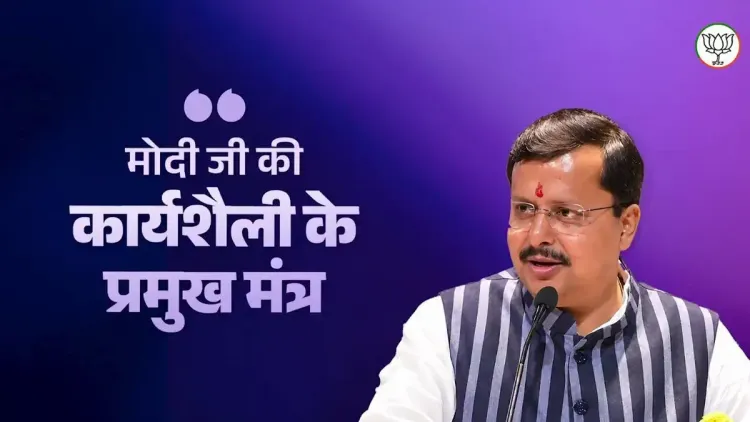
Quoting BJP National President Nitin Nabin, CM Gupta wrote that every story in the book reflects five core 'mantras' of Modi's working style: 'Out of the Box Thinking' (exemplified by GST and income-tax reforms), 'Challenging Your Limits' (through Direct Benefit Transfer), 'Focusing on the Basics' (via Swachh Bharat and Ayushman Bharat), 'Setting Standards' (zero tolerance on corruption and terrorism), and 'Taking People Along' (the collective dream of Viksit Bharat @ 2047).
Five schemes, one narrative arc
Each of the five 'mantras' maps directly onto a flagship initiative. GST, rolled out in July 2017, unified dozens of central and state levies into a single indirect-tax architecture — a structural overhaul that had eluded Indian policymakers for decades. Direct Benefit Transfer (DBT), expanded aggressively from 2014 onwards, routes subsidies straight to beneficiaries' bank accounts, cutting out intermediaries that historically siphoned public money. Swachh Bharat Abhiyan, launched on 2 October 2014, took on the generational challenge of open defecation and urban waste. Ayushman Bharat, announced in 2018, extended health insurance coverage to low-income families who had previously fallen outside any formal safety net. Together, the two schemes represent the 'basics' the quote singles out — sanitation and health, the floor beneath every other aspiration.Viksit Bharat 2047 as the unifying horizon
The fifth mantra — 'Taking People Along' — points toward Viksit Bharat @ 2047, the government's publicly outlined vision, formalised in 2023, for India to achieve developed-nation status by the centenary of independence. The framework has since become the BJP's master narrative, pulling individual schemes into a single long-arc story of national transformation. By amplifying the BJP National President's framing, CM Gupta signals Delhi's alignment with that central story — placing the capital's administration firmly within the larger Viksit Bharat conversation at a moment when both state and national programmes are being stress-tested on delivery. The five mantras may read like chapter headings, but for the BJP they function as an electoral and administrative manifesto — a checklist the party can hold up against a decade of governance and ask: delivered, or not?Point of View
Delhi CM Gupta reinforces the narrative without making it appear as direct political campaigning. The five-mantra structure is significant: it gives party communicators a portable, memorable framework that can be deployed at every level, from Delhi wards to national rallies. With Viksit Bharat 2047 as the capstone, the BJP is signalling that its administrative record is not a list of past achievements but an ongoing, forward-looking project — a framing designed to make electoral accountability a question of 'are you on board with the journey' rather than 'did the schemes work'.
NationPress
20 Nov 2026
Frequently Asked Questions
What is the book about PM Modi's governance that Delhi CM Rekha Gupta mentioned?
The post does not name the book explicitly, but quotes BJP National President Nitin Nabin describing it as a work whose every story reflects five core mantras of PM Modi's working style, covering schemes like GST, DBT, Swachh Bharat, and Ayushman Bharat.
What are the five governance mantras of PM Modi according to the BJP?
According to the quote shared by CM Rekha Gupta, the five mantras are: Out of the Box Thinking (GST and income-tax reforms), Challenging Your Limits (Direct Benefit Transfer), Focusing on the Basics (Swachh Bharat and Ayushman Bharat), Setting Standards (zero tolerance on corruption and terrorism), and Taking People Along (Viksit Bharat @ 2047).
What is Viksit Bharat 2047?
Viksit Bharat 2047 is the Indian government's vision, formally outlined in 2023, for India to become a developed nation by 2047 — the centenary of its independence.
When was Swachh Bharat Abhiyan launched?
Swachh Bharat Abhiyan was launched on 2 October 2014 to address open defecation and improve sanitation and waste management across India.
How does Direct Benefit Transfer work?
Direct Benefit Transfer (DBT) routes government subsidies and welfare payments directly into beneficiaries' bank accounts, reducing leakage and cutting out intermediaries. It was expanded significantly from 2014 onwards under the Modi government.