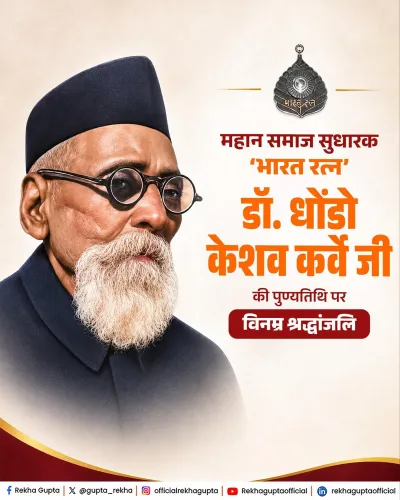
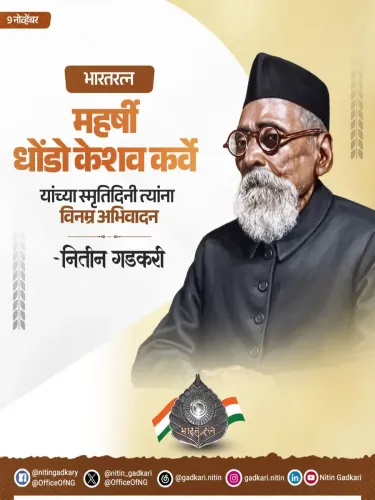
CM Rekha Gupta pays tribute to Bharat Ratna Dhondo Keshav Karve
Synopsis
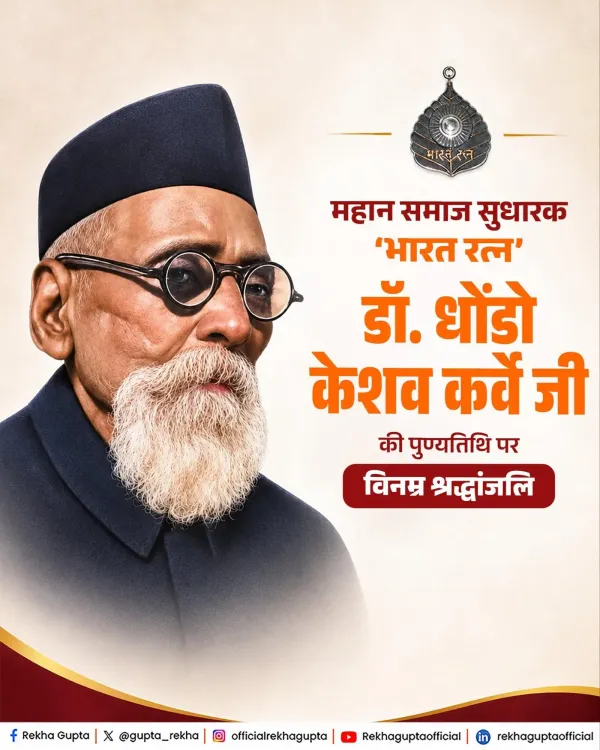
Delhi Chief Minister Rekha Gupta paid tribute to Bharat Ratna Maharshi Dhondo Keshav Karve on his death anniversary, honouring the 19th-century reformer's pioneering work on widow remarriage, women's education, and the founding of SNDT Women's University in 1916.
Key Takeaways
Delhi CM Rekha Gupta paid tribute to Maharshi Dhondo Keshav Karve on his death anniversary on 9 November 2026 .
Karve was awarded the Bharat Ratna in 1958 for a lifetime of advocacy for women's rights and education.
He founded the Widow Remarriage Association in 1893 and opened a school for widows in 1896 .
His SNDT Women's University , founded in 1916 , was one of India's first universities exclusively for women.
Karve personally married a widow in 1893 , lending extraordinary moral weight to his reform work.
CM Gupta described his lifelong struggle as 'an important chapter of transformation in Indian society.'
A reformer who fought for India's widows and daughters more than a century ago was remembered on Monday by Delhi Chief Minister Rekha Gupta, who paid her respects on the death anniversary of Bharat Ratna Maharshi Dhondo Keshav Karve — one of modern India's most consequential champions of women's rights.
Posting on 9 November 2026, CM Gupta wrote: 'Nari shiksha, vidhwa punarvivaah aur mahilaon ke sammanjanak jeevan ke liye unka aajeevan sangharsh Bharatiya samaj mein parivartan ka mahatvapurna adhyaya hai' — 'His lifelong struggle for women's education, widow remarriage, and a life of dignity for women is an important chapter of transformation in Indian society.'Who was Dhondo Keshav Karve — and why his legacy endures
Maharshi Dhondo Keshav Karve was born in 1858 in Maharashtra and spent his entire adult life dismantling the social structures that confined Indian women — particularly widows — to lives of destitution and silence. At a time when widow remarriage was not merely frowned upon but socially catastrophic, Karve married a widow himself in 1893, making a personal statement that echoed across the subcontinent. That same year, he founded the Widow Remarriage Association, and by 1896 had opened a dedicated school for widows. These were not symbolic gestures — they were functioning institutions built against fierce social resistance. His most enduring creation, the SNDT Women's University, was founded in 1916, becoming one of India's first universities exclusively for women. For this lifetime of work, the Indian state awarded him the Bharat Ratna in 1958 — the nation's highest civilian honour.A pattern of tribute with present-day resonance
CM Gupta's tribute follows a well-established tradition among Indian political leaders of marking the death anniversaries of 19th- and early-20th-century social reformers — particularly those associated with women's empowerment. These commemorations are rarely ceremonial alone; they serve as rhetorical bridges between historical advocacy and present-day policy emphasis on female literacy, education access, and social welfare. Karve's legacy is especially resonant today because the structural barriers he fought — limited access to education for girls, the social stigma around widows, the denial of a dignified independent life for women — remain live policy concerns across Indian states. His story is not just history. It is a measuring stick.A man who lived to 104 years old and worked every one of those decades, Karve left behind universities, associations, and a quietly radical idea: that no woman's life should be governed by her marital status. That idea is still being legislated, argued over, and fought for today.
Point of View
Gupta signals alignment with Maharashtra's reformist legacy while reinforcing her government's focus on female education and welfare in Delhi. Such commemorations, however routine, are politically deliberate: they frame the ruling party as the natural heir to India's progressive social conscience. Whether concrete policy announcements follow these tributes remains the more consequential question.
NationPress
9 Nov 2026
Frequently Asked Questions
Who was Maharshi Dhondo Keshav Karve?
Maharshi Dhondo Keshav Karve was a Maharashtrian social reformer born in 1858 who dedicated his life to women's education and widow remarriage. He founded the SNDT Women's University in 1916 and was awarded the Bharat Ratna in 1958.
When did Dhondo Keshav Karve receive the Bharat Ratna?
Dhondo Keshav Karve received the Bharat Ratna — India's highest civilian honour — in 1958, recognising his lifelong contributions to women's education and social reform.
What did Dhondo Keshav Karve do for widow remarriage?
Karve founded the Widow Remarriage Association in 1893 and opened a school for widows in 1896. He also married a widow himself in 1893, making a powerful personal stand against the social stigma surrounding widowhood in India.
What is SNDT Women's University?
SNDT Women's University, founded by Maharshi Karve in 1916, was one of India's first universities established exclusively for women. It remains a functioning university today and stands as his most enduring institutional legacy.
Why did Delhi CM Rekha Gupta pay tribute to Karve?
Delhi CM Rekha Gupta paid tribute to Maharshi Karve on his death anniversary, honouring his work on women's education, widow remarriage, and dignified living for women — themes that remain central to contemporary social welfare policy in India.