CM Rekha Gupta dedicates four connectivity projects to Delhi

Synopsis
Delhi Chief Minister Rekha Gupta dedicated four connectivity projects to residents on 29 September 2026, covering Badli, Shalimar Bagh, Azadpur, Jahangirpuri, Rohini and Sanjay Gandhi Transport Nagar with cycle tracks, pedestrian paths, lighting and drainage upgrades under the Seva Sankalp Abhiyan campaign.
Key Takeaways
Four infrastructure projects were dedicated to Delhi residents on 29 September 2026 by Chief Minister Rekha Gupta .
The projects cover six localities: Badli, Shalimar Bagh, Azadpur, Jahangirpuri, Rohini , and Sanjay Gandhi Transport Nagar .
Key features include cycle tracks, pedestrian walkways, improved street lighting , and upgraded drainage systems .
The dedication was made under the Seva Sankalp Abhiyan , a BJP-led public-commitment campaign in Delhi.
The rollout is branded under the Viksit Delhi vision for future-ready urban infrastructure.
Further project inaugurations and budget disclosures under the same campaign are expected in coming weeks.
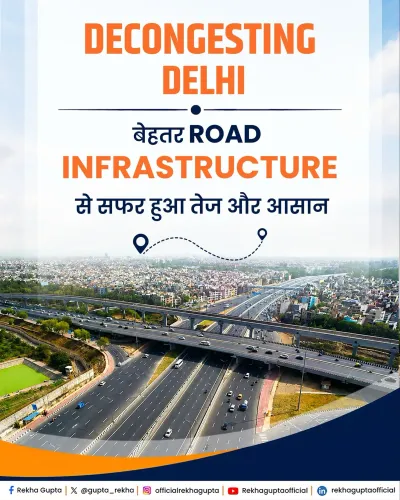
Four infrastructure projects aimed at reshaping daily commutes across northern Delhi were dedicated to residents on Tuesday, 29 September 2026, with Delhi Chief Minister Rekha Gupta announcing that localities including Badli, Shalimar Bagh, Azadpur, Jahangirpuri, Rohini, and Sanjay Gandhi Transport Nagar will now see smoother movement on their streets.
What the four projects bring to north Delhi's streets
Posting on X, CM Gupta said the projects deliver a bundle of upgrades residents in these dense, high-traffic corridors have long needed: dedicated cycle tracks, safer footpaths for pedestrians, improved street lighting, and upgraded drainage systems. The announcement was made under the Seva Sankalp Abhiyan (Service Pledge Campaign), a BJP-led initiative in Delhi that frames infrastructure delivery as a direct public commitment. The accompanying hashtag #ViksitDelhi — 'Developed Delhi' — signals the broader urban-vision branding the current administration is building around such rollouts.
The six localities named span a wide arc of north and northwest Delhi — areas characterised by dense residential pockets, busy wholesale markets, and arterial roads that feed into the city's ring-road network. Congestion, waterlogging during monsoon, and poor pedestrian infrastructure have historically been cited as persistent complaints in these zones.
Cycling lanes and drainage: the infrastructure mix that matters
The combination of features — cycle tracks alongside pedestrian paths, lighting, and drainage — reflects a shift in how Delhi's government is framing urban mobility upgrades. Rather than standalone flyovers or road-widening, this package bundles last-mile walkability with monsoon resilience, a formula increasingly favoured in high-density Indian cities. For the lakhs of daily commuters in Jahangirpuri and Rohini alone, safer non-motorised corridors can meaningfully cut the risk of road accidents.
The rollout fits a pattern visible across several state governments: clustering multiple smaller projects into a single high-visibility dedication event tied to a named campaign, amplifying political visibility while delivering tangible neighbourhood improvements. The Seva Sankalp Abhiyan framework gives the BJP in Delhi a recurring occasion to mark such deliveries publicly.
What to watch as the campaign continues
With the Seva Sankalp Abhiyan still active, further project inaugurations and possible budget disclosures for the next tranche of works are the immediate signals to track. Whether the Viksit Delhi vision translates into a formal capital-expenditure roadmap — with timelines and costs published — will determine how much of this momentum is structural rather than ceremonial.
For now, six north Delhi neighbourhoods have new infrastructure on the ground. The city is watching whether the pace holds.
Point of View
Neighbourhood-level delivery events — keeping infrastructure visible and politically attributable ahead of any future electoral cycle in the capital. Bundling cycle tracks, pedestrian safety and drainage into a single announcement allows the administration to speak simultaneously to middle-class commuters, daily-wage workers, and urban-planning advocates. The 'Viksit Delhi' framing consciously echoes the national 'Viksit Bharat' narrative, tying local delivery to a larger developmental identity. Whether the pace of project completion matches the pace of announcements will be the real test of the administration's urban ambitions.
NationPress
29 Sept 2026
Frequently Asked Questions
What are the four infrastructure projects dedicated by Delhi CM Rekha Gupta?
The specific names and costs of the four projects have not been officially disclosed in verifiable detail, but they include connectivity and mobility upgrades — cycle tracks, pedestrian paths, street lighting and drainage improvements — across Badli, Shalimar Bagh, Azadpur, Jahangirpuri, Rohini, and Sanjay Gandhi Transport Nagar in north Delhi.
What is the Seva Sankalp Abhiyan in Delhi?
Seva Sankalp Abhiyan is a BJP-led campaign in Delhi under which the state government publicly dedicates infrastructure and civic projects to residents, framing delivery as a direct service pledge to constituents.
Which areas in Delhi benefit from the new connectivity projects?
The six localities that benefit are Badli, Shalimar Bagh, Azadpur, Jahangirpuri, Rohini, and Sanjay Gandhi Transport Nagar — all in north and northwest Delhi.
What is Viksit Delhi?
Viksit Delhi, meaning 'Developed Delhi', is the overarching urban-development vision being promoted by the Rekha Gupta-led BJP government in Delhi, focused on future-ready infrastructure including mobility, lighting and drainage.
Do the new Delhi projects include cycle tracks?
Yes. Dedicated cycle tracks are among the features included in the four projects, alongside safer pedestrian paths, improved street lighting and upgraded drainage systems.