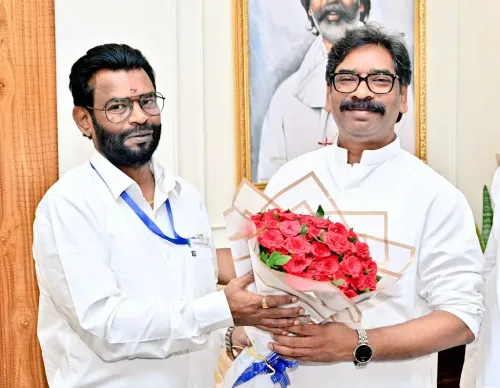
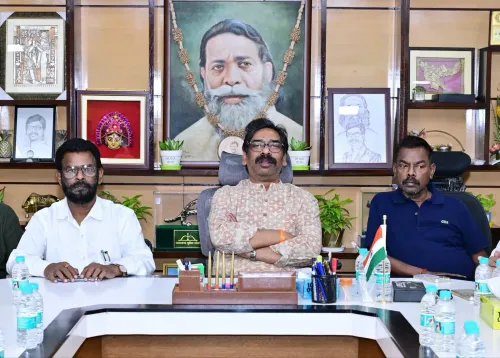
CM Hemant Soren congratulates Baidyanath Ram on Rajya Sabha oath
Synopsis
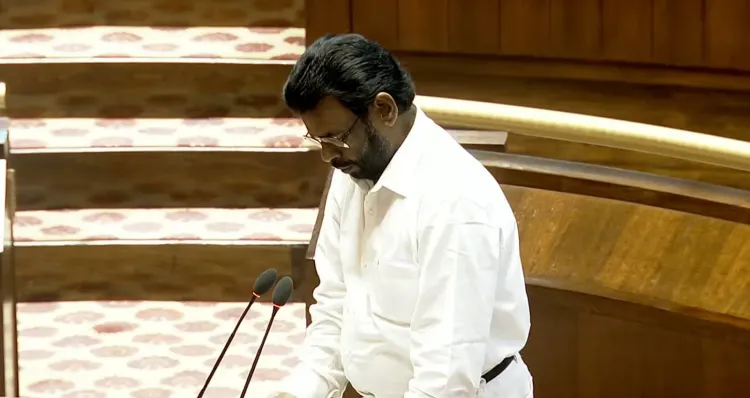
Jharkhand Chief Minister Hemant Soren on 25 June 2026 congratulated senior JMM leader Baidyanath Ram on his swearing-in as a Rajya Sabha member, urging him to champion Jharkhand's aspirations, social justice and Ambedkarite constitutional values in the upper house.
Key Takeaways
Baidyanath Ram , a senior Jharkhand Mukti Morcha leader, was sworn in as a Rajya Sabha member on 25 June 2026 .
CM Hemant Soren publicly congratulated Ram on X, invoking the traditional tribal greeting 'Johar' alongside his felicitations.
Soren expressed confidence that Ram would raise Jharkhand 's aspirations, social justice and constitutional values in the upper house.
The post explicitly invoked the legacy of Dr B.R.
Ambedkar , reflecting JMM 's stated ideological alignment with Ambedkarite principles.
JMM has maintained a Rajya Sabha presence since Jharkhand 's statehood in 2000 to advocate for tribal and state-specific concerns at the national level.
Jharkhand Chief Minister Hemant Soren on Thursday, 25 June 2026 congratulated senior Jharkhand Mukti Morcha (JMM) leader Baidyanath Ram on being sworn in as a member of the Rajya Sabha, expressing confidence that Ram would raise the state's aspirations and constitutional values in the upper house of Parliament.
Context
Posting on X, CM Soren extended his greetings — 'हार्दिक बधाई, शुभकामनाएं और जोहार' ('heartfelt congratulations, best wishes, and Johar') — to Baidyanath Ram, describing him as a senior leader of the JMM family. The salutation 'Johar' is a traditional greeting used among tribal communities in Jharkhand and carries cultural and political significance for the party.
Soren wrote that he was fully confident Ram would 'strongly raise issues related to Jharkhand's aspirations, social justice, equality and the values of the Constitution' in the upper house. He closed with the rallying cries 'Jai Bhim! Jai Jharkhand!' — a dual invocation of Dr B.R. Ambedkar's legacy and regional pride.
Policy Backdrop
The Jharkhand Mukti Morcha, founded to champion tribal rights and autonomy in the region that became a separate state in 2000, has maintained a consistent presence in the Rajya Sabha to articulate state-specific and tribal concerns at the national level. The party's ideological commitment to Ambedkarite principles of social justice has been a recurring thread in its election manifestos and legislative interventions since the 1990s.
Soren's message explicitly invoked the thought of Babasaheb Dr Bhimrao Ambedkar, the principal architect of the Indian Constitution and the foremost advocate of social justice and equality, expressing the hope that Ram's tenure would strengthen 'the fight for social justice, dignity and rights inspired by Ambedkar's ideas.' This framing positions Baidyanath Ram's Rajya Sabha role within a broader ideological continuum that combines regional identity with anti-caste and equality politics.
Stakeholders and Impact
For Jharkhand's large tribal population and social justice advocates across eastern and central India, the swearing-in of a senior JMM leader in the Rajya Sabha signals the party's intent to keep state-specific and constitutional concerns on the national legislative agenda. The upper house provides a platform to scrutinise central legislation affecting tribal land rights, forest governance and federal resource allocation — issues that have long been central to Jharkhand's political mobilisation.
Regional parties routinely use Rajya Sabha nominations to extend their influence beyond the state assembly. JMM's emphasis on Ambedkarite thought aligns with a wider pattern among parties in the region that seek to bridge local tribal identity with the national discourse on equality and constitutional rights, broadening their appeal beyond their core base.
What's Next
Baidyanath Ram's interventions in Rajya Sabha debates on tribal rights, forest and land legislation, and Jharkhand-specific policy will be closely watched as a measure of how effectively the party translates its stated ideological commitments into parliamentary action. His positioning on constitutional and social justice issues could also shape JMM's broader national narrative ahead of future electoral cycles. The party's candidate choices in the next round of Rajya Sabha biennial elections will further indicate its strategic priorities at the centre.
Point of View
Framing Baidyanath Ram's Rajya Sabha entry as a mission to carry Ambedkarite and tribal rights discourse into the national legislature. By pairing 'Jai Bhim' with 'Jai Jharkhand', the JMM signals a dual identity that seeks to connect regional tribal politics with the broader pan-India Dalit and social justice movement. This is consistent with a pattern among eastern and central Indian regional parties that use Rajya Sabha nominations strategically to amplify their national visibility on constitutional and federal equity issues. How Ram performs in the upper house will be a test of whether the party can convert this symbolic positioning into substantive legislative impact.
NationPress
25 Jun 2026
Frequently Asked Questions
Who is Baidyanath Ram?
Baidyanath Ram is a senior leader of the Jharkhand Mukti Morcha (JMM) who was sworn in as a member of the Rajya Sabha , the upper house of the Indian Parliament, on 25 June 2026 .
Why did CM Hemant Soren congratulate Baidyanath Ram?
CM Hemant Soren congratulated Baidyanath Ram on his oath-taking as a Rajya Sabha member, expressing confidence that Ram would raise Jharkhand 's aspirations and issues of social justice and constitutional values in the upper house.
What is the significance of JMM's presence in the Rajya Sabha?
The Jharkhand Mukti Morcha has maintained a Rajya Sabha presence since Jharkhand 's statehood in 2000 to advocate for tribal rights, state-specific concerns and federal equity at the national level, extending the party's influence beyond the state assembly.
What does 'Jai Bhim' mean in Hemant Soren's post?
'Jai Bhim' is a salutation honouring Dr B.R. Ambedkar , the architect of the Indian Constitution and champion of social justice. CM Soren used it to underline JMM 's ideological commitment to Ambedkarite principles of equality and constitutional rights.
What issues is Baidyanath Ram expected to raise in the Rajya Sabha?
According to CM Soren 's post, Baidyanath Ram is expected to raise issues related to Jharkhand 's aspirations, social justice, equality and constitutional values, consistent with JMM 's long-standing focus on tribal rights and federal equity.