CM Hemant Soren Pushes Digital Jharkhand Vision 2029
Synopsis
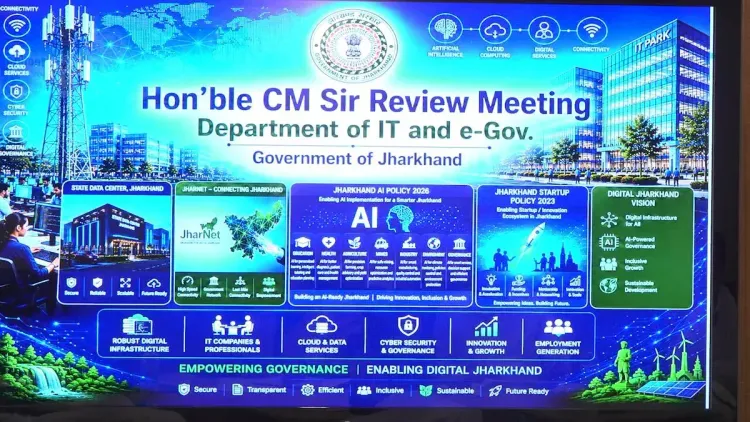
Chief Minister Hemant Soren has directed the appointment of IT officers in all Jharkhand districts and departments and ordered centralisation of government data, as part of the Digital Jharkhand Vision 2029 agenda discussed at a high-level meeting on 22 July 2026.
Key Takeaways
The Chief Minister's Office of Jharkhand convened a meeting on 22 July 2026 covering three digital initiatives.
CM Hemant Soren directed appointment of IT officers across all districts and departments in the state.
The Chief Minister Data Intelligence Platform was discussed as a centralised analytics and decision-support tool.
Construction of IT Parks in Jharkhand was on the agenda to attract private technology investment and create employment.
The overarching framework is Digital Jharkhand Vision 2029 , aligning with the national Digital India programme.
Data centralisation across government departments is a key administrative direction from the Chief Minister.
The Chief Minister's Office of Jharkhand announced on Wednesday, 22 July 2026 that Chief Minister Hemant Soren has directed the appointment of IT officers across all districts and departments in the state, alongside a push to centralise government data under a new analytics platform.
The official post stated: 'बैठक में डिजिटल झारखण्ड विजन 2029, IT पार्क निर्माण और चीफ मिनिस्टर डेटा इंटेलिजेंस प्लेटफॉर्म पर चर्चा हुई।' ('The meeting discussed Digital Jharkhand Vision 2029, IT Park construction, and the Chief Minister Data Intelligence Platform.') The Chief Minister also directed the centralisation of data across all government wings.
Context
The announcements emerged from a high-level review meeting convened by the Chief Minister's Office. Three interlocking initiatives were on the agenda: the Digital Jharkhand Vision 2029 roadmap, the construction of IT Parks in the state, and the proposed Chief Minister Data Intelligence Platform. The meeting concluded with specific administrative directions from CM Hemant Soren to operationalise these goals. The directive to place IT officers in every district and department is significant because it signals an intent to embed technology capacity at the ground level of administration, not merely at the state secretariat. Data centralisation, paired with dedicated personnel, is designed to enable real-time monitoring of scheme delivery and public services.Policy Backdrop
Jharkhand's engagement with digital governance stretches back to the national Digital India programme launched in 2015, which encouraged states to digitise service delivery and build e-governance infrastructure. Over the past decade, state governments across India have progressively moved toward data-driven administration, with centralised dashboards and district-level IT cadres becoming standard tools of modern governance. The Digital Jharkhand Vision 2029 fits squarely within this national pattern, extending the horizon to align with India's broader aspirations for a digitally empowered public sector. The proposed Chief Minister Data Intelligence Platform mirrors similar decision-support systems adopted by other state governments to consolidate departmental data and improve policy responses.Stakeholders and Impact
The primary beneficiaries of these directives are state government departments and the citizens who depend on their services. By stationing IT officers in every district, the government aims to reduce the technology gap between Ranchi and remote administrative units across Jharkhand's 24 districts. The planned IT Parks carry an additional economic dimension: they are intended to attract private technology companies, generate skilled employment, and diversify the state's economy beyond its traditional dependence on mining and heavy industry. IT professionals and technology firms are the key private-sector stakeholders watching the rollout of these infrastructure commitments.What's Next
The immediate milestones to watch are the rollout timeline for the Chief Minister Data Intelligence Platform and the pace of IT officer appointments across districts and departments. Progress on land acquisition and construction for the proposed IT Parks will serve as a tangible indicator of how quickly the Digital Jharkhand Vision 2029 moves from policy statement to ground reality. If implemented at scale, the combination of dedicated district-level IT personnel, centralised data infrastructure, and purpose-built technology parks could meaningfully shift how Jharkhand delivers public services and positions itself in India's growing digital economy.Point of View
If executed, could outlast any single scheme by institutionalising tech governance within the bureaucracy. The Chief Minister Data Intelligence Platform signals an ambition to use real-time data for political as well as administrative accountability, a tool that gives the Chief Minister's Office direct visibility into departmental performance. Taken together, these moves position Jharkhand within the competitive race among Indian states to demonstrate digital governance credentials ahead of the national Digital India review cycle.
NationPress
23 Jul 2026
Frequently Asked Questions
What is Digital Jharkhand Vision 2029?
Digital Jharkhand Vision 2029 is a state initiative to expand digital governance, IT infrastructure, and data systems across Jharkhand by the year 2029, aligned with the national Digital India programme.
What is the Chief Minister Data Intelligence Platform in Jharkhand?
The Chief Minister Data Intelligence Platform is a proposed centralised data analytics and decision-support system under the Jharkhand Chief Minister's Office, aimed at improving real-time monitoring of government services.
Why is Jharkhand appointing IT officers in every district?
CM Hemant Soren has directed IT officer appointments across all districts and departments to embed technology capacity at the ground level of administration and support data centralisation efforts.
What are the IT Parks planned in Jharkhand?
Jharkhand's planned IT Parks are dedicated technology infrastructure zones intended to attract private IT companies, generate skilled employment, and diversify the state economy.
How does Jharkhand's digital push relate to Digital India?
Jharkhand's digital governance initiatives build on the national Digital India programme launched in 2015, which encouraged states to digitise public services and develop e-governance infrastructure.