CM Himanta Announces ₹176 Cr Investment in Assam Youth Education
Synopsis
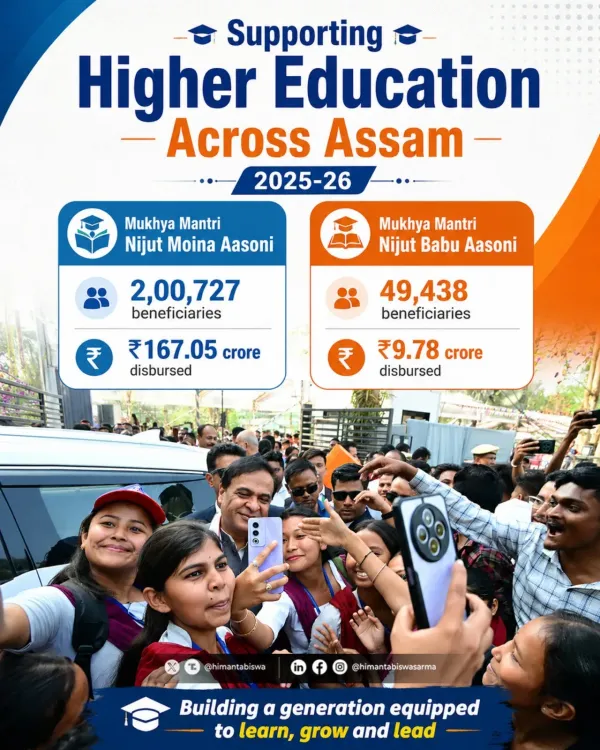
Assam Chief Minister Himanta Biswa Sarma announced on 25 June 2026 that the state invested over ₹176 crore in youth education last year through the Nijut Moina and Babu Asonis schemes, framing the outlay as a long-term investment in Assam's economic and social transformation.
Key Takeaways
Assam Chief Minister Himanta Biswa Sarma announced an investment of over ₹176 crore in youth education in the past year.
The funds were channelled through two flagship schemes: Nijut Moina and Babu Asonis .
Both schemes are aimed at enabling access to higher education for students across Assam.
The government frames youth development as central to Assam's economic and social transformation .
The investment aligns with a broader state policy of directing successive budgets toward student support alongside physical infrastructure.
Outcome data — including enrolment figures and placement rates — will be key to assessing the schemes' real-world impact.
Assam Chief Minister Himanta Biswa Sarma on Thursday, 25 June 2026, announced that the state government invested over ₹176 crore in the past year to expand access to higher education for Assam's youth, citing two flagship scholarship programmes as the primary vehicles for this outlay.
Context
In his post, CM Sarma stated: 'Last year, we have invested ₹176+ cr in one of Assam's greatest strengths, our youth. Through the Nijut Moina and Babu Asonis, we are enabling access to higher education for our children, so that they can grow up to become drivers of economic and social change in Assam.' The statement frames the expenditure not merely as a budgetary line item but as a strategic investment in the state's long-term human capital.
The two schemes named — Nijut Moina and Babu Asonis — are positioned as the operational arms of this push, channelling financial support directly to students pursuing higher education across the state.
Policy Backdrop
Since the BJP-led government took office in Assam following the 2021 assembly elections, successive state budgets have directed resources toward both physical infrastructure and direct student support. The expansion of scholarship and fee-support measures has been a consistent thread in the government's approach to raising higher-education enrolment in the northeast.
This emphasis aligns with broader national goals of increasing access to higher education and skill development in India's northeastern states, where enrolment gaps have historically been wider than the national average. Assam's state spending on youth welfare has reflected this dual focus on infrastructure and direct financial enablement.
Stakeholders and Impact
The primary beneficiaries of the Nijut Moina and Babu Asonis schemes are students from Assam seeking to access higher education — a demographic the Chief Minister has consistently described as central to the state's economic and social transformation. For many families in semi-urban and rural Assam, such scholarship support can be the difference between a student continuing to college or dropping out.
Beyond individual students, the investment carries implications for Assam's broader workforce pipeline. A better-educated youth cohort is expected to strengthen the state's capacity to attract investment and support sectors ranging from agriculture to services, reinforcing the government's framing of youth as 'drivers of economic and social change.'
What's Next
Attention will now turn to the next Assam state budget and any official enrolment or placement data linked to the Nijut Moina and Babu Asonis schemes. Concrete outcome metrics — such as the number of students supported, enrolment rate changes, and post-graduation employment figures — will determine whether the ₹176 crore outlay translates into the generational impact CM Sarma has articulated.
As Assam continues to position itself as a development model for the northeast, the performance of its youth-focused schemes will be closely watched both within the state and by policymakers across the North-East Democratic Alliance (NEDA) bloc.
Point of View
The Chief Minister is reinforcing programme-level accountability and brand recognition among student and parent voter blocs. The framing of youth as 'drivers of economic and social change' also echoes a national BJP narrative that positions education spending as economic policy rather than mere welfare. How the government follows up with verifiable enrolment and outcome data will determine whether this investment narrative hardens into a durable political asset or invites scrutiny.
NationPress
25 Jun 2026
Frequently Asked Questions
What is the Nijut Moina scheme in Assam?
Nijut Moina is an Assam government scholarship scheme designed to support female students in accessing higher education by providing financial assistance, and it is one of two programmes cited by CM Himanta Biswa Sarma in his ₹176 crore youth education investment announcement.
What is the Babu Asonis scheme in Assam?
Babu Asonis is an Assam state government scheme aimed at enabling students to pursue higher education through financial support, named alongside Nijut Moina as a key vehicle for the state's ₹176 crore education investment.
How much has Assam invested in youth education?
Assam Chief Minister Himanta Biswa Sarma announced on 25 June 2026 that the state invested over ₹176 crore in youth education in the past year through the Nijut Moina and Babu Asonis schemes.
What is Himanta Biswa Sarma's education policy for Assam?
CM Himanta Biswa Sarma has pursued a policy of expanding higher education access through direct student support schemes such as Nijut Moina and Babu Asonis, backed by consistent budgetary allocations since the BJP-led government took office in 2021.
Who benefits from Assam's Nijut Moina and Babu Asonis schemes?
Students in Assam seeking to pursue higher education are the primary beneficiaries, with the schemes providing financial support that the state government says will help young people become drivers of economic and social change in the region.