CM Himanta Expands Jagannath Skill Centres in Assam Tea Gardens
Synopsis
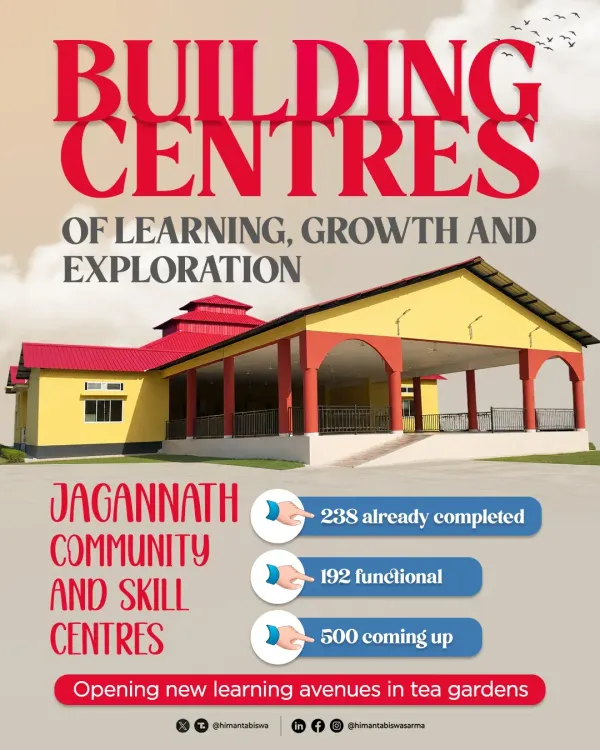
Assam CM Himanta Biswa Sarma on 26 May 2026 spotlighted the Mahaprabhu Jagannath Community Hall-cum-Skill Centres, a state initiative building combined community and vocational training spaces inside tea estates to uplift historically disadvantaged tea-tribe families across Assam.
Key Takeaways
Assam CM Himanta Biswa Sarma on 26 May 2026 highlighted the expanding Mahaprabhu Jagannath Community Hall-cum-Skill Centres across the state's tea gardens.
The centres combine community hall facilities with vocational skill training, located directly inside tea estates.
The initiative targets tea tribe families — descendants of 19th-century migrants from Odisha, Jharkhand and neighbouring regions — who form a historically disadvantaged workforce.
The programme continues a welfare policy lineage dating to 2016 , when dedicated tea-tribe packages covering housing, scholarships and health were introduced in Assam.
The naming convention referencing Mahaprabhu Jagannath signals cultural inclusion toward communities with Odia heritage roots.
Analysts are watching future state budget allocations and independent assessments of youth placement outcomes from the skill training component.
Assam Chief Minister Himanta Biswa Sarma on Tuesday, 26 May 2026, highlighted the expanding reach of the Mahaprabhu Jagannath Community Hall-cum-Skill Centres, describing the initiative as building 'vibrant spaces across Assam's tea gardens' that are enabling livelihoods and strengthening community life across tea estate families in the state.
Context
The Mahaprabhu Jagannath Community Hall-cum-Skill Centres are a state-run initiative that combines community gathering spaces with vocational training facilities, constructed inside Assam's tea estates. CM Sarma noted that the 'growing network of centres across the state' is now reaching 'every tea garden family,' signalling the programme's widening geographic footprint.
Tea garden communities in Assam are largely descendants of workers who migrated from present-day Odisha, Jharkhand, and neighbouring regions during the 19th century. They constitute a historically disadvantaged workforce and a significant demographic presence across the state's plantation belt.
Policy Backdrop
Since 2016, successive Assam governments have run dedicated tea-tribe welfare packages encompassing housing, scholarships, and health camps. The Jagannath Skill Centres represent a continuation and deepening of this policy lineage, adding physical infrastructure for skill development directly within plantation communities.
The naming of the centres after Mahaprabhu Jagannath — a revered deity in the Odia cultural tradition — is consistent with a broader state approach of incorporating regional Hindu symbols to signal cultural inclusion toward communities with Odia heritage roots. This dual-purpose model, pairing community halls with vocational training, is designed to address both social cohesion and economic mobility in a single intervention.
Stakeholders and Impact
The primary beneficiaries are tea tribe workers and their families, who have historically had limited access to formal skill training and public infrastructure within the closed geography of tea estates. Vocational training at these centres is intended to open pathways to livelihoods beyond plantation labour, particularly for younger family members.
Tea garden communities also represent a sizable electoral constituency in Assam, and sustained infrastructure investment in these areas reflects both a welfare commitment and a political priority for the BJP-led state government. Community halls additionally serve as venues for social and cultural events, reinforcing a sense of belonging among workers who live in geographically isolated estate settlements.
What's Next
Observers and policy analysts are watching state budget allocations for the expansion of further centres and any independent evaluation of placement outcomes among youth who have completed vocational training. The scale and pace of commissioning new centres will be a key indicator of the programme's long-term ambition.
If the model demonstrates measurable livelihood gains, it could serve as a template for similar plantation-community welfare interventions in other tea-growing states across Northeast India. The Assam government's ability to document and publicise outcomes will shape both the policy credibility and the political dividend of this initiative.
Point of View
Who number in the millions and are pivotal in several assembly constituencies. By embedding skill infrastructure inside the closed geography of tea estates, the state sidesteps the access barriers that have historically kept plantation workers out of mainstream vocational pipelines. The dual branding — welfare and cultural identity — is deliberate and politically sophisticated. The programme's true test, however, will be whether placement data and independent audits confirm that the skill training is translating into tangible livelihood diversification beyond plantation labour.
NationPress
11 Oct 2026
Frequently Asked Questions
What are the Mahaprabhu Jagannath Community Hall-cum-Skill Centres in Assam?
They are state-built facilities inside Assam's tea estates that combine community gathering halls with vocational training centres, aimed at uplifting tea-tribe families by providing skill development opportunities and social infrastructure within plantation areas.
Who are the tea tribe communities in Assam?
Tea tribe communities in Assam are largely descendants of workers brought from present-day Odisha, Jharkhand, and neighbouring regions during the 19th century to work on British-era plantations. They remain a significant and historically disadvantaged demographic in the state.
What is Himanta Biswa Sarma doing for tea garden workers in Assam?
CM Himanta Biswa Sarma's government has been expanding the Mahaprabhu Jagannath Community Hall-cum-Skill Centres across Assam's tea estates, building on a welfare policy lineage that has included housing, scholarships, and health camps for tea-tribe families since 2016.
Why are the centres named after Mahaprabhu Jagannath?
Mahaprabhu Jagannath is a revered deity in the Odia cultural tradition, and many tea-tribe workers in Assam trace their heritage to Odisha. The naming is part of a broader state approach to signal cultural inclusion and recognition of the community's roots.
What skills are taught at the Assam tea garden skill centres?
The specific vocational trades offered at the Mahaprabhu Jagannath Skill Centres have not been independently detailed in confirmed public records, but the centres are designed to provide livelihood-enabling training to help tea garden youth access employment beyond plantation work.