CM Himanta flags 24-million-year-old fossil find in Assam
Synopsis
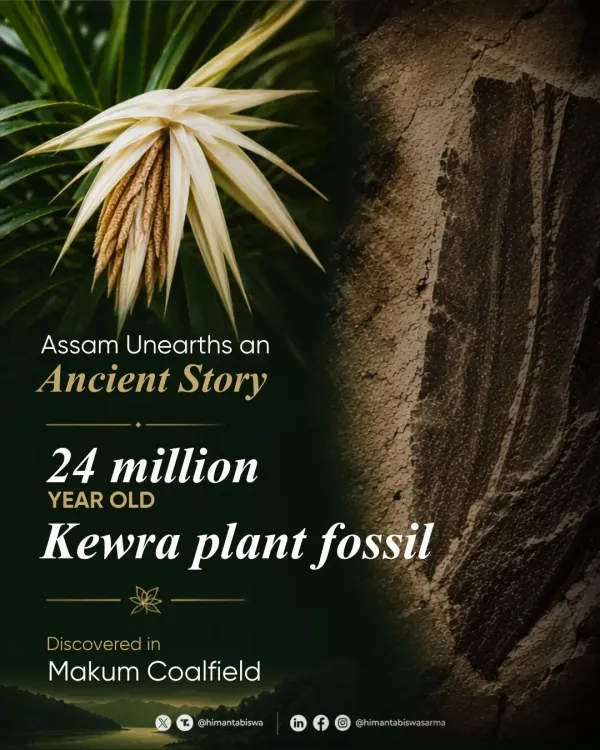
Assam Chief Minister Himanta Biswa Sarma announced the discovery of a 24-million-year-old Kewra (Pandanus) fossil from Makum in Tinsukia district, indicating the plant reached the Indian subcontinent during the Miocene epoch. The find highlights Assam's rich, largely unexplored geological heritage buried beneath its coal-bearing sedimentary basins.
Key Takeaways
A 24-million-year-old Kewra ( Pandanus ) fossil was discovered at Makum in Tinsukia district , Assam.
The Pandanus plant family is estimated to be 85 million years old ; the fossil marks its arrival on the Indian subcontinent during the Miocene epoch.
Assam Chief Minister Himanta Biswa Sarma shared the find on 21 July 2026 , calling it a glimpse into the region's ancient floral ecosystem.
Makum's Tertiary sedimentary formations have long been studied by Indian geologists for plant fossil records.
Peer-reviewed publication and independent laboratory confirmation of the fossil's age and identification are still awaited.
The discovery raises questions about balancing fossil-site preservation with active coal mining in the Makum belt.
Assam Chief Minister Himanta Biswa Sarma on Tuesday, 21 July 2026, announced the discovery of a 24-million-year-old Kewra (Pandanus) fossil from Makum in Tinsukia district, describing it as a window into the ancient floral ecosystem of the region.
Context
The fossil, unearthed from the Makum coal-mining belt, belongs to the Pandanus genus — commonly known as Kewra — a plant family estimated to be 85 million years old. According to CM Sarma, the specimen indicates that the plant migrated to the Indian subcontinent roughly 24 million years ago during the Miocene epoch, and has since established a persistent presence in Assam. 'Beneath Assam's surface, lies many such untold stories,' he wrote, signalling the state's geological depth beyond its visible biodiversity.
Makum sits within Tinsukia district in upper Assam and is historically associated with coal extraction. Its Tertiary sedimentary formations have long attracted the attention of Indian geologists, and the area's layered rock sequences are considered a repository of plant fossil records tied to the subcontinent's tectonic and climatic history.
Policy Backdrop
The India-Asia tectonic collision, which began roughly 50 million years ago, fundamentally reshaped plant migration routes across the subcontinent. Assam's coal belts and sedimentary basins have preserved evidence of successive floral arrivals that followed these geological upheavals, including the establishment of monsoon-adapted ecosystems. Institutions such as the Geological Survey of India and university departments have periodically documented Tertiary flora from Northeast India over several decades, building a patchwork record of ancient biodiversity.
State governments in the region have increasingly highlighted such discoveries as part of broader efforts to position Northeast India as a destination for scientific tourism and heritage conservation. A fossil find of this nature — linking a living, culturally significant plant like Kewra to a 24-million-year local lineage — carries both scientific and narrative weight for the state's identity.
Stakeholders and Impact
Paleobotanists and geologists stand to benefit most immediately, as the specimen could inform peer-reviewed reconstructions of Miocene plant biogeography in South Asia. The Pandanus genus is not merely a scientific curiosity — Kewra is culturally embedded in Assam, used in traditional medicine, weaving, and religious practice, making a fossil record of its ancient arrival particularly resonant for local communities.
The tourism sector in Tinsukia and the wider upper Assam belt could also benefit if the find is followed by institutional investment. A dedicated paleontological interpretive centre or repository at Makum would create a new category of geological heritage tourism, complementing the region's existing wildlife and tea-garden circuits.
What's Next
The immediate priority for the scientific community will be peer-reviewed publication of the fossil analysis, including independent confirmation of the 24-million-year age estimate and the Pandanus identification through laboratory methods. The institutional lead on the excavation and analysis has not been publicly confirmed at the time of this report.
Beyond the science, CM Sarma's post is likely to prompt questions about whether the Assam government will propose formal protections for fossil-bearing sites in the Makum coalfield — a zone where active mining and geological preservation have historically existed in tension. How the state balances those competing interests will determine whether this discovery becomes a one-off headline or the foundation of a lasting heritage initiative.
Point of View
Culturally familiar plant like Kewra and anchoring it to a 24-million-year local lineage, the announcement bridges science and sentiment in a way that generic biodiversity messaging rarely achieves. The real test will come in whether the state follows the announcement with institutional action — site protection, research funding, or a public repository — or whether the discovery remains a social-media milestone. The tension between the Makum coalfield's extractive economy and its paleontological value is a policy fault line that this find has now made impossible to ignore.
NationPress
22 Jul 2026
Frequently Asked Questions
What fossil was discovered in Assam in 2026?
A 24-million-year-old Kewra ( Pandanus ) fossil was discovered at Makum in Tinsukia district, Assam, indicating the plant's arrival on the Indian subcontinent during the Miocene epoch.
Where is Makum and why is it significant for fossils?
Makum is a coal-mining area in Tinsukia district , upper Assam. Its Tertiary sedimentary rock formations have preserved ancient plant fossils that help scientists reconstruct the region's floral history over tens of millions of years.
What is the Kewra or Pandanus plant?
Kewra, known scientifically as Pandanus , is a plant family estimated to be 85 million years old . In Assam it is culturally significant, used in traditional medicine, weaving, and religious practice.
Who announced the Assam fossil discovery?
Assam Chief Minister Himanta Biswa Sarma announced the discovery on 21 July 2026 via a post on X, describing it as evidence of the region's untold geological stories.
What happens next after the Makum fossil find?
Scientists are expected to pursue peer-reviewed publication and independent laboratory confirmation of the fossil's 24-million-year age and Pandanus identification. There may also be state-level discussion on protecting fossil-bearing sites in the Makum coalfield.