CM Himanta Flags ₹6,000cr Welfare Push, August Scheme Restart

Synopsis
Assam Chief Minister Himanta Biswa Sarma has announced that his government is spending ₹6,000 crore on welfare schemes uplifting low-income households, and that paused programmes will resume by August 2026, reaffirming the BJP administration's social security commitments.
Key Takeaways
Assam CM Himanta Biswa Sarma announced on 12 July 2026 that the state is spending ₹6,000 crore on welfare schemes.
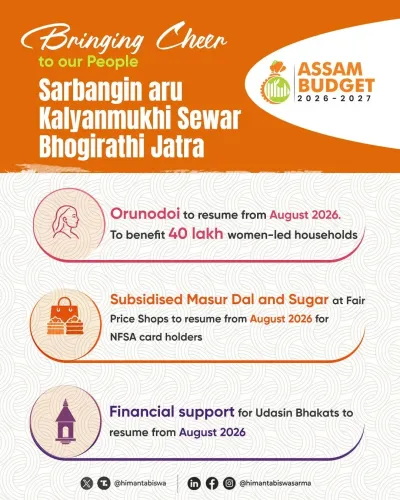
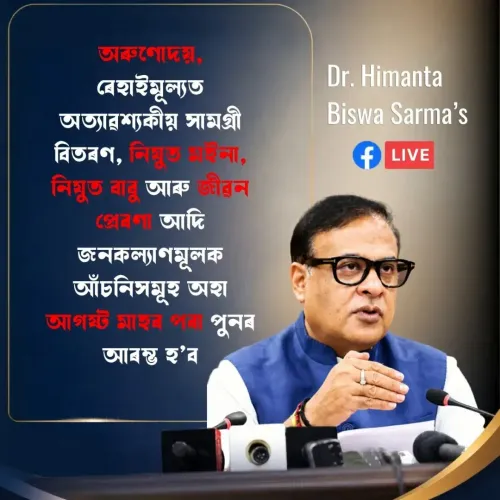
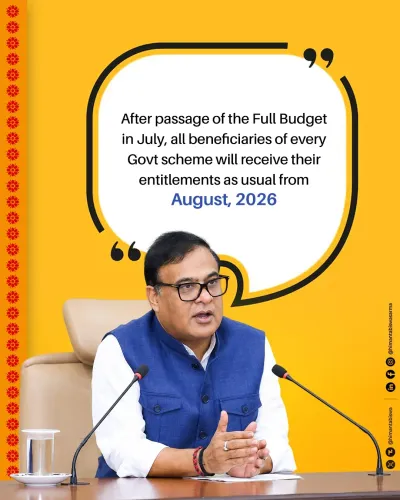
Welfare schemes currently on pause will resume by August 2026 , according to the Chief Minister.
The BJP-led Assam government has expanded direct benefit transfers, including the Orunodoi scheme for women, since taking office in 2021 .
The primary beneficiaries are low-income households and women in rural and semi-urban Assam .
Details of fresh allocations and revised eligibility criteria for the August restart are yet to be announced.
Assam Chief Minister Himanta Biswa Sarma on Sunday, 12 July 2026, reaffirmed his government's commitment to social welfare, announcing that the state is spending ₹6,000 crore on welfare schemes and that programmes paused for administrative review will resume by August 2026.
Context
In his post on X, Sarma stated: 'Our Govt remains committed to the welfare of the people. We are spending ₹6,000cr on welfare schemes which is uplifting people and opening doors of new opportunities for them. Come August, our welfare schemes will resume again.' The statement signals both a defence of the government's existing social expenditure record and a forward-looking commitment to beneficiaries awaiting fresh disbursements.
The announcement comes mid-year, a period when state governments typically assess scheme performance against budgetary allocations before the next cycle of disbursements. The explicit mention of an August restart suggests a deliberate administrative pause rather than a policy withdrawal.
Policy Backdrop
Since the BJP-led Sarma administration took office in 2021, Assam has significantly expanded direct welfare transfers to low-income households. Flagship programmes such as the Orunodoi scheme — which provides monthly financial assistance primarily to women — became central to the government's social security architecture, mirroring the national emphasis on direct benefit transfers.
Assam's welfare budgets have grown steadily over successive fiscal years, with the government positioning these outlays as instruments of economic upliftment in one of India's lower-income states. The ₹6,000 crore figure, cited by CM Sarma, represents the cumulative scale of this welfare commitment across active schemes.
Periodic pauses in scheme disbursements are common across Indian states, typically triggered by beneficiary re-verification drives, Aadhaar-linking mandates, or transitions between budget cycles. Resumptions are often announced publicly to reassure beneficiaries and demonstrate administrative responsiveness.
Stakeholders and Impact
The primary beneficiaries of Assam's welfare architecture are low-income households, women enrolled in direct-transfer schemes, and rural communities in districts where state support forms a meaningful share of household income. Any disruption — even a temporary one — to these transfers can affect daily consumption for vulnerable families.
For the BJP government in Assam, welfare delivery is also a political signal. CM Sarma, who also serves as convenor of the North-East Democratic Alliance (NEDA), has consistently used welfare metrics to demonstrate governance credibility across the north-east region. Announcing the resumption publicly ensures beneficiaries receive the message directly rather than through intermediaries.
What's Next
Specific details of which schemes will restart in August 2026, the quantum of fresh disbursements, and any revised eligibility criteria are expected to be announced by the Assam government in the coming weeks. Observers will watch whether the restart is accompanied by expanded coverage or enhanced transfer amounts under existing programmes.
The broader pattern of welfare-spending announcements ahead of political milestones suggests the August resumption could coincide with Independence Day-linked state-level events, a common window for government delivery announcements in India.
Point of View
000 crore figure and the August resumption timeline are calibrated to reassure scheme beneficiaries during a pause period, preventing the narrative from drifting toward 'scheme withdrawal.' For Sarma, who is also the NEDA convenor, demonstrating welfare delivery in Assam carries regional resonance, as it sets a governance benchmark for BJP-aligned governments across the north-east. The announcement's timing — mid-July, ahead of Independence Day — positions the government for a delivery-focused August news cycle.
NationPress
12 Jul 2026
Frequently Asked Questions
What did Assam CM Himanta Biswa Sarma announce about welfare schemes?
CM Himanta Biswa Sarma announced on 12 July 2026 that the Assam government is spending ₹6,000 crore on welfare schemes and that paused programmes will resume by August 2026.
Which welfare schemes are resuming in Assam in August 2026?
CM Sarma did not specify individual scheme names in his announcement; specific details of which programmes will restart and revised disbursement amounts are expected to be announced separately by the Assam government.
What is the Orunodoi scheme in Assam?
The Orunodoi scheme is a flagship direct benefit transfer programme launched by the Assam government that provides monthly financial assistance primarily to women from low-income households, and is one of the key welfare initiatives under the Sarma administration.
Why were Assam welfare schemes paused?
Welfare scheme pauses in Indian states are typically linked to beneficiary re-verification drives, Aadhaar-linking requirements, or transitions between budget cycles; CM Sarma's post did not specify the exact reason for the current pause.
How much is the Assam government spending on welfare schemes?
According to CM Himanta Biswa Sarma's post on 12 July 2026, the Assam government is spending ₹6,000 crore on welfare schemes aimed at uplifting people and creating new opportunities.