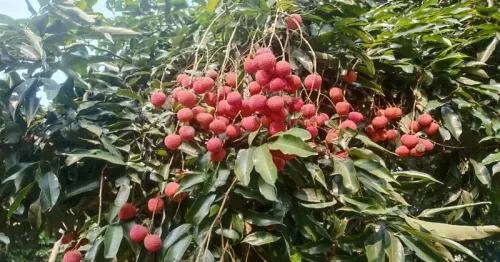
CM Himanta Flags Off Assam GI Litchis to Singapore

Synopsis
Assam Chief Minister Himanta Biswa Sarma flagged off a consignment of the state's GI-tagged litchis to Singapore on June 12, 2026, reinforcing India's Act East Policy and opening a premium export channel for Assam's litchi cultivators and agri-exporters in the ASEAN market.
Key Takeaways
Assam CM Himanta Biswa Sarma formally flagged off a consignment of GI-tagged Assam litchis to Singapore on June 12, 2026 .
The litchis carry a Geographical Indication tag under India's GI Act, 1999 , enabling premium branding and legal protection in export markets.
The export aligns with India's Act East Policy , which prioritises trade linkages with ASEAN economies including Singapore .
Key beneficiaries include Assam litchi cultivators and agri-exporters who gain access to high-value international markets.
Singapore 's role as a regional hub could serve as a gateway for wider Southeast Asian distribution of Assam's produce.
Sustained exports will depend on continued investment in cold-chain logistics and quality certification infrastructure in the Northeast.
Assam Chief Minister Himanta Biswa Sarma on Friday, June 12, 2026, formally flagged off a consignment of the state's GI-tagged litchis to Singapore, marking a fresh milestone in the Northeast's push to access international fruit markets. The ceremony was livestreamed on X, with Sarma inviting followers to tune in to the broadcast.
Context
Assam's litchis carry a Geographical Indication (GI) tag under India's Geographical Indications of Goods (Registration and Protection) Act, 1999, which confers legal protection and enables premium branding in export markets. The tag distinguishes the variety by its region of origin, lending it credibility and traceability that buyers in overseas markets increasingly demand. The flag-off event signals that the current harvest season's produce has cleared the quality and logistics chain required for international shipment.
Policy Backdrop
The export aligns squarely with India's Act East Policy, which prioritises deepening trade and economic linkages with ASEAN nations, of which Singapore is among the most strategically significant. Successive central and state governments have used GI certification as a tool to elevate the Northeast's horticultural produce — from Assam tea and large cardamom to silk — into premium international categories. Perishable produce such as litchis requires robust cold-chain logistics, and flag-off events of this kind typically signal that such infrastructure is in place for the consignment.
The broader national effort to register and market GI products from the Northeast has accelerated in recent years, with Assam actively pursuing new certifications for its agricultural output. Such registrations provide cultivators legal recourse against imitation products and open doors to premium pricing in export markets.
Stakeholders and Impact
The primary beneficiaries of this export consignment are Assam's litchi cultivators and agri-exporters, who gain access to a high-value market in Singapore with strong demand for premium tropical fruit. For farmers, international offtake can translate into better farmgate prices compared with saturated domestic markets during peak harvest. The move also supports the livelihoods of workers involved in grading, packaging, cold-chain handling, and logistics along the export corridor.
Singapore, as a regional trading hub, also serves as a potential gateway for Assam's produce to reach wider Southeast Asian consumers. A successful consignment strengthens the case for repeat and scaled-up orders in subsequent seasons, building the export brand equity of the GI tag over time.
What's Next
Attention will now turn to whether this flag-off marks the beginning of a regular export corridor for Assam litchis to ASEAN destinations, or remains a one-off promotional shipment. The coming trade season will be watched for additional consignments to other Southeast Asian markets and for any new GI registrations covering Northeastern horticultural products. A sustained export pipeline would require continued investment in cold-chain infrastructure and consistent quality certification — both of which remain key challenges for perishable produce from the region.
Point of View
Using a premium horticultural product to reinforce India's Act East Policy narrative at the state level. For CM Sarma, it serves a dual purpose: demonstrating tangible economic dividends for Assam's farming community while positioning the Northeast as a serious contributor to India's export ambitions. The GI tag framework, often underutilised in practice, gains visibility through such high-profile events, potentially encouraging other Northeastern states to accelerate their own certification pipelines. The real test, however, lies in whether this consignment seeds a durable export corridor or remains a one-season showcase.
NationPress
19 Sept 2026
Frequently Asked Questions
What is the GI tag for Assam litchi?
Assam litchi holds a Geographical Indication tag under India's GI Act of 1999, which legally protects the variety by its region of origin and enables it to be marketed as a premium, region-specific product in domestic and international markets.
Why are Assam litchis being exported to Singapore?
Singapore is a key ASEAN trading hub and a priority destination under India's Act East Policy. Exporting GI-tagged Assam litchis to Singapore helps open a premium market channel for Assam's farmers and positions the fruit for wider Southeast Asian distribution.
What did CM Himanta Biswa Sarma do on June 12 2026?
On June 12, 2026, Assam Chief Minister Himanta Biswa Sarma flagged off a consignment of the state's GI-tagged litchis to Singapore, livestreaming the ceremony on X.
What is India's Act East Policy and how does it relate to Assam exports?
India's Act East Policy aims to strengthen economic and strategic ties with ASEAN nations. Assam, as a northeastern border state, is a key corridor under this policy, and agricultural exports like GI-tagged litchis to Singapore directly reflect its trade objectives.
Who benefits from Assam litchi exports?
The primary beneficiaries are Assam's litchi cultivators and agri-exporters, who gain access to higher-value international markets, potentially earning better prices than in saturated domestic markets during peak harvest season.