CM Himanta flags Kokrajhar-Gelephu rail link as Act East pivot

Synopsis
Assam Chief Minister Himanta Biswa Sarma has described Assam as the fulcrum of India's Act East Policy, spotlighting a proposed 65-km rail link between Kokrajhar and Bhutan's Gelephu Mindfulness City as a catalyst for cross-border trade and tourism in the Northeast.
Key Takeaways
CM Himanta Biswa Sarma called Assam the 'fulcrum' of India's Act East Policy on 4 July 2026 .
A proposed 65-km rail corridor between Kokrajhar (western Assam) and Gelephu (southern Bhutan) is at the centre of this connectivity push.
Gelephu is being developed as a Mindfulness City by Bhutan , targeting sustainable tourism and wellness sectors.
India's Act East Policy , launched in 2014 , upgraded the 1991 Look East Policy and prioritises physical connectivity with ASEAN nations and immediate neighbours.
The project, if completed, would benefit traders, tourism operators, and agricultural businesses on both sides of the Assam–Bhutan border.
Land acquisition, funding, and a construction timeline remain key milestones before the rail link becomes operational.
Assam Chief Minister Himanta Biswa Sarma on Saturday, 4 July 2026, described Assam as the 'fulcrum' of India's Act East Policy, pointing to a proposed 65-km rail corridor between Kokrajhar in western Assam and Bhutan's Gelephu Mindfulness City as a transformative connectivity project that could open new trade and tourism frontiers.
Context
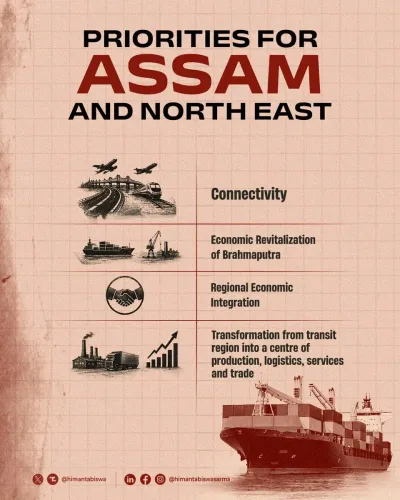
In his post, CM Sarma stated: 'Assam is emerging as the fulcrum of India's Act East policy, with connectivity being a major pillar. The upcoming 65 km rail link between Kokrajhar and Bhutan's Gelephu Mindfulness City will connect Assam into a new frontier of trade and tourism opportunities.' The statement positions Assam not merely as a transit corridor but as an active economic hub anchoring India's outreach to its northeastern neighbourhood.
The remarks come as India and Bhutan continue to deepen their already close bilateral relationship, which spans security cooperation, hydropower development, and infrastructure financing. Gelephu, a southern Bhutanese town bordering Assam's Kokrajhar district, has been designated for development as a special economic and wellness zone — a project Bhutan has described as central to its next phase of economic modernisation.
Policy Backdrop
India's Act East Policy was formally launched in 2014, upgrading the earlier 1991 Look East Policy to sharpen engagement with ASEAN nations and immediate neighbours, including Bhutan, Myanmar, and beyond. Physical connectivity — through rail, road, and inland waterways — has consistently been the policy's primary instrument, converting geographic proximity into functioning trade corridors.
The Northeast occupies a unique position in this architecture: eight states sharing borders with five countries, yet historically underserved by rail and road infrastructure. Cross-border projects like the proposed Kokrajhar–Gelephu line are designed to address that deficit while reinforcing India's development partnership with Bhutan, one of its closest diplomatic allies.
CM Sarma, as convenor of the North-East Democratic Alliance (NEDA), has repeatedly advocated for the region's integration into national and sub-regional supply chains, making this statement consistent with a broader political and administrative posture he has maintained since taking office.
Stakeholders and Impact
The most immediate beneficiaries of a functional Kokrajhar–Gelephu rail link would be traders, small manufacturers, and tourism operators on both sides of the border. Kokrajhar, headquarters of the Bodoland Territorial Council, has historically sought greater economic integration and investment, and improved cross-border connectivity could accelerate that process.
On the Bhutan side, Gelephu's planned development as a mindfulness and wellness destination means tourism infrastructure and hospitality services stand to gain significantly from direct rail access to Assam and, through it, the broader Indian rail network. Agricultural trade, which already moves informally across this border, could also be formalised and scaled.
What's Next
Key milestones to watch include the finalisation of land acquisition, funding arrangements, and a construction timeline for the proposed rail corridor. Bilateral trade facilitation and customs agreements between India and Bhutan would need to accompany the physical infrastructure to unlock the full economic potential CM Sarma has outlined.
If the project advances on schedule, it could serve as a template for similar cross-border rail links elsewhere in the Northeast — reinforcing Assam's stated ambition to become the region's connectivity and commercial fulcrum under India's Act East framework.
Point of View
Strengthening his case for greater federal investment in northeastern infrastructure. The Kokrajhar–Gelephu rail link, if it advances, would be the most tangible cross-border rail project between India and Bhutan to date, giving the bilateral relationship a new commercial dimension beyond hydropower. Sarma's dual role as Assam CM and NEDA convenor means this statement carries sub-regional weight, potentially nudging other northeastern states to align their own connectivity asks with the Act East framework. The announcement also arrives at a moment when Bhutan's Gelephu project is attracting international attention, giving India an opportunity to anchor its neighbour's economic modernisation within the Indian rail network's orbit.
NationPress
4 Jul 2026
Frequently Asked Questions
What is the Kokrajhar to Gelephu rail link?
It is a proposed 65-km cross-border railway connecting Kokrajhar in western Assam to Gelephu in southern Bhutan , aimed at boosting trade and tourism between the two countries.
What is Gelephu Mindfulness City in Bhutan?
Gelephu Mindfulness City is a special development zone being created in southern Bhutan focused on sustainable tourism, wellness, and economic modernisation, positioned near the Assam border.
What is India's Act East Policy?
India's Act East Policy was launched in 2014 to deepen economic, cultural, and strategic ties with ASEAN nations and immediate neighbours like Bhutan , upgrading the earlier Look East Policy of 1991.
Why is Assam important for Act East Policy?
Assam shares borders with Bhutan , Bangladesh , and other northeastern states that border Myanmar , making it a natural gateway for cross-border trade and connectivity under the Act East framework.
What is the current status of the Kokrajhar-Gelephu rail project?
As of July 2026 , the project has been highlighted as 'upcoming' by CM Himanta Biswa Sarma ; land acquisition, funding finalisation, and a construction timeline are key milestones still to be confirmed.