CM Himanta Flags Model School for Ketela Tea Garden Kids
Synopsis
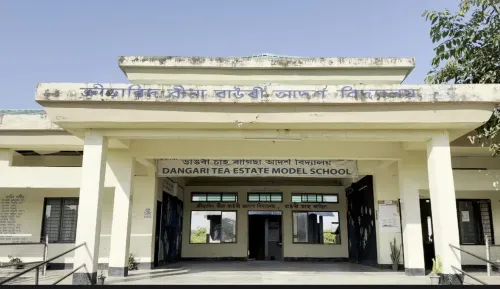
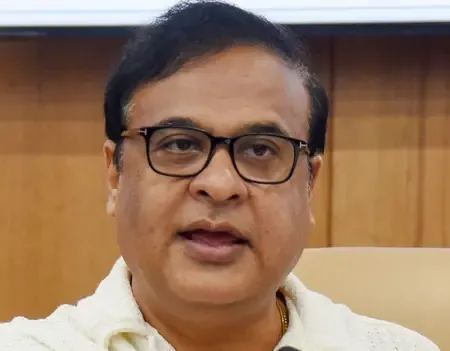
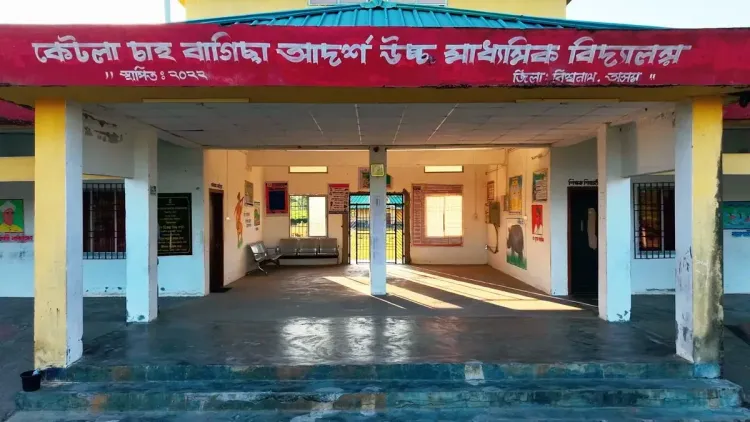
Assam CM Himanta Biswa Sarma spotlighted a model school at Ketela Tea Garden in Biswanath, saying tea garden families deserve educational opportunities close to home for their children.
Key Takeaways
Assam CM Himanta Biswa Sarma highlighted a model school established at Ketela Tea Garden in Biswanath district .
The school aims to provide quality education to children of multi-generational tea tribe communities without requiring long-distance travel.
Assam produces the bulk of India's tea, relying on tea tribe labour across more than 800 registered estates .
Education access gaps — including high dropout rates, especially for girls — have historically challenged tea garden communities.
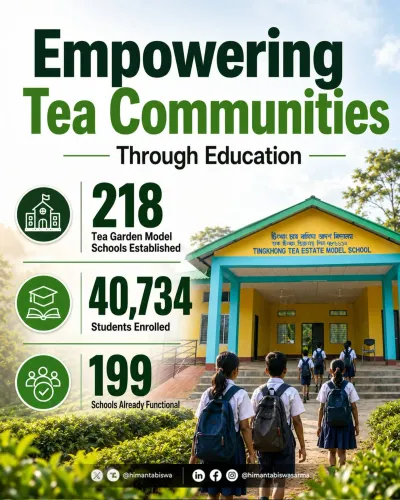
The Ketela school could serve as a template for similar model schools across Assam's tea belt if the state scales the initiative.
For generations, the families of Assam's tea gardens have poured their labour into an industry that fills cups across the world — yet the children born into those estates have often had to travel far for a decent education. Assam Chief Minister Himanta Biswa Sarma is pointing to a change at Ketela Tea Garden in Biswanath district, where a model school now brings quality schooling directly to the community.
Posting on Saturday, 21 November 2026, Sarma wrote: 'Our tea garden families have worked for generations to put Assam on the world map. Their children deserve every chance to make their own mark. At Ketela Tea Garden in Biswanath, our model school brings that opportunity closer to home.'
Biswanath's tea belt and the education gap
Assam accounts for the bulk of India's tea output, and much of that production runs on the backs of multi-generational tea tribe communities settled across estates in districts like Biswanath in the state's north. These communities — often classified officially as tea tribes — have historically faced limited access to schools within or near the garden premises, with children frequently dropping out before secondary level. State administrations across decades have periodically introduced welfare measures targeting this group, but persistent gaps in literacy and social mobility have remained a defining challenge. The Tea Tribes Welfare Board and state education budgets have both been cited as instruments for change, though implementation at the estate level has been uneven.What a model school at the garden gate means
The phrase 'closer to home' in Sarma's post carries real weight in the context of estate life. When a school sits inside or adjacent to a tea garden, it removes the distance barrier that pushes families — especially those with daughters — toward early withdrawal from education. Model schools, as deployed under state programmes, typically offer improved infrastructure, trained teachers, and a broader curriculum compared to single-room estate schools of the past. The Ketela Tea Garden school represents the kind of hyper-local infrastructure investment that CM Sarma's government has flagged as a priority for tea belt constituencies. Biswanath itself sits in a region dense with estates, making it a bellwether for how the model scales.A pattern worth watching across Assam's 800-plus estates
Assam has more than 800 registered tea estates, and the promise implied in Sarma's post — that every garden child deserves a real shot — sets a high bar. Whether the Ketela school becomes a template for rollout across other estates, and how it integrates with existing welfare board funding, will determine whether this is a milestone or a one-off showcase. For now, one school in Biswanath is the visible proof of concept. The children of Ketela's tea pickers will be the ones who say whether it delivers.Point of View
The CM frames the model school not merely as a facility but as a social-mobility intervention — a narrative that resonates strongly with tea tribe voters who form a significant electoral bloc in Assam. The move also fits a wider BJP pattern of converting welfare delivery into visible, story-driven communication. The real test will be whether Ketela becomes a scalable model or remains a symbolically useful single example.
NationPress
21 Nov 2026
Frequently Asked Questions
What is the model school at Ketela Tea Garden in Biswanath?
It is a school established within or near the Ketela Tea Garden in Biswanath district, Assam , designed to provide quality education to children of tea garden workers without requiring them to travel far from the estate.
Who are the tea tribe communities in Assam?
Tea tribes are multi-generational communities whose ancestors were brought to Assam to work in tea estates. They are officially recognised as a distinct socio-cultural group and have been targeted by various state welfare programmes over the decades.
Why does education access matter specifically for Assam tea garden children?
Children in tea estates have historically faced limited schooling options within the gardens, long distances to outside schools, and economic pressure to join the workforce early, leading to high dropout rates particularly at secondary level.
What is the Tea Tribes Welfare Board in Assam?
The Tea Tribes Welfare Board is a state body tasked with designing and implementing welfare, education, and social-upliftment schemes specifically for Assam's tea tribe communities across the estate belt.
How many tea estates does Assam have?
Assam has more than 800 registered tea estates , making it the largest tea-producing state in India and home to hundreds of thousands of tea tribe workers and their families.