CM Himanta Hails CA|TS Accreditation for Nameri Tiger Reserve
Synopsis
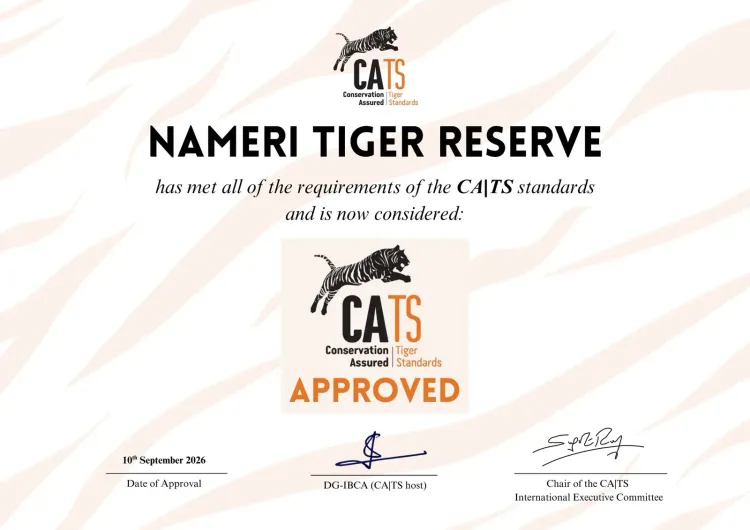
Nameri Tiger Reserve in Assam's Sonitpur district has earned CA|TS accreditation, the internationally recognised tiger conservation certification. CM Himanta Biswa Sarma praised the Assam Forest Department, frontline teams, and local communities for the achievement, calling it a proud moment for the state.
Key Takeaways
Nameri Tiger Reserve in Sonitpur district, Assam has received CA|TS (Conservation Assured | Tiger Standards) accreditation.
CA|TS is an internationally recognised framework that independently verifies a reserve's tiger conservation management quality.
CM Himanta Biswa Sarma credited the Assam Forest Department, field teams, and local communities for the milestone.
Nameri forms part of a critical wildlife corridor linking Assam's plains to Arunachal Pradesh's highlands, making the accreditation regionally significant.
Community-based conservation models — including eco-camp and nature guide programmes — were a core part of the reserve's qualifying framework.
A global conservation benchmark has arrived in Assam's forests. Nameri Tiger Reserve has earned the CA|TS (Conservation Assured | Tiger Standards) accreditation — a rigorous international certification that validates a tiger reserve's management quality and habitat protection — and Assam Chief Minister Himanta Biswa Sarma credited the achievement to the forest department, frontline field teams, and the local communities who made it possible.
What the CA|TS badge actually means
CA|TS is no ceremonial award. Developed under the global TX2 tiger-doubling initiative, it is a site-level assessment framework that evaluates tiger reserves against internationally agreed standards — covering anti-poaching protocols, habitat integrity, prey-base management, human-wildlife conflict mitigation, and community engagement. A reserve that earns accreditation has demonstrated that its conservation systems are not just functioning but independently verified to be so. For a tiger landscape in northeastern India, where forest corridors face pressure from agriculture, infrastructure, and human settlement, that verification carries real weight.
Nameri's position in Assam's tiger landscape
Nameri Tiger Reserve, straddling the foothills of the eastern Himalayas in Sonitpur district, covers roughly 200 sq km of core area and forms part of a critical biological corridor linking Assam's plains to Arunachal Pradesh's highlands. The reserve is known for its riverine ecosystems along the Jia Bhoroli river, significant elephant populations, and rich avian diversity — alongside its tigers. Its proximity to the Pakke Tiger Reserve in Arunachal Pradesh makes landscape-level conservation here particularly consequential for the broader northeastern tiger meta-population.
The human architecture behind the accreditation
CM Sarma's congratulatory post specifically named the Assam Forest Department, field teams, and local communities — a deliberate acknowledgment that CA|TS accreditation is won on the ground, not in offices. Community-based conservation around Nameri has historically involved eco-camp models and nature guide programmes that give fringe villages an economic stake in the forest's survival. That alignment of local livelihoods with conservation outcomes is precisely the kind of governance design CA|TS assessors look for. The accreditation, in that sense, is as much a validation of community trust-building as it is of ranger patrolling.
For Assam — a state that has in recent years pursued aggressive forest and wildlife governance reforms — the Nameri CA|TS badge adds an internationally legible credential to a conservation record that is increasingly being watched at the national level. The forests didn't just hold the line. They got certified for it.
Point of View
Whose administration has tied development ambitions to visible environmental credentials, the timing reinforces a dual narrative: economic growth and biodiversity protection as parallel tracks rather than competing ones. The deliberate naming of local communities in his congratulations reflects an awareness that tiger conservation in India's northeast succeeds only when fringe populations become stakeholders rather than bystanders. At the national level, each CA|TS accreditation strengthens India's hand in international biodiversity diplomacy, where tiger population recovery is one of the country's most compelling soft-power stories.
NationPress
8 Oct 2026
Frequently Asked Questions
What is CA|TS accreditation for tiger reserves?
CA|TS stands for Conservation Assured | Tiger Standards — an internationally recognised framework that independently assesses whether a tiger reserve meets defined standards for habitat protection, anti-poaching, prey management, and community engagement. A reserve that earns accreditation has had its conservation systems externally verified.
Which tiger reserve in Assam got CA|TS accreditation?
Nameri Tiger Reserve, located in Sonitpur district of Assam along the foothills of the eastern Himalayas, has received CA|TS accreditation.
Where is Nameri Tiger Reserve located?
Nameri Tiger Reserve is situated in Sonitpur district in northern Assam, along the Jia Bhoroli river , and shares a forest corridor with Pakke Tiger Reserve in Arunachal Pradesh.
What did CM Himanta Biswa Sarma say about Nameri's CA|TS accreditation?
CM Sarma stated that the accreditation 'reflects sustained work in protecting tiger habitats and improving conservation management in Nameri' and congratulated the Assam Forest Department, field teams, and local communities, calling it 'a proud moment for Assam.'
How many tiger reserves in India have CA|TS accreditation?
The research available does not provide a confirmed current count of CA|TS-accredited reserves in India; Nameri is among those that have achieved the certification, joining a select group of reserves that have met the international standard.