CM Himanta hails India-Indonesia mineral pact as 36th supply-chain node
Synopsis
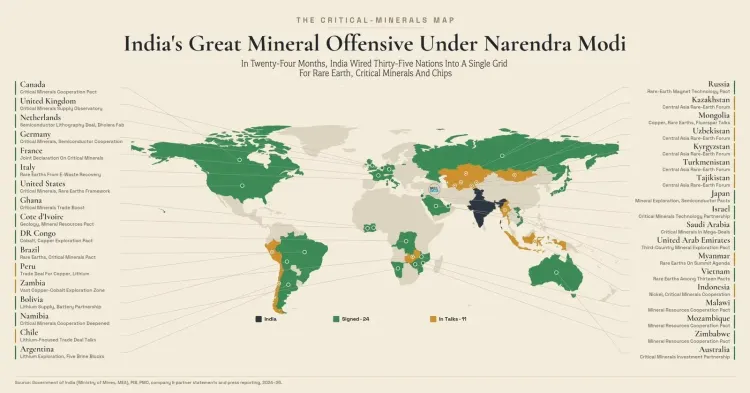
Assam Chief Minister Himanta Biswa Sarma has praised India's critical-minerals agreement with Indonesia as the 36th node in a global supply-chain grid being assembled under PM Modi, aimed at reducing dependence on Chinese-dominated rare-earth processing and powering India's clean-energy and electronics sectors.
Key Takeaways
Assam CM Himanta Biswa Sarma on 8 July 2026 described the India-Indonesia critical minerals agreement as the 36th node in India's global mineral supply-chain grid.
The grid is part of a strategy to de-risk rare earth and critical mineral supply chains and reduce reliance on Chinese-dominated processing .
India joined the US-led Mineral Security Partnership in June 2023 , complementing a series of bilateral pacts with Australia, Argentina, Chile , and African nations since 2022.
Indonesia is a major global producer of nickel , a key input for EV batteries and electronics — sectors that stand to benefit most from the agreement.
The initiative aligns with India's Atmanirbhar Bharat framework, which pairs overseas resource diplomacy with domestic processing incentives.
Implementing MoUs and potential announcements at India-ASEAN or G20 minerals meetings are the next milestones to watch.
Assam Chief Minister Himanta Biswa Sarma on Wednesday, 8 July 2026, lauded India's agreement with Indonesia on rare earth and critical minerals, calling it the 36th node in a global supply-chain grid being built under the leadership of Prime Minister Narendra Modi. Sarma framed the pact as a strategic step toward securing the raw materials needed for a 'futuristic economy,' citing India's broader drive to de-risk mineral supply chains.
Context
Sarma wrote on X that 'India is wiring together a global grid for rare earth and critical minerals to help de-risk supply chains,' describing the Indonesia agreement as unlocking 'ingredients for a futuristic economy.' He credited the initiative to the guidance of Prime Minister Modi, underscoring the diplomatic and strategic weight New Delhi has placed on mineral security in recent years.
Indonesia is one of the world's largest producers of nickel, a critical input for electric-vehicle batteries and electronics. A bilateral resource-cooperation agreement with Jakarta therefore carries significant industrial and strategic value for India's clean-energy ambitions.
Policy Backdrop
India's push to build a diversified mineral supply chain has accelerated since 2022, with bilateral agreements signed with countries including Australia, Argentina, Chile, and several African nations. The strategy aims to reduce dependence on Chinese-dominated rare-earth processing, which accounts for the bulk of global refining capacity.
In June 2023, India formally joined the US-led Mineral Security Partnership, a multilateral framework designed to coordinate investment in critical-mineral supply chains among like-minded economies. The Indonesia pact, as described by Sarma, slots into this wider architecture and complements domestic processing incentives under the Atmanirbhar Bharat framework.
New Delhi's approach combines resource diplomacy — securing offtake and exploration rights abroad — with efforts to build refining and processing capacity at home, reducing vulnerability at multiple points in the supply chain.
Stakeholders and Impact
The sectors with the most direct stake in India's critical-mineral diplomacy are electric-vehicle battery manufacturers and electronics producers, both of which depend on a reliable supply of lithium, cobalt, nickel, and rare-earth elements. Disruptions in any single source country can cascade into production delays and cost spikes across these industries.
For Indonesia, deeper mineral ties with India offer an additional export market and potential investment in downstream processing — a priority Jakarta has pursued to move beyond raw-ore exports. The agreement therefore carries mutual economic interest beyond a simple buyer-seller relationship.
Sarma's public endorsement of the pact, as convenor of the North-East Democratic Alliance (NEDA) and a senior BJP leader, also signals political consensus within the ruling coalition around the government's mineral-diplomacy agenda.
What's Next
Analysts and industry bodies will watch for the release of implementing memoranda of understanding (MoUs) or joint-venture frameworks that give operational form to the India-Indonesia agreement. Parliamentary ratification timelines, if required, will be a key procedural milestone.
Upcoming India-ASEAN summits and any G20 minerals-related ministerials could provide platforms to announce further progress or additional bilateral nodes in the network Sarma described. With 36 agreements now cited, the pace of additions to the grid will itself become a metric of the government's diplomatic momentum in this space.
Point of View
Tying a foreign-policy win to PM Modi's personal leadership at a time when supply-chain resilience has become a central plank of India's economic narrative. The '36th node' framing is significant: it presents mineral diplomacy not as isolated bilateral deals but as a coherent, accumulating architecture — a message aimed as much at domestic investors and industry as at foreign partners. Positioning Indonesia within an ASEAN context also signals that India sees Southeast Asia as a critical theatre in its contest with China for resource influence. If the implementing agreements follow through, the grid metaphor could become a durable electoral and economic talking point for the ruling coalition.
NationPress
8 Jul 2026
Frequently Asked Questions
What is India's agreement with Indonesia on critical minerals about?
India and Indonesia have signed a cooperation agreement covering rare earth and critical minerals, aimed at securing supplies of key inputs — such as nickel — needed for electric-vehicle batteries and electronics manufacturing, as part of India's broader strategy to diversify away from Chinese-dominated supply chains.
What did Assam CM Himanta Biswa Sarma say about the India-Indonesia minerals deal?
Sarma described the Indonesia agreement as the 36th node in a global critical-minerals grid being built under PM Modi's guidance, saying it unlocks 'ingredients for a futuristic economy' and helps de-risk India's supply chains.
What is the Mineral Security Partnership and is India a member?
The Mineral Security Partnership is a US-led multilateral framework to coordinate investment in critical-mineral supply chains. India formally joined it in June 2023, aligning its bilateral mineral diplomacy with a broader coalition of like-minded economies.
Why is Indonesia important for India's rare earth and mineral strategy?
Indonesia is one of the world's largest producers of nickel, a critical input for EV batteries. Securing a bilateral minerals agreement with Jakarta gives India access to a major source of this material outside Chinese-controlled supply chains.
How many countries has India signed critical mineral agreements with?
According to Assam CM Himanta Biswa Sarma's post on 8 July 2026, India has built a network of 36 bilateral mineral agreements, including pacts with Australia, Argentina, Chile, several African nations, and now Indonesia.