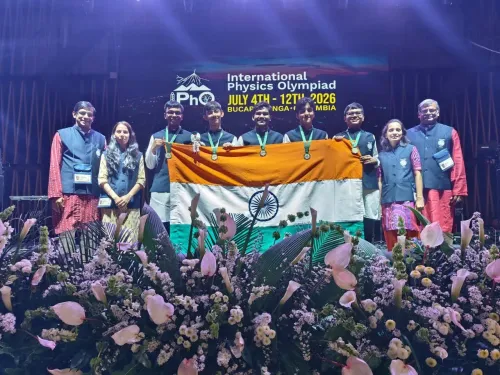
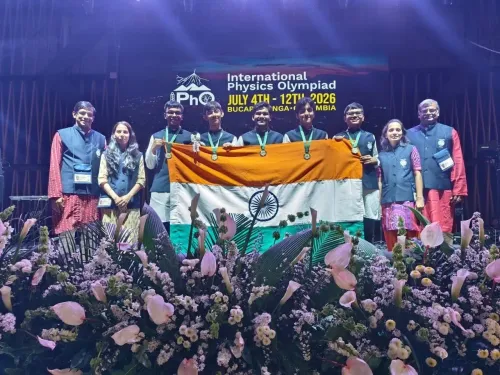
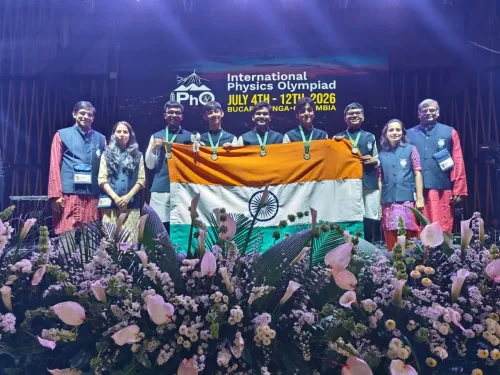
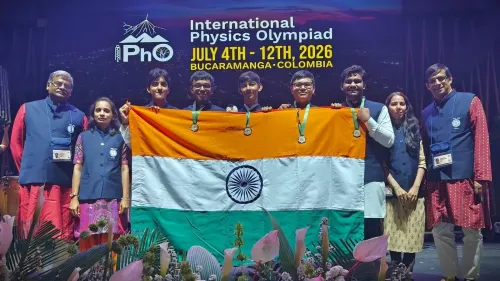
CM Himanta Hails India's Gold at 56th Physics Olympiad
Synopsis
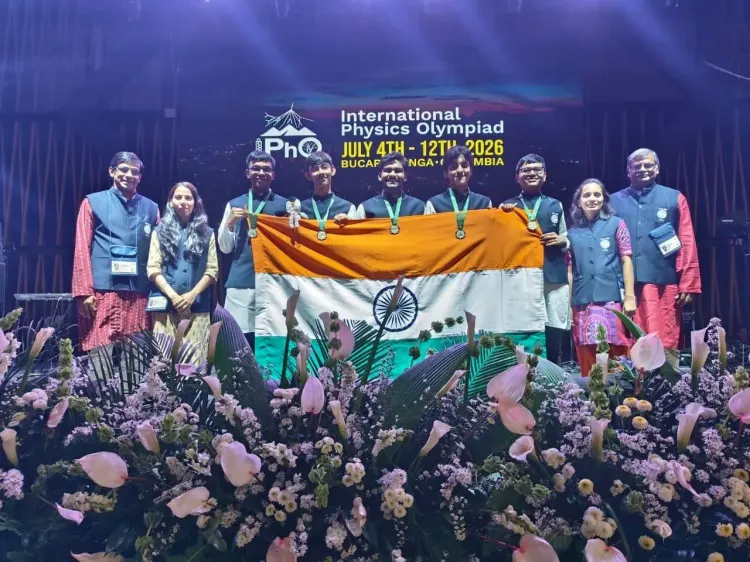
Five Indian high-school students won gold at the 56th International Physics Olympiad 2026 in Colombia. Assam CM Himanta Biswa Sarma hailed the feat as proof that talent and hard work translate to gold, linking the achievement to India's Viksit Bharat vision for 2047.
Key Takeaways
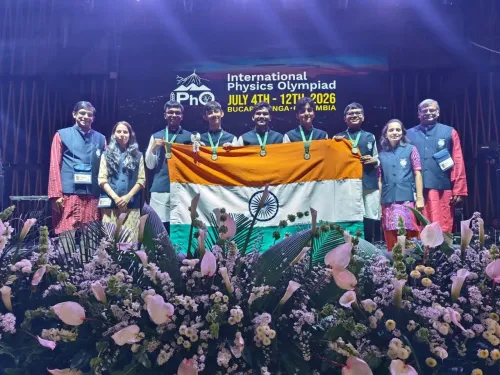
Kanishk Jain , Riddhesh Anant Bendale , Rishit Garg , Shresth Suraiya , and Svarit Joshi won gold for India at the 56th International Physics Olympiad 2026 in Colombia .
Assam Chief Minister Himanta Biswa Sarma publicly congratulated the students on 13 July 2026 , framing the win as 'Talent + Hard Work = Gold for India.' The IPhO is an annual global physics competition for high-school students; India has participated since the late 1990s.
Sarma linked the achievement to the Viksit Bharat vision, the government's roadmap for a developed India by 2047 .
India's science olympiad performance is underpinned by the National Education Policy 2020 and the INSPIRE programme launched in 2008 .
Policymakers are expected to cite the result in debates over olympiad training centre expansion and science education budgets.
Assam Chief Minister Himanta Biswa Sarma on Monday, 13 July 2026 congratulated five Indian students who won gold at the 56th International Physics Olympiad (IPhO) 2026 held in Colombia, calling the achievement a validation of the equation 'Talent + Hard Work = Gold for India.'
Context
Sarma named all five gold medallists — Kanishk Jain, Riddhesh Anant Bendale, Rishit Garg, Shresth Suraiya, and Svarit Joshi — in his post on X, expressing hope that their success would 'inspire a new generation of Indians to dream, discover and lead in science.' The International Physics Olympiad is an annual global competition for high-school students, with India having participated since the late 1990s. A clean sweep of gold medals by an Indian contingent represents a landmark moment in the country's olympiad history.
Policy Backdrop
India's strong showing at international science olympiads sits at the intersection of several long-running policy initiatives. The National Education Policy 2020 placed explicit emphasis on cultivating scientific temper, critical thinking, and innovation from the school level. The INSPIRE programme, launched in 2008, has for nearly two decades provided scholarships and mentorship to attract school students toward basic sciences, building a pipeline of talent that feeds into competitive olympiad preparation.
Successive central and state governments have treated performance at events like the IPhO as visible markers of progress in STEM education and human-capital development. Sarma's post explicitly links this individual achievement to the Viksit Bharat vision — the Government of India's framework for a fully developed nation by 2047 — framing scientific excellence as an instrument of national advancement, not merely a competitive trophy.
Stakeholders and Impact
The immediate beneficiaries are the five students themselves, whose gold medals at one of the world's most prestigious pre-university science competitions open doors to elite academic and research institutions globally. For India's broader community of science educators, olympiad coaches, and school students, the result provides a powerful proof of concept: rigorous school-level science training can compete at the highest international standard.
State governments, including those in the North-East where Sarma wields significant political influence through the North-East Democratic Alliance (NEDA), may find in this moment a prompt to expand regional olympiad training infrastructure. The result also reinforces the case for sustained public investment in science education at the secondary level, a constituency that includes millions of students preparing for competitive examinations across India.
What's Next
Attention will now turn to whether the central government follows up with formal recognition — such as awards or scholarship enhancements — for the gold-winning students. Policymakers and science advocates are likely to cite the 56th IPhO result in ongoing debates around education budgets and the expansion of olympiad coaching centres. Looking further ahead, India's performance at the 2027 International Physics Olympiad will be closely watched to determine whether this gold-medal sweep marks a sustained inflection point or a singular high-water mark in the country's science olympiad journey.
Point of View
The Assam CM personalises the achievement in a way that amplifies its resonance with aspirational middle-class families invested in competitive education. The post also signals that STEM excellence has become a cross-party political asset, with leaders at the state level eager to associate themselves with national science milestones even when those achievements fall outside their direct administrative jurisdiction. For India's science education ecosystem, such high-visibility political endorsement can translate into real budgetary and institutional attention — making the optics consequential beyond social media.
NationPress
13 Jul 2026
Frequently Asked Questions
Who are the Indian students who won gold at IPhO 2026?
The five Indian students who won gold at the 56th International Physics Olympiad 2026 in Colombia are Kanishk Jain, Riddhesh Anant Bendale, Rishit Garg, Shresth Suraiya, and Svarit Joshi.
Where was the 56th International Physics Olympiad 2026 held?
The 56th International Physics Olympiad 2026 was held in Colombia.
What is the International Physics Olympiad?
The International Physics Olympiad (IPhO) is an annual global science competition for high-school students. India has participated since the late 1990s and the event is considered one of the most prestigious pre-university physics contests in the world.
What is Viksit Bharat and how does it relate to science education?
Viksit Bharat is the Government of India's vision for a fully developed nation by 2047. It includes a strong emphasis on scientific and technological capability, and leaders like CM Himanta Biswa Sarma have cited olympiad achievements as evidence of progress toward this goal.
What government programmes support India's science olympiad preparation?
India's olympiad talent pipeline is supported by the National Education Policy 2020, which emphasises scientific temper from school level, and the INSPIRE programme launched in 2008, which provides scholarships and mentorship to students pursuing basic sciences.