CM Himanta hails Namghar inauguration in Pune as cultural bridge

Synopsis
Assam CM Himanta Biswa Sarma welcomed the inauguration of a Namghar in Pune by the Sarhad organisation, calling it a union of Srimanta Sankardev's Vaishnavite legacy with Maharashtra's Bhakti tradition of Sant Dnyaneshwar and Sant Tukaram Maharaj.
Key Takeaways
A Namghar — Assam's traditional Vaishnavite community prayer hall — was inaugurated in Pune, Maharashtra .
The initiative was led by the Sarhad organisation , a Pune-based civil-society body known for northeast-Maharashtra cultural work.
CM Himanta Biswa Sarma linked the Namghar to the shared Bhakti legacy of Srimanta Sankardev , Sant Dnyaneshwar , and Sant Tukaram Maharaj .
The Chief Minister described the development as a moment of 'great joy and pride' for Assam-Maharashtra relations.
The Namghar serves the Assamese diaspora in Pune as a centre for language, devotional music, and cultural continuity.
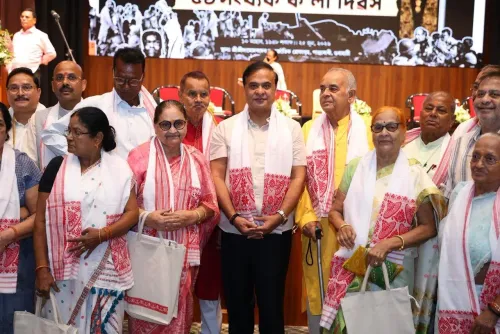
A piece of Assam has taken root in Pune — and Assam Chief Minister Himanta Biswa Sarma says it fills him with 'great joy and pride.' On Wednesday, 7 October 2026, the Chief Minister marked the inauguration of a Namghar in Pune, Maharashtra, calling it a living symbol of the devotional traditions that have long connected India's diverse regions.
What a Namghar in Pune represents
A Namghar is a Vaishnavite prayer hall — the spiritual and community centrepiece of Assamese society, rooted in the 15th–16th century neo-Vaishnavite reform movement of the saint-scholar Srimanta Sankardev. Equal parts place of worship and cultural anchor, Namghars have historically served Assamese communities wherever they have settled. The establishment of one in Pune marks a deliberate effort to keep that tradition alive far from home.
CM Sarma framed the inauguration not as an Assamese enclave, but as a meeting point of traditions. He drew a direct line between Srimanta Sankardev's message of devotion from Assam and the Bhakti movement legacy of Sant Dnyaneshwar and Sant Tukaram Maharaj — two of Maharashtra's most venerated poet-saints. The convergence, he argued, is natural: all three traditions preach devotion, equality, and harmony across social divides.
Sarhad organisation's role in the initiative
The Chief Minister extended his 'appreciation and congratulations' specifically to the Sarhad organisation for driving the project. Sarhad — the name itself means 'border' or 'frontier' in several Indian languages — is a Pune-based non-governmental organisation known for its work fostering cultural exchange and community integration, particularly between Maharashtra and the northeastern states of India.
The gesture of crediting Sarhad by name signals recognition at the highest political level of Maharashtra-Northeast cultural diplomacy happening outside the government framework — driven by civil society.
A thread connecting Assam and Maharashtra
The inauguration arrives at a moment when India's northeast has become an increasingly visible presence in national cultural and political life. For the Assamese diaspora in Pune — one of India's fastest-growing metropolitan centres — a Namghar is not merely religious infrastructure; it is identity infrastructure. It is where language, music, and the Borgeet devotional songs of Sankardev's tradition are passed to the next generation.
By invoking Dnyaneshwar and Tukaram alongside Sankardev, CM Sarma made a point that needed no translation: India's Bhakti saints were, in their time, the original architects of cultural unity across linguistic borders. The Namghar in Pune is the latest address on that very old road.
Point of View
Celebrated by a sitting Chief Minister, reflects a quiet but deliberate effort to give northeast India cultural visibility in the country's major urban centres. CM Sarma's invocation of Maharashtra's own Bhakti saints alongside Srimanta Sankardev is smart political symbolism — it frames Assamese tradition not as regional or peripheral, but as co-equal with the devotional heritage of India's most politically influential states. For BJP, which governs both Assam and is a key player in Maharashtra, moments of cultural convergence carry soft-power value that transcends ceremony. The crediting of a civil-society body like Sarhad also signals an awareness that cultural diplomacy works best when it appears organic rather than state-directed.
NationPress
7 Oct 2026
Frequently Asked Questions
Where was the Namghar inaugurated in Pune?
A Namghar was inaugurated in Pune, Maharashtra, through an initiative by the Sarhad organisation. The exact locality within Pune was not specified in CM Himanta Biswa Sarma's post.
Who is the Sarhad organisation?
Sarhad is a Pune-based non-governmental organisation known for promoting cultural exchange and community integration, particularly between Maharashtra and the northeastern states of India. CM Sarma specifically credited Sarhad for the Namghar initiative.
Who was Srimanta Sankardev?
Srimanta Sankardev was a 15th–16th century Assamese saint-scholar, poet, and social reformer who founded the neo-Vaishnavite Ekasarana Dharma movement. His teachings, which emphasised devotion, equality, and harmony, form the spiritual foundation of Namghar culture.
Why did CM Himanta Sarma mention Sant Dnyaneshwar and Sant Tukaram Maharaj?
CM Sarma invoked the two revered Maharashtra Bhakti saints to draw a thematic connection between Assam's Vaishnavite tradition and Maharashtra's own devotional heritage, framing the Namghar inauguration as a convergence of shared spiritual values across regional boundaries.