CM Himanta Marks Anti-Drug Day, Vows Crackdown in Assam
Synopsis
On the International Day Against Drug Abuse and Illicit Trafficking, Assam Chief Minister Himanta Biswa Sarma reaffirmed a relentless state crackdown on narcotics, citing the need to protect youth from social destruction. Assam sits on a key drug-transit corridor from the Golden Triangle region.
Key Takeaways
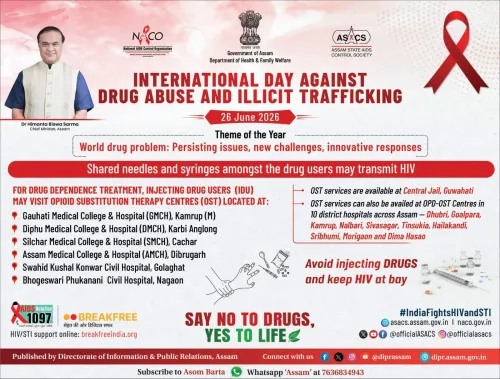
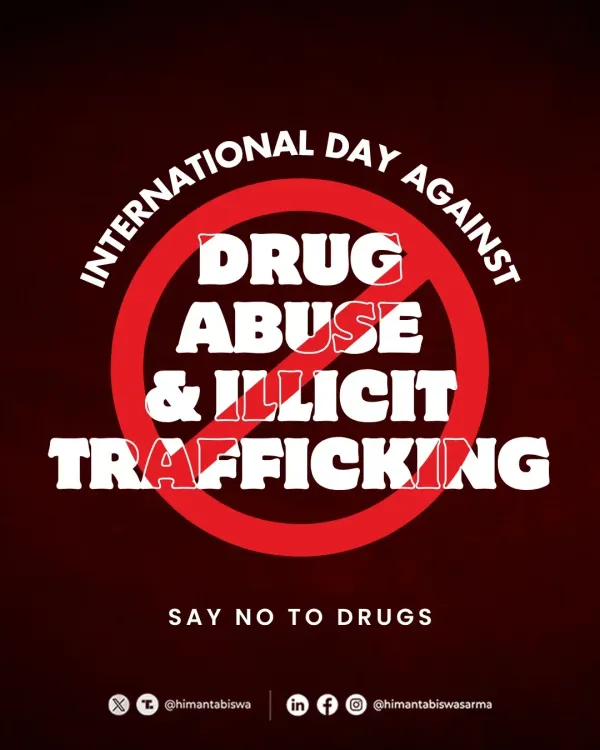
Chief Minister Himanta Biswa Sarma marked International Day Against Drug Abuse and Illicit Trafficking on 26 June 2026 with a public commitment to ongoing anti-drug enforcement.
Assam borders Myanmar and Bhutan and is a recognised transit route for synthetic drugs from the Golden Triangle .
The central government's Nasha Mukt Bharat Abhiyan (launched August 2020 ) covers 272 high-risk districts, including several in Assam.
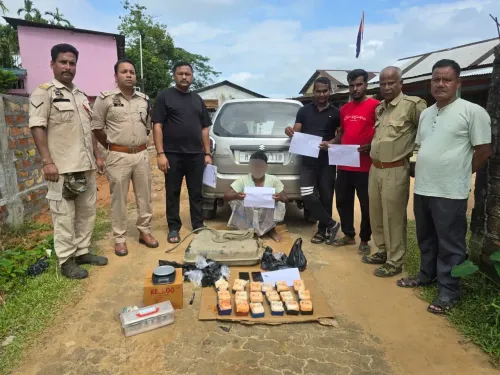
The Assam Excise and Narcotics Department has intensified raids and destruction of illicit poppy cultivation since 2021 .
Rehabilitation infrastructure in the northeast remains limited relative to enforcement activity, a gap flagged by health and civil-society groups.
Possible next steps include new de-addiction centres in Assam's 2026-27 budget and deeper coordination on India-Myanmar border narcotics control.
Assam Chief Minister Himanta Biswa Sarma on Friday, 26 June 2026 marked the International Day Against Drug Abuse and Illicit Trafficking, reaffirming his government's commitment to an ongoing crackdown on narcotics and pledging to protect the state's youth from what he called 'social destruction.'
Context
The International Day Against Drug Abuse and Illicit Trafficking is observed every year on 26 June, established by the UN General Assembly through Resolution 42/112 in 1987 and coordinated globally by the United Nations Office on Drugs and Crime (UNODC). The day serves as a focal point for governments to publicly restate enforcement and prevention commitments. Chief Minister Sarma used the occasion to signal that Assam remains on an active enforcement footing, stating: 'We remain committed to preserve the future of our youth and save them from this social destruction.'
Assam occupies a strategically sensitive position in India's narcotics landscape. The state shares borders with Myanmar and Bhutan and has long been identified as a transit corridor for synthetic drugs flowing out of the Golden Triangle region — the drug-producing zone spanning parts of Myanmar, Laos, and Thailand.
Policy Backdrop
At the central level, the Nasha Mukt Bharat Abhiyan — launched by the Ministry of Social Justice and Empowerment in August 2020 — targets 272 of India's most drug-affected districts, several of which fall within Assam. The scheme combines enforcement with community awareness and rehabilitation outreach. Assam's state government has run parallel efforts through the Assam Excise and Narcotics Department, which intensified raids and the destruction of illicit poppy cultivation from 2021 onwards under the present administration.
Successive governments in the northeast have treated drug abuse as simultaneously a law-and-order problem and a public-health crisis. Enforcement actions — seizures, arrests, and crop destruction — have been the more visible prong; rehabilitation infrastructure, by contrast, has remained comparatively limited across the region.
Stakeholders and Impact
Assam's youth are the stated focus of the government's anti-drug agenda. Drug abuse among young people in northeastern states has been linked to both the easy availability of substances along transit routes and limited economic opportunity in certain districts. Civil-society groups and health workers in the region have consistently called for a balance between punitive enforcement and accessible de-addiction services.
Northeastern states share a common interest in coordinated narcotics control given their shared geography. Chief Minister Sarma, as convenor of the North-East Democratic Alliance (NEDA), is positioned to push for regional alignment on border-level enforcement, particularly with respect to the India-Myanmar frontier where smuggling networks are most active.
What's Next
Observers will watch for concrete follow-through: whether Assam's 2026-27 budget allocations translate into new district-level de-addiction centres, and whether the state pursues formal coordination with central agencies or neighbouring countries on border narcotics control. The government's public posture on 26 June sets an expectation for measurable action in the months ahead. How Assam balances enforcement with rehabilitation will be a key indicator of whether its anti-drug drive delivers lasting outcomes for the youth it aims to protect.
Point of View
But the durability of the crackdown will be tested by whether enforcement is matched with rehabilitation investment. As NEDA convenor, Sarma also has a regional platform to push for coordinated northeastern action, which could amplify the policy's reach beyond Assam's borders. The statement stops short of announcing specific new measures, leaving room for both ambition and accountability.
NationPress
26 Jun 2026
Frequently Asked Questions
What is the International Day Against Drug Abuse and Illicit Trafficking?
It is a UN observance held every year on 26 June, established by the UN General Assembly in 1987 and coordinated by UNODC, to strengthen action and cooperation against drug abuse worldwide.
What has the Assam government done to fight drug abuse?
The Assam government, under Chief Minister Himanta Biswa Sarma since 2021, has intensified raids through the Assam Excise and Narcotics Department and pursued destruction of illicit poppy cultivation as part of a broader anti-narcotics drive.
Why is Assam particularly vulnerable to drug trafficking?
Assam shares borders with Myanmar and Bhutan and sits on a transit corridor for synthetic drugs produced in the Golden Triangle region spanning Myanmar, Laos, and Thailand, making it a high-risk state for drug smuggling.
What is the Nasha Mukt Bharat Abhiyan?
Nasha Mukt Bharat Abhiyan is a central government scheme launched in August 2020 by the Ministry of Social Justice and Empowerment, targeting 272 of India's most drug-affected districts — including several in Assam — through enforcement and community awareness.
What is NEDA and what role does Himanta Biswa Sarma play in it?
The North-East Democratic Alliance (NEDA) is a political alliance of BJP and allied parties in northeastern India; Chief Minister Himanta Biswa Sarma serves as its convenor, giving him a regional platform to coordinate policy across northeastern states.