CM Himanta moves Assam tourism registration online
Synopsis
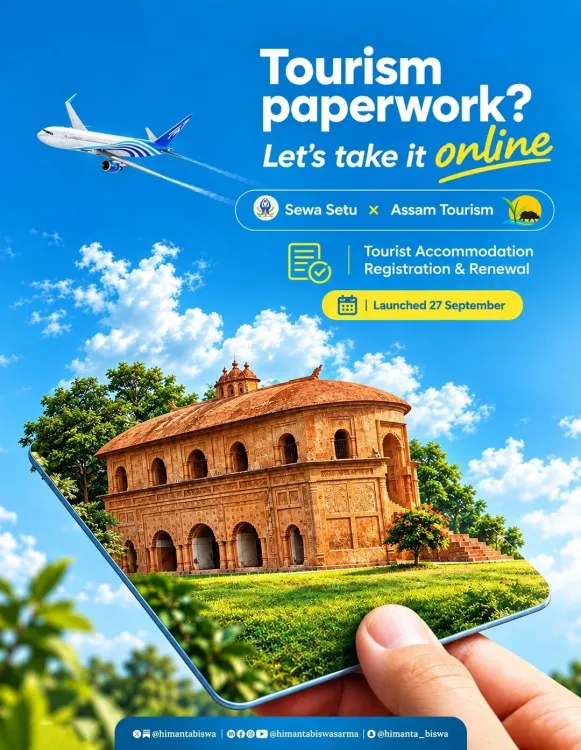
Assam CM Himanta Biswa Sarma on World Tourism Day 2026 moved tourism service provider registration and renewal fully online, scrapping a decade-old offline process as part of the state's broader e-governance push.
Key Takeaways
Assam tourism service provider registration and renewal went fully online on 27 September 2026 , World Tourism Day.
CM Himanta Biswa Sarma framed the shift as replacing 'rules of 2010' with a system fit for a 2026 destination.
The reform is part of Assam's broader Digital India -aligned e-governance modernisation drive active since the mid-2010s.
The Sarma government, in power since 2021 , has consistently targeted legacy administrative processes across economic sectors.
Assam's tourism economy is anchored by Kaziranga National Park and Majuli , giving the digital overhaul a high-value backdrop.
Adoption metrics on the new portal and follow-up policy revisions by the Assam Tourism Development Corporation will be the next signals to watch.
Legacy red tape has a new expiry date in Assam. On World Tourism Day, 27 September 2026, Assam Chief Minister Himanta Biswa Sarma announced that registration and renewal for tourism service providers in the state are now fully online — a direct strike at the paperwork-heavy processes that have long slowed the sector down.
From 2010 rules to a single click
Sarma's framing was blunt: 'We can't be a 2026 tourist destination with rules of 2010.' The move digitises a process that previously required physical paperwork and in-person visits, replacing it with a portal-based system where a provider can register or renew with — in the CM's own words — 'a button and voila.' The timing on World Tourism Day, the United Nations' annual observance on 27 September marking tourism's role in global development, was deliberate: it signals that Assam is open for business on its own reformist terms.
Assam's e-governance push behind the announcement
This is not a stand-alone move. Since the mid-2010s, Assam has steadily digitised citizen and business services under India's broader Digital India framework. The Sarma government, in office since 2021, has particularly leaned into administrative modernisation as an economic lever — updating legacy regulations across sectors rather than layering new policy on top of old process. Tourism is now the latest sector to get that treatment.
Assam's tourism economy is anchored by globally recognised assets: Kaziranga National Park, a UNESCO World Heritage Site and home to two-thirds of the world's one-horned rhinoceroses, and Majuli, the world's largest river island. Getting more licensed service providers into a clean digital registry helps the state present a credible, investor- and visitor-ready ecosystem around those assets.
What tourism operators need to know
Tourism service providers — hotels, homestays, tour operators, adventure sports outfits — who previously navigated offline bureaucracy can now complete registration and renewal entirely online. The Assam Tourism Development Corporation oversees the framework, and adoption rates for the new portal will be the first real test of whether the reform delivers on its promise. Any follow-up policy revisions the state announces around the portal will signal how deep the overhaul is intended to go.
In a country where tourism employment supports millions and Northeast India remains an underleveraged destination despite extraordinary natural and cultural wealth, removing friction for providers is the ground-level reform that actually moves the needle.
Point of View
Not just a technology programme. The real test is whether portal adoption is broad and friction-free, or whether offline bottlenecks simply migrate to new digital queues. If the reform sticks, it could become a template other Northeast states under NEDA's orbit are nudged to replicate.
NationPress
27 Sept 2026
Frequently Asked Questions
What did Assam CM Himanta Biswa Sarma announce on World Tourism Day 2026?
CM Himanta Biswa Sarma announced that registration and renewal for tourism service providers in Assam are now available fully online, replacing the earlier offline process, effective 27 September 2026.
How can Assam tourism service providers register online?
Tourism service providers in Assam can now complete their registration or renewal through the state's online portal managed under the Assam Tourism Development Corporation framework, without needing to visit a physical office.
Why did Assam move tourism registration online?
The Sarma government cited outdated regulations — described as 'rules of 2010' — as incompatible with Assam's 2026 tourism ambitions, and digitised the process as part of the state's broader e-governance reforms aligned with the Digital India programme.
What is World Tourism Day and why was this announced on that date?
World Tourism Day is observed globally on 27 September each year to highlight tourism's role in development. Assam timed the portal launch to the date as a deliberate signal of its commitment to modernising the sector.
Which tourism sites make Assam a major destination?
Assam's flagship tourism assets include Kaziranga National Park, a UNESCO World Heritage Site home to the one-horned rhinoceros, and Majuli, recognised as the world's largest river island.