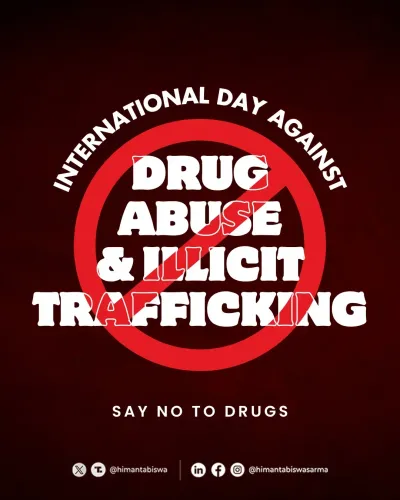
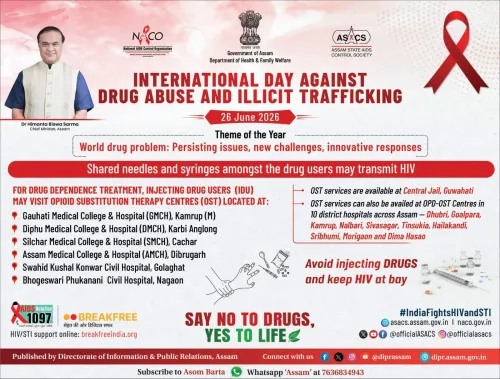
CM Himanta Vows Ruthless Centre-State Drug Crackdown in Assam
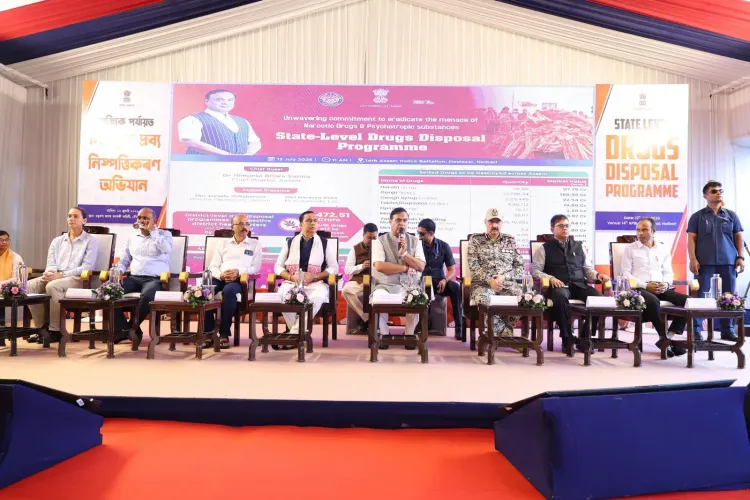
Synopsis
Assam Chief Minister Himanta Biswa Sarma has announced a Centre-State joint approach to track illicit substances, identify history sheeters, and intercept drug traffickers at Assam's borders, vowing ruthless enforcement and strong prosecution.
Key Takeaways
Assam CM Himanta Biswa Sarma announced a Centre-State joint approach to combat drug trafficking on 12 July 2026 .
The mechanism aims to track illicit substance movement, identify history sheeters, and catch them at Assam's borders before entry.
The stated goal includes building strong prosecution cases under the existing legal framework.
Assam borders Myanmar and Bangladesh , making it a key transit corridor for narcotics into India's Northeast.
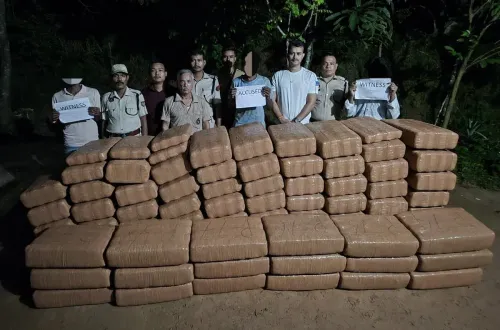
The Sarma government has intensified anti-narcotics drives since 2021 , including large-scale raids and border checks.
CM Sarma publicly framed the commitment as both a 'PROMISE' and a 'WARNING' to drug networks.
Assam Chief Minister Himanta Biswa Sarma on Sunday, 12 July 2026, issued a stern public warning against drug traffickers, declaring that a new Centre-State joint approach will be deployed to intercept illicit substances and 'history sheeters' before they cross into Assam.
Context
Posting on X, CM Sarma outlined the operational logic of the coordinated mechanism: tracking the movement of illicit substances, identifying repeat offenders, and apprehending them at the borders before they can enter the state. He closed with an unambiguous declaration — 'We will be ruthless in this fight against drugs — that's a PROMISE & WARNING.'
The post is framed as a reply, indicating it follows an earlier exchange, likely elaborating on a joint enforcement announcement. The use of the term 'history sheeters' — a standard Indian law-enforcement term for individuals with prior criminal records — signals the focus on known repeat offenders within narcotics networks.
Policy Backdrop
Since 2021, the Sarma government has significantly intensified anti-narcotics operations in Assam, conducting large-scale raids and tightening border checks. Assam shares porous international borders with Myanmar and Bangladesh, making it a critical transit corridor for illicit drug flows into the Indian mainland.
The broader pattern across BJP-governed northeastern states has involved coordinated operations with central agencies, including the Narcotics Control Bureau (NCB), under the framework of the Narcotic Drugs and Psychotropic Substances (NDPS) Act. The emphasis has consistently been on pre-emptive interdiction and robust prosecution rather than reactive policing.
A Centre-State joint approach of the kind described by CM Sarma would typically involve shared intelligence databases, coordinated task forces between state police and central agencies, and streamlined case-building for prosecution — though the specific mechanisms of this particular initiative are yet to be formally detailed.
Stakeholders and Impact
The primary targets of the crackdown are established narcotics networks and their known operatives — the 'history sheeters' — who have historically exploited border vulnerabilities to move contraband into Assam and further into the Northeast. State police and central enforcement agencies stand as the key institutional actors in executing this mandate.
For border communities, a tightened joint surveillance regime could mean more rigorous checks and a visible law-enforcement presence at entry points. Civil liberties observers are likely to watch the prosecution pipeline closely to assess whether the 'strong case' standard translates into due-process-compliant outcomes in court.
What's Next
The immediate watch point is the formal rollout of the Centre-State coordination mechanism — specifically whether shared databases, joint task forces, or dedicated border interception units are constituted and notified. Prosecution statistics over the coming months will serve as the measurable test of whether the 'ruthless' standard CM Sarma has publicly committed to translates into courtroom convictions.
With CM Sarma having framed this as both a promise and a warning, the political accountability bar has been set publicly — making follow-through on enforcement outcomes a visible metric for his administration heading into the latter half of 2026.
Point of View
A model that has been replicated across northeastern states since 2021. The focus on 'history sheeters' and border interception reflects a shift from reactive seizure-based policing toward a pre-emptive, intelligence-led posture. The real test of this commitment will be the prosecution conviction rate, which historically lags behind arrest and seizure numbers in narcotics cases across India.
NationPress
12 Jul 2026
Frequently Asked Questions
What is Assam CM Himanta Biswa Sarma's new drug crackdown plan?
CM Sarma has announced a Centre-State joint approach to track illicit substance movement, identify repeat offenders known as history sheeters, intercept them at Assam's borders, and build strong cases for prosecution under the NDPS Act.
Why is Assam particularly vulnerable to drug trafficking?
Assam shares porous international borders with Myanmar and Bangladesh, both of which are significant sources or transit routes for narcotics, making the state a critical entry point for illicit drugs into mainland India.
What is a 'history sheeter' in Indian law enforcement?
A history sheeter is a standard Indian police term for an individual with a documented history of prior criminal offences, in this context referring to known repeat offenders within narcotics networks.
How has the Assam government tackled drugs since 2021?
Since 2021, the Sarma government has conducted large-scale raids, tightened border checks, and pursued coordinated operations with central agencies including the Narcotics Control Bureau under the NDPS Act framework.
What role does the central government play in Assam's anti-drug operations?
Central agencies such as the Narcotics Control Bureau work alongside state police in joint operations, potentially sharing intelligence databases and task forces to strengthen interdiction and prosecution efforts across northeastern states.