CM Himanta Vows to Eradicate Child Marriage in Assam

Synopsis
On Independence Day 2026, Assam CM Himanta Biswa Sarma declared child marriage has significantly declined in the state and announced a major enforcement campaign from November to eradicate the practice entirely.
Key Takeaways
Assam CM Himanta Biswa Sarma announced a 'massive campaign' against child marriage starting November 2026 .
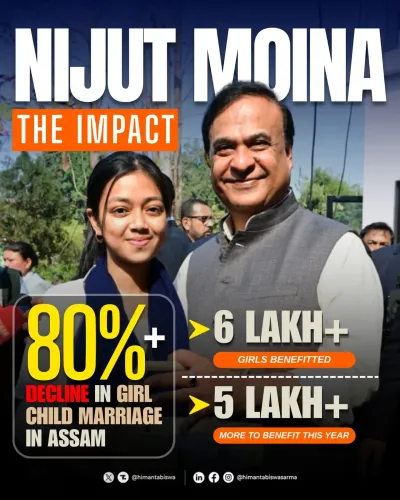
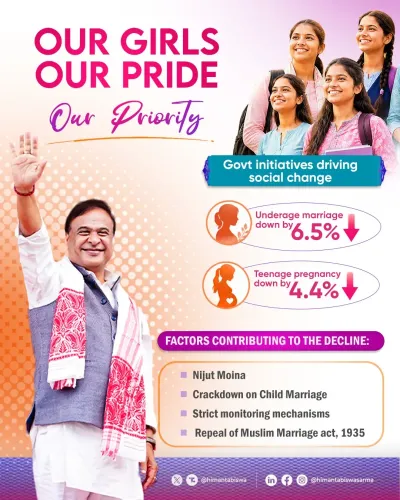
He stated child marriage has 'significantly declined' in Assam, crediting the government's enforcement approach.
Assam's crackdown on child marriage began in 2022 with arrests under POCSO and the Prohibition of Child Marriage Act.
The announcement was made on Independence Day, August 15, 2026 , linking national freedom to the protection of girls.
Sarma stressed the campaign will continue 'until it is eradicated,' signalling long-term political commitment.
Four years of arrests, awareness drives, and political will — and Assam Chief Minister Himanta Biswa Sarma says the numbers are moving. On Independence Day, August 15, 2026, he declared that child marriage has 'significantly declined' in the state, and announced a fresh enforcement blitz starting November 2026 to finish the job.
A promise made, a campaign coming
Sarma framed the announcement as a delivery on an earlier commitment — 'as promised,' he wrote, signalling continuity rather than a new initiative. The November campaign, he said, will be 'massive,' targeting offenders and bringing them 'to justice.' The Independence Day timing was deliberate: linking the freedom of the nation to the freedom of its daughters carries unmistakable political and moral weight.
What the Assam crackdown has looked like since 2022
The state government began its enforcement push in 2022, deploying police to register cases under the Protection of Children from Sexual Offences (POCSO) Act and the Prohibition of Child Marriage Act. The early drives triggered hundreds of arrests across districts, sparking debate about due process but also generating measurable social pressure on communities where early marriage had been normalised. Adolescent girls in rural Assam — the primary stakeholders — stood at the centre of that pressure.
The unfinished mile
Sarma's own words carry the caveat: 'we will not stop until it is eradicated.' That phrasing acknowledges progress without declaring victory. Child marriage in India is a layered problem — poverty, patriarchy, and gaps in secondary schooling all feed it — and enforcement alone has never been a complete answer anywhere. The November campaign's design, its geographic reach, and whether it pairs legal action with school-retention programmes will determine whether this becomes a model or a headline.
Assam is watching. So is the rest of the country.
Point of View
Reinforcing his image as a decisive administrator in a state where BJP needs visible governance wins. The 2022 enforcement drive was controversial in its early phase, drawing criticism over mass arrests, so the pivot to a 'massive campaign' in November suggests the government is doubling down rather than moderating. Nationally, this positions Assam as a BJP-governed state taking child protection seriously ahead of an election cycle, offering a replicable template other state governments may be pressed to match. Whether the November campaign delivers on enforcement while also addressing root causes — school dropout, poverty, social norms — will be the real test of its durability.
NationPress
15 Aug 2026
Frequently Asked Questions
What is Assam's new campaign against child marriage?
Assam CM Himanta Biswa Sarma announced a major enforcement campaign to be launched in November 2026, targeting offenders involved in child marriage and aiming for complete eradication of the practice in the state.
When did Assam start cracking down on child marriage?
The Assam government began strict enforcement action against child marriage from 2022, involving arrests under the POCSO Act and the Prohibition of Child Marriage Act, alongside community awareness drives.
Has child marriage actually declined in Assam?
CM Himanta Biswa Sarma stated on Independence Day 2026 that child marriage has 'significantly declined' in Assam. Independent verification of the precise figures is not yet available from public records.
What laws are used against child marriage in Assam?
Assam enforces the Prohibition of Child Marriage Act and the Protection of Children from Sexual Offences (POCSO) Act to prosecute those involved in arranging or facilitating child marriages.
Why did Himanta Biswa Sarma announce this on Independence Day?
Sarma made the announcement on August 15, 2026, using the Independence Day platform to link national freedom with the protection of girls — a deliberate framing that elevates the issue as a matter of constitutional rights and social reform.