CM Himanta's Assam: Sonitpur Tea Estate Gets First PNG Link
Synopsis
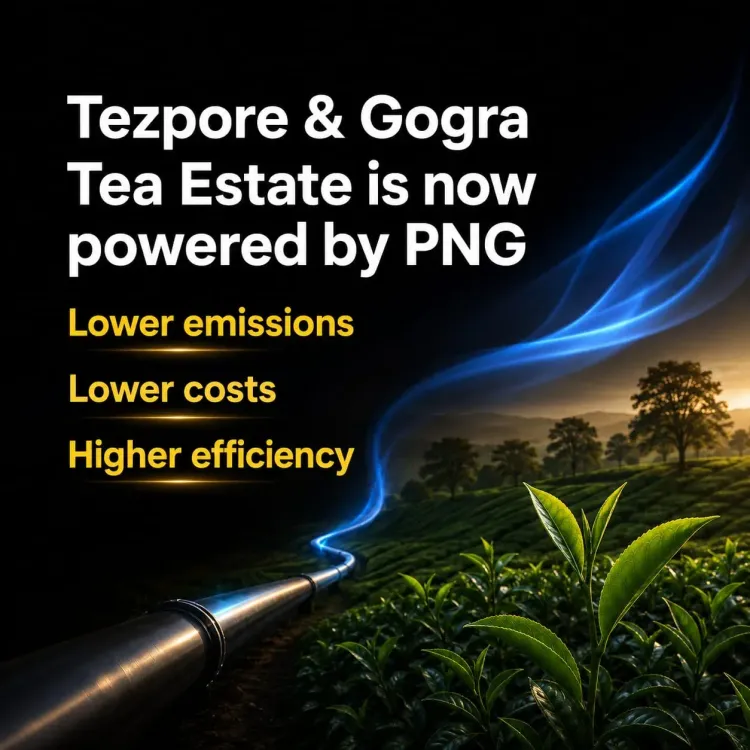
Tezpore and Gogra Tea Estate in Sonitpur, Assam, has received the district's first tea-estate PNG connection under CM Himanta Biswa Sarma, with the estate set to use nearly 2,000 SCM of natural gas daily, replacing around 1,678 kg of LPG consumption per day.
Key Takeaways
Tezpore and Gogra Tea Estate in Sonitpur is now the first tea estate in the district to receive a piped natural gas (PNG) connection.
It is also the second industrial PNG connection in Sonitpur, signalling gradual expansion of the gas distribution network.
The estate is expected to consume nearly 2,000 SCM of natural gas daily , replacing approximately 1,678 kg of LPG per day.
The development is part of Assam's broader push to redirect its natural gas reserves toward in-state industrial use, reducing dependence on LPG and coal.
The move aligns with the national Urja Ganga pipeline project and India's goal of increasing natural gas's share in the primary energy mix.
Successful implementation at this estate could accelerate PNG rollout to other tea estates across Sonitpur, Dibrugarh , and Jorhat districts.
The Chief Minister's Office of Assam announced on Saturday, 27 June 2026 that Tezpore and Gogra Tea Estate in Sonitpur district has been connected to piped natural gas (PNG), marking the first tea-estate PNG connection and the second industrial PNG connection in the district, under the leadership of Chief Minister Dr. Himanta Biswa Sarma.
Context
The CMO's post noted that the estate will use 'nearly 2,000 SCM of natural gas daily' and is expected to 'reduce LPG consumption by around 1,678 kg every day.' The announcement frames the development as part of Assam's broader clean energy transition, drawing a line from Duliajan's gas fields in eastern Assam to the tea belt of Sonitpur in the north.
Tea processing is one of the most energy-intensive industries in the Brahmaputra valley, historically dependent on LPG and coal for withering, drying, and other stages of production. Shifting to PNG directly reduces both fuel costs and carbon emissions at the estate level.
Policy Backdrop
The connection fits within a longer national policy arc. The Urja Ganga gas pipeline project, launched in 2016, was designed to extend the national gas grid into eastern India, including Assam. The Petroleum and Natural Gas Regulatory Board has been authorising City Gas Distribution networks across Assam districts in phased tranches since 2010.
Assam holds substantial natural gas reserves, historically exported as feedstock to refineries and fertiliser plants outside the state. The state government has been redirecting a portion of that output toward in-state industrial substitution — a strategy that simultaneously cuts import costs for businesses and advances India's national goal of raising natural gas's share in the primary energy mix.
Stakeholders and Impact
Tea estates across Sonitpur and neighbouring districts are the most immediate stakeholders. For Tezpore and Gogra Tea Estate, the switch to PNG is expected to lower operating costs and reduce dependence on LPG cylinders, which are subject to price volatility and supply-chain disruptions. Workers at the estate, a significant local employer, stand to benefit indirectly from a more stable and cost-efficient production process.
Industrial consumers across Assam's tea belt are also watching closely. A successful pilot at Tezpore and Gogra could accelerate demand for PNG connections at other estates in Sonitpur, Dibrugarh, and Jorhat — districts that together account for a large share of Assam's tea output.
What's Next
The immediate question is how quickly the state and gas distribution companies can replicate this model across other tea estates. Any state budget allocations or subsidy schemes supporting industrial gas conversion would determine the pace of that rollout.
If Assam's tea sector transitions meaningfully from LPG and coal to PNG, it could position the state as a model for industrial clean-energy substitution in northeastern India — with implications for emissions accounting, export branding, and energy security across the region.
Point of View
Rather than exporting it as raw feedstock. For CM Himanta Biswa Sarma, each such milestone reinforces a narrative of governance-driven modernisation in a state that has long been resource-rich but infrastructure-poor. The tea sector angle is politically astute: the industry employs hundreds of thousands across the Brahmaputra valley, and cost savings at the estate level can translate into tangible worker-welfare arguments. The real test will be whether the state can scale this from a single estate to a district-wide or region-wide programme before the next electoral cycle.
NationPress
27 Jun 2026
Frequently Asked Questions
What is the PNG connection at Tezpore and Gogra Tea Estate in Assam?
Tezpore and Gogra Tea Estate in Sonitpur district, Assam, has been connected to piped natural gas (PNG), making it the first tea estate in Sonitpur to receive such a connection and the second industrial PNG link in the district.
How much natural gas will the Assam tea estate use daily?
According to the Chief Minister's Office of Assam, the estate is expected to use nearly 2,000 SCM (standard cubic metres) of natural gas every day.
How much LPG will the PNG connection save at the Assam tea estate?
The CMO stated that the PNG connection is expected to reduce LPG consumption by around 1,678 kg per day at Tezpore and Gogra Tea Estate.
What is the Urja Ganga project and how does it relate to Assam?
The Urja Ganga gas pipeline project, launched in 2016, was designed to extend India's national gas grid into eastern India including Assam, forming the infrastructure backbone for city gas distribution networks now supplying industrial consumers like tea estates.
Will other tea estates in Assam get PNG connections?
The Sonitpur connection is being watched as a pilot. Expansion to other tea estates in Sonitpur, Dibrugarh, and Jorhat districts is possible, though it will depend on gas distribution infrastructure rollout and any state subsidy or budget support for industrial gas conversion.