CM Pema Khandu backs Sahiwal cattle scheme for Longding village

Synopsis
Arunachal Pradesh CM Pema Khandu has endorsed the 'SAHIWAL for SENUA' initiative — a joint scheme by Longding's Animal Husbandry Department and the NDDB to distribute Sahiwal cattle in Senua village — calling it a potential blueprint for dairy-led rural transformation across the state.
Key Takeaways
CM Pema Khandu publicly praised the 'SAHIWAL for SENUA' scheme on 27 May 2026 , calling it 'commendable and visionary.' The initiative is a collaboration between the Department of Animal Husbandry & Veterinary, Longding and the National Dairy Development Board (NDDB) .
Senua village in Longding district was selected for its established tradition of cattle rearing and milk production.
The scheme aims to build a 'long-term ecosystem of self-reliance, cooperative growth, nutritional security, and economic empowerment' for rural families.
The NDDB has supported dairy cooperative models across India since Operation Flood in 1970 , but Northeastern tribal regions have historically been on the periphery of such programmes.
CM Khandu suggested the model could be replicated across other districts in Arunachal Pradesh.
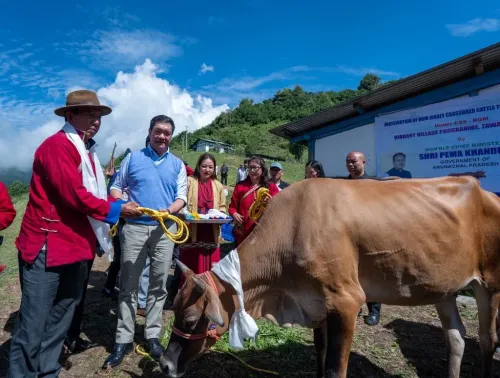
Arunachal Pradesh Chief Minister Pema Khandu on Wednesday, 27 May 2026, praised a joint dairy initiative between the Department of Animal Husbandry & Veterinary, Longding, and the National Dairy Development Board (NDDB), calling it a model for dairy-led rural transformation across the state.
Context
The initiative, titled 'SAHIWAL for SENUA', involves the distribution of Sahiwal cattle — a high-yielding indigenous breed — to rural families in Senua village, located in Longding district of Arunachal Pradesh. Longding is a remote district bordering Myanmar, where animal husbandry has long supported tribal livelihoods alongside subsistence agriculture.
CM Khandu described the scheme as going beyond simple cattle distribution, stating it is 'about creating a long-term ecosystem of self-reliance, cooperative growth, nutritional security, and economic empowerment for rural families.' He specifically noted that Senua village was chosen for its established tradition of cattle rearing and milk production, calling the selection 'a thoughtful and culturally rooted development approach.'
Policy Backdrop
The NDDB, founded in 1965, spearheaded India's White Revolution through Operation Flood, launched in 1970, which built village dairy cooperatives and a national milk grid, eventually making India the world's largest milk producer. Since the 1980s, the NDDB has sustained state-level partnerships for breed improvement and cooperative dairy models across India.
Northeastern states have historically been outside the core geography of Operation Flood, but ongoing centre-state programmes have progressively extended NDDB-supported dairy activity into tribal and remote regions. The Sahiwal breed, known for heat tolerance and milk yield, is increasingly favoured in such programmes for its suitability to local conditions.
Stakeholders and Impact
The direct beneficiaries are rural farming families in Senua village and the broader livestock-rearing community of Longding district. The scheme is designed to integrate improved cattle genetics with existing traditional rearing practices, aiming to raise milk productivity without displacing local knowledge.
CM Khandu framed the initiative within a wider goal of nutritional security and economic empowerment, suggesting the cooperative model could reduce dependence on subsistence farming and create a more organised dairy economy in one of Arunachal Pradesh's more remote frontier districts.
What's Next
The Chief Minister indicated that 'SAHIWAL for SENUA' has the potential to serve as a replicable model for other districts in Arunachal Pradesh. Attention will now turn to whether the state government allocates dedicated animal husbandry infrastructure funding in upcoming budget cycles and whether the NDDB partnership is extended to additional villages. If outcomes in Senua demonstrate measurable gains in household income and milk output, the scheme could anchor a broader dairy-led rural development strategy for the state's tribal frontier regions.
Point of View
Using the NDDB's cooperative framework as a trusted institutional vehicle. By publicly framing the scheme as a potential state-wide model, Khandu is also positioning animal husbandry as a pillar of the BJP-led government's rural economy agenda in the Northeast. The emphasis on cultural rootedness — selecting a village with existing cattle-rearing traditions — reflects a shift toward context-sensitive development rather than top-down delivery. Whether the scheme translates into sustained income gains will determine if it becomes a genuine policy template or remains a symbolic gesture.
NationPress
10 Oct 2026
Frequently Asked Questions
What is the SAHIWAL for SENUA scheme in Arunachal Pradesh?
'SAHIWAL for SENUA' is a joint initiative by the Department of Animal Husbandry & Veterinary, Longding, and the National Dairy Development Board (NDDB) to distribute Sahiwal cattle to rural families in Senua village, Longding district, with the goal of building a dairy-based self-reliance ecosystem.
Why was Senua village chosen for the Sahiwal cattle distribution?
Senua village was selected because of its established traditional practices of cattle rearing and milk production, making it a culturally and practically suitable site for a dairy development programme.
What is the National Dairy Development Board and its role in this scheme?
The NDDB is a national body founded in 1965 that led India's White Revolution through Operation Flood. In this scheme, it is partnering with Longding's Animal Husbandry Department to bring improved Sahiwal cattle breeds and cooperative dairy models to a remote tribal district.
What did CM Pema Khandu say about the Sahiwal cattle scheme?
CM Pema Khandu called the initiative 'commendable and visionary' and said it has the potential to become a model for dairy-led rural transformation in Arunachal Pradesh, emphasising its goal of creating self-reliance and economic empowerment.
Can the SAHIWAL for SENUA model be expanded to other parts of Arunachal Pradesh?
CM Khandu has indicated the scheme could serve as a replicable model for other districts. Expansion would depend on outcomes in Senua village and future state budget allocations for animal husbandry infrastructure.