CM Pema Khandu Greets IBC on 14th Foundation Day
Synopsis
Arunachal Pradesh Chief Minister Pema Khandu greeted the International Buddhist Confederation on its 14th Foundation Day, calling IBC a global bridge for Buddhist traditions and invoking Bhagwan Buddha's teachings in the pursuit of world peace and harmony.
Key Takeaways
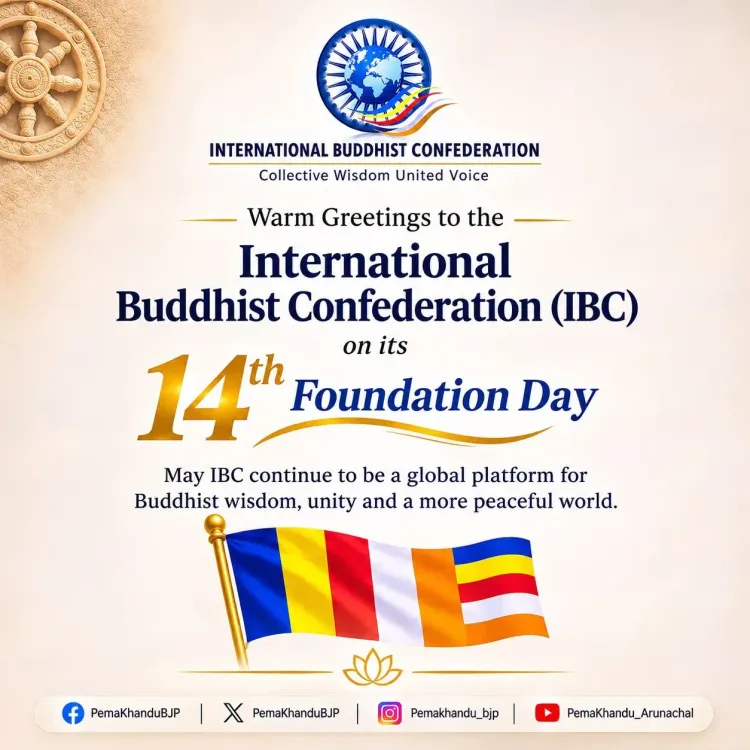
Arunachal Pradesh Chief Minister Pema Khandu extended warm greetings to the International Buddhist Confederation (IBC) on its 14th Foundation Day on 2 November 2026 .
Khandu praised IBC as 'a bridge connecting Buddhist traditions, cultures and communities across the world.' He invoked the teachings of Bhagwan Buddha and called for IBC's collective wisdom to grow stronger in pursuit of global peace.
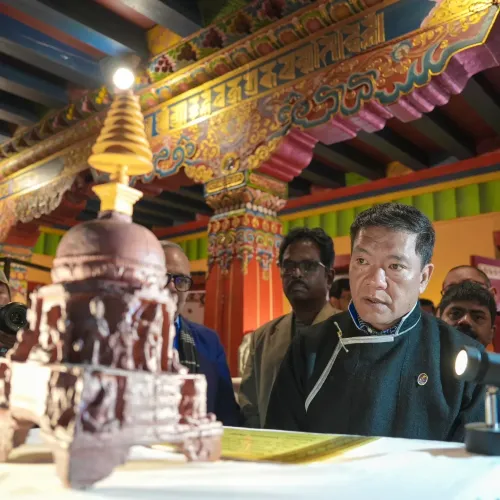
Arunachal Pradesh hosts historic monasteries and Vajrayana Buddhist communities, giving Khandu's message cultural depth beyond ceremony.
India regularly engages global Buddhist bodies as part of a broader strategy of Buddhist-heritage-based cultural diplomacy.
Fourteen years of stitching the world's Buddhist traditions into a single, speaking voice — and Arunachal Pradesh Chief Minister Pema Khandu marked the occasion with warmth on Monday, 2 November 2026. Khandu extended greetings to the International Buddhist Confederation (IBC) on its 14th Foundation Day, saluting the body's role as a bridge across Buddhist cultures, communities, and continents.
In his message, Khandu wrote: 'For 14 remarkable years, IBC has served as a bridge connecting Buddhist traditions, cultures and communities across the world, nurturing the universal ideals of wisdom, compassion and peaceful coexistence.' He invoked the teachings of Bhagwan Buddha and called for IBC's 'collective wisdom and united voice' to grow ever stronger in the pursuit of global peace and harmony.
Why Khandu's Voice Carries Particular Weight Here
Arunachal Pradesh is not a bystander in the Buddhist world — it is a living part of it. The state is home to historic monasteries, active gompa networks, and communities whose spiritual life is woven directly into the Himalayan Buddhist tradition. For its Chief Minister to greet a global Buddhist body is less a formality and more a natural extension of the state's cultural identity.
Khandu himself belongs to a region where Buddhism is a daily reality, not a diplomatic abstraction. That grounding gives his message a resonance that goes beyond the ceremonial.
IBC's Place in India's Cultural Diplomacy
The International Buddhist Confederation was established to unite the diverse strands of global Buddhism under a shared platform, promoting values of peace and compassionate coexistence. India, as the land of the Buddha's enlightenment, has long positioned its Buddhist heritage as a pillar of soft power and cultural diplomacy — and IBC sits at the centre of that strategy.
Indian leaders across levels of government have consistently recognised IBC milestones, signalling that engagement with the global Buddhist community is a sustained, cross-party commitment rather than a one-off gesture. The 14th Foundation Day offers another data point in that longer arc.
With IBC's footprint spanning traditions from Theravada to Mahayana to Vajrayana — the last of which is deeply rooted in Arunachal Pradesh — the Confederation's anniversary is a moment that connects a Himalayan state directly to a worldwide conversation about what Buddhism means in the twenty-first century.
Fourteen years in, the Confederation's founding ambition — one table for Buddhism's many voices — appears more relevant than ever.
Point of View
Making his engagement substantive rather than purely symbolic. As India deepens its Buddhist-heritage diplomacy in the Indo-Pacific context, the relationship between northeastern state governments and bodies like IBC is likely to become more, not less, strategic. The 14th Foundation Day message is a small but consistent stitch in that larger fabric.
NationPress
2 Nov 2026
Frequently Asked Questions
What is the International Buddhist Confederation (IBC)?
The International Buddhist Confederation is a global body established to unite diverse Buddhist traditions and promote shared values of peace, wisdom, and compassionate coexistence across the world.
Why did Pema Khandu greet the IBC on its foundation day?
As Chief Minister of Arunachal Pradesh — a state with deep Vajrayana Buddhist roots and historic monasteries — Khandu greeted IBC on its 14th Foundation Day to honour the body's role in connecting Buddhist communities worldwide.
What is the significance of IBC's 14th Foundation Day?
The 14th Foundation Day marks 14 years of IBC's efforts to serve as a bridge for Buddhist traditions, cultures, and communities globally, reinforcing ideals of wisdom, compassion, and peaceful coexistence.
How does Arunachal Pradesh connect to global Buddhism?
Arunachal Pradesh is home to historic monasteries and active Vajrayana Buddhist communities, placing it at the heart of the Himalayan Buddhist tradition and linking it to wider Asian and global Buddhist networks.
What role does Buddhism play in India's foreign and cultural policy?
India consistently leverages its status as the land of the Buddha's enlightenment for cultural diplomacy, with leaders regularly engaging international Buddhist bodies like IBC to project soft power and promote peace.