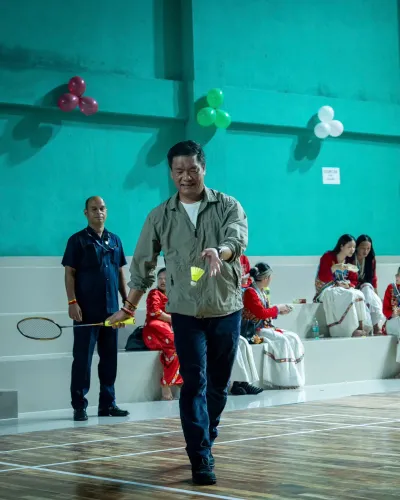
CM Pema Khandu hails Mashelo Village's community-built sports complex

Synopsis
Arunachal Pradesh CM Pema Khandu highlighted Mashelo Village in Roing, where GPC Chairperson Azad Miku led young panchayat leaders to build a community-funded sports complex with football turf, volleyball ground, children's park, and CCTV — citing it as proof of PM Modi's call for service-driven youth politics.
Key Takeaways
Mashelo Village in Roing, Lower Dibang Valley , Arunachal Pradesh built an integrated sports complex through community crowdfunding, without relying on government grants.
The complex includes a football turf , volleyball ground , children's park , and CCTV surveillance .
GPC Chairperson Azad Miku led the young Gram Panchayat team behind the initiative.
CM Pema Khandu framed the project as a direct embodiment of PM Narendra Modi's call for youth to enter politics for public service, not power.
The project fits a broader pattern of panchayat-level self-help infrastructure drives in northeastern states under BJP governance since 2016.
The 73rd Constitutional Amendment of 1992 underpins the Panchayati Raj framework that empowers such local bodies to undertake community development.
Arunachal Pradesh Chief Minister Pema Khandu on Saturday, 11 July 2026, spotlighted Mashelo Village in Roing as a model of grassroots governance, praising local Gram Panchayat leaders who used community crowdfunding to build an integrated sports and civic complex without waiting for government grants.
Context
The post centres on Mashelo Village, located in Roing, the headquarters of Lower Dibang Valley district in Arunachal Pradesh. Gram Panchayat Chairperson Shri Azad Miku led a group of young elected representatives who pooled community resources to construct an integrated sports complex featuring a football turf, a volleyball ground, a children's park, and CCTV surveillance infrastructure. Chief Minister Khandu described the initiative as turning 'vision into action.'
Khandu directly linked the effort to the philosophy articulated by Prime Minister Narendra Modi, who has repeatedly urged India's youth to enter politics 'not for power, but for public service' — a line Khandu quoted verbatim in his post. The framing positions the Mashelo project as a living example of that call to action.
Policy Backdrop
India's village-level self-governance architecture traces its constitutional roots to the 73rd Constitutional Amendment of 1992, which established the Panchayati Raj system and mandated decentralised rural governance. Gram Panchayats were empowered to plan and execute local development, including civic amenities and community infrastructure.
Since 2014, Prime Minister Modi has made youth political participation a recurring theme, framing elected local office as a vehicle for nation-building rather than personal gain. Chief Minister Khandu, who has led Arunachal Pradesh since 2016, has consistently amplified this message, frequently highlighting panchayat-level achievements in the state's tribal-majority districts.
The broader pattern across northeastern states governed by the BJP since 2016 includes a documented emphasis on self-help infrastructure projects in sports and civic amenities, often cited to support arguments for decentralised decision-making and local youth leadership.
Stakeholders and Impact
The most immediate beneficiaries are the residents of Mashelo Village and surrounding communities in Lower Dibang Valley, who now have access to organised sporting facilities and a safer public space equipped with CCTV. Young people in the village gain both recreational infrastructure and a civic model to emulate.
For the broader Gram Panchayat ecosystem in Arunachal Pradesh, the Mashelo example carries symbolic weight: it demonstrates that elected local bodies can mobilise community capital independently, potentially reducing dependence on delayed state or central disbursements. GPC Chairperson Azad Miku and his team's approach could serve as a replicable template for other panchayats in the state's remote districts.
At the political level, the post reinforces the BJP's narrative of youth-led, service-oriented governance ahead of future electoral cycles in the northeast.
What's Next
Attention will turn to whether the Arunachal Pradesh government formally recognises or replicates the Mashelo model through state-level awards, policy circulars, or integration with central rural development and sports schemes. Future Gram Sabha resolutions in Lower Dibang Valley may reference the project as a benchmark. Chief Minister Khandu's public endorsement also raises the possibility of the initiative being cited in upcoming assembly sessions as evidence of grassroots governance success under the Panchayati Raj framework.
Point of View
Reinforcing the BJP's brand of service-oriented governance in a frontier state. By naming a specific village, a specific leader, and a specific set of assets, Khandu avoids the vagueness that often undercuts such messaging, lending it credibility. The Mashelo example also fits a deliberate northeastern BJP strategy of showcasing grassroots infrastructure wins to counter perceptions that development in the region is top-down and Delhi-driven. If the model is institutionalised, it could become a template cited in Panchayati Raj policy discussions at the national level.
NationPress
10 Oct 2026
Frequently Asked Questions
What did Mashelo Village in Roing build through community crowdfunding?
Mashelo Village in Roing, Lower Dibang Valley, built an integrated sports complex comprising a football turf, volleyball ground, children's park, and CCTV surveillance, funded entirely through community crowdfunding led by young Gram Panchayat leaders.
Why did CM Pema Khandu highlight Mashelo Village?
CM Pema Khandu highlighted Mashelo Village as a real-world example of PM Narendra Modi's call for India's youth to enter politics for public service rather than for power, pointing to the self-funded sports complex as proof of that vision in action.
What is the Panchayati Raj system and how does it relate to this project?
The Panchayati Raj system, established by the 73rd Constitutional Amendment of 1992, empowers village-level Gram Panchayats to govern and develop their communities. The Mashelo project is an example of a Gram Panchayat exercising that mandate through community-led infrastructure development.
Where is Roing located?
Roing is the headquarters of Lower Dibang Valley district in Arunachal Pradesh, home to diverse tribal communities and the site of the Mashelo Village panchayat initiative highlighted by CM Pema Khandu.