CM Pema Khandu Marks Modi's Longest-Serving PM Milestone
Synopsis
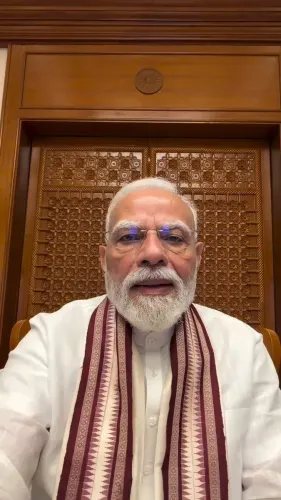
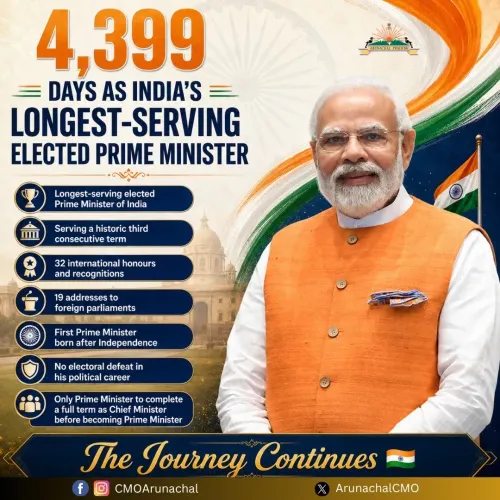
Arunachal Pradesh Chief Minister Pema Khandu on June 10, 2026 marked Prime Minister Narendra Modi's distinction as India's longest-serving democratically elected Prime Minister, reflecting on twelve years of changes he described as fundamentally altering the country's trajectory.
Key Takeaways
CM Pema Khandu posted on X on June 10, 2026 marking PM Modi 's milestone as India's longest-serving democratically elected Prime Minister.
Narendra Modi has served continuously since May 2014 , winning re-election in 2019 and again in 2024 .
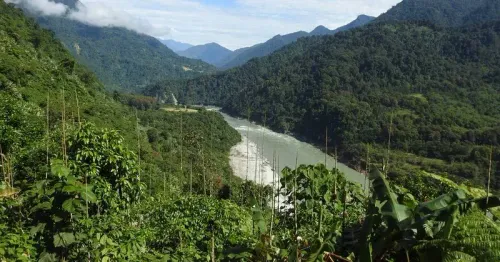
Khandu framed the milestone in terms of twelve years of changes that have 'fundamentally altered the country's trajectory.' Arunachal Pradesh has seen expanded border infrastructure and connectivity under central government programmes during this period.
State-level commemorative events and possible new centrally sponsored scheme announcements are expected in the coming days.
Arunachal Pradesh Chief Minister Pema Khandu on Wednesday, June 10, 2026, took to X to mark Prime Minister Narendra Modi's distinction as India's longest-serving democratically elected Prime Minister, calling for reflection on twelve years of changes that have 'fundamentally altered the country's trajectory.'
Context
Narendra Modi first assumed office as Prime Minister in May 2014 following the Bharatiya Janata Party's majority victory in the general election. He was subsequently re-elected for a second term in May 2019 and a third consecutive term in June 2024, extending an unbroken tenure at the helm of the central government. This continuous run places him in rare company among India's post-independence leaders.
Chief Minister Khandu, a senior BJP leader who has consistently aligned Arunachal Pradesh's state agenda with central government priorities, used the occasion to invite public reflection rather than enumerate specific achievements — framing the milestone in terms of structural, long-term national change.
Policy Backdrop
The twelve-year period under Modi's leadership has seen sustained investment in physical infrastructure, digital public goods, and security infrastructure along India's borders — areas of particular relevance to frontier states such as Arunachal Pradesh. The northeastern region has been integrated more closely with the national mainstream through dedicated central funding windows and improved road and air connectivity.
Extended single-leader tenure at the centre has historically enabled continuity in large-scale national programmes. Analysts draw parallels with earlier long-serving prime ministers whose extended mandates shaped institutional frameworks and foreign-policy direction over successive decades.
Stakeholders and Impact
State chief ministers across BJP-governed states have been among the most visible voices marking the milestone, reflecting the party's unified messaging around the anniversary. For Arunachal Pradesh specifically, the period has coincided with accelerated central investment in border infrastructure and connectivity, making the milestone politically and developmentally significant for the state's leadership.
BJP legislators at both the national and state levels are expected to amplify the occasion through public events and social media, reinforcing the party's narrative of governance continuity as an electoral asset ahead of future cycles.
What's Next
State-level commemorative events and legislative resolutions marking the same milestone are anticipated across BJP-governed states in the coming days. Policy watchers will also track whether new centrally sponsored schemes are announced around the 2026-27 budget cycle, which would lend further substance to the anniversary narrative. CM Khandu's post signals that the Arunachal Pradesh government is likely to align any such announcements with the broader theme of transformative governance under continued central leadership.
Point of View
Khandu positions himself as a thoughtful regional voice within the broader BJP ecosystem. The post also underscores how northeastern states, long peripheral in national political discourse, have become active participants in the ruling party's messaging architecture. Ahead of future electoral cycles, such gestures reinforce the perception of ideological and administrative cohesion between Itanagar and New Delhi.
NationPress
29 Jul 2026
Frequently Asked Questions
Why is Narendra Modi called India's longest-serving democratically elected Prime Minister?
Narendra Modi has served continuously as Prime Minister since May 2014 across three consecutive election victories — in 2014, 2019, and 2024 — making his unbroken tenure the longest for a democratically elected Prime Minister in India's post-independence history.
What did Pema Khandu say about Modi's milestone?
Arunachal Pradesh Chief Minister Pema Khandu said that as Modi becomes India's longest-serving democratically elected Prime Minister, 'it is worth reflecting on the changes that have fundamentally altered the country's trajectory over the past twelve years.'
What has changed in Arunachal Pradesh during Modi's tenure?
During Modi's tenure, Arunachal Pradesh has seen expanded road and air connectivity, increased central funding for border infrastructure, and closer integration of the northeastern region with national development programmes.
What events are expected following Modi's longest-serving PM milestone?
State-level commemorative events and legislative resolutions are expected across BJP-governed states, and policy watchers are tracking whether new centrally sponsored schemes will be announced around the 2026-27 budget cycle to coincide with the milestone.