CM Majhi Backs Exam Anti-Cheating Bill Passed by Lok Sabha

Synopsis
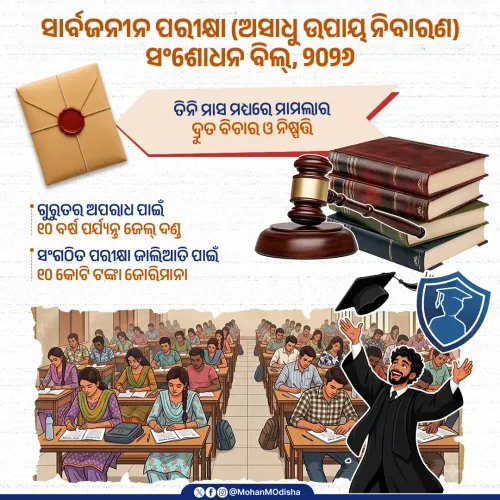
Odisha CM Mohan Charan Majhi backed the Lok Sabha's passage of the Public Examinations Amendment Bill, 2026, which mandates two-month investigations, three-month trials, up to 10 years imprisonment, and fines up to ₹10 crore for organised exam malpractice — a sharp escalation of India's 2024 anti-cheating law.
Key Takeaways
The Public Examinations Amendment Bill, 2026 was passed by the Lok Sabha on 29 July 2026 .
Investigations under the new law must conclude within two months ; trials within three months .
Convictions can carry imprisonment of up to 10 years .
Fines reach up to ₹5 crore for examination service providers and a minimum of ₹10 crore for organised crime networks.
The bill builds on the Public Examinations (Prevention of Unfair Means) Act, 2024 , which was India's first major central law targeting paper leaks.
The legislation must now pass the Rajya Sabha before it can be notified for implementation.
India's competitive examination system — the gateway for millions of young aspirants to government jobs and higher education — just got a formidable new shield. Odisha Chief Minister Mohan Charan Majhi on Wednesday, 29 July 2026, hailed the passage of the Public Examinations Amendment Bill, 2026 by the Lok Sabha, calling it a decisive step toward protecting merit and restoring integrity in public examinations.
What the Bill Says: Investigations in Two Months, Trials in Three
The amendment lays down a tight enforcement clock. Investigations must conclude within two months. Trials must wrap up within three months. Convictions can carry imprisonment of up to 10 years — and the financial bite is equally sharp: fines of up to ₹5 crore for examination service providers, and a minimum fine of ₹10 crore for those running organised malpractice networks.
CM Majhi quoted these provisions directly, framing them as an unambiguous signal: 'the Modi Government has zero tolerance for those who play with the future of our youth.' The time-bound structure is deliberate — it targets the slow-moving investigations that have historically allowed paper-leak accused to escape accountability.
From NEET to UPSC: The Scandal Trail That Built This Moment
This amendment does not emerge from a vacuum. The Public Examinations (Prevention of Unfair Means) Act, 2024 was Parliament's first major legislative response to a wave of paper leak scandals that rocked national-level examinations, shaking public confidence in systems that determine the careers of crores of young Indians. NEET-UG and UPSC irregularities had triggered street protests and political pressure for a structural fix — not just administrative reshuffles.
The 2026 amendment sharpens the 2024 law's teeth, adding specific timelines and dramatically escalating the financial penalties on institutional actors — the examination service providers and organised syndicates that make large-scale cheating possible in the first place.
Youth Empowerment as the Viksit Bharat Pillar
CM Majhi explicitly linked the reform to Prime Minister Narendra Modi's Viksit Bharat vision — the government's roadmap for India achieving developed-nation status by 2047, with youth empowerment as a core pillar. For a country where competitive examinations are often a young person's single most consequential opportunity, the integrity of those exams is not a bureaucratic concern — it is a social justice issue.
The bill now moves to the Rajya Sabha. Rules governing implementation timelines are expected to be notified by the Union Ministry of Personnel or the Ministry of Education following final passage.
For every aspirant who has spent years preparing for an exam only to watch a leaked paper erase their effort overnight, this bill is not just legislation — it is a statement about whose future the state is willing to protect.
Point of View
The law shifts accountability upstream from individual cheaters to the entities that enable mass malpractice. CM Majhi's endorsement also signals Odisha's alignment with the Centre's youth-governance narrative ahead of the Viksit Bharat 2047 messaging cycle. The real test, however, will be whether enforcement agencies and courts absorb the time-bound mandate or whether it becomes another provision honoured in the breach.
NationPress
29 Jul 2026
Frequently Asked Questions
What is the Public Examinations Amendment Bill 2026?
The Public Examinations Amendment Bill, 2026 is a central legislation passed by the Lok Sabha that amends India's 2024 anti-cheating law for public examinations. It mandates investigations within two months, trials within three months, imprisonment of up to 10 years, fines up to ₹5 crore for service providers, and a minimum fine of ₹10 crore for organised malpractice networks.
What penalty does the new exam law impose on paper leak organisers?
Individuals convicted under the law can face imprisonment of up to 10 years. Examination service providers can be fined up to ₹5 crore, while those running organised crime networks face a minimum fine of ₹10 crore.
Has the Public Examinations Amendment Bill 2026 become law yet?
As of 29 July 2026, the bill has been passed by the Lok Sabha. It still needs to be passed by the Rajya Sabha and receive Presidential assent before it becomes law.
What was the 2024 Public Examinations Act and why was it amended?
The Public Examinations (Prevention of Unfair Means) Act, 2024 was Parliament's first major central law targeting malpractice in public recruitment and competitive examinations, enacted in the wake of scandals involving NEET-UG and other national exams. The 2026 amendment strengthens it by adding strict investigation and trial timelines and significantly higher financial penalties.
What did Odisha CM Mohan Majhi say about the exam bill?
CM Mohan Charan Majhi praised the bill's passage, stating that its stringent provisions send a clear message of zero tolerance against those who compromise the future of India's youth, and linked the reform to PM Modi's Viksit Bharat vision.