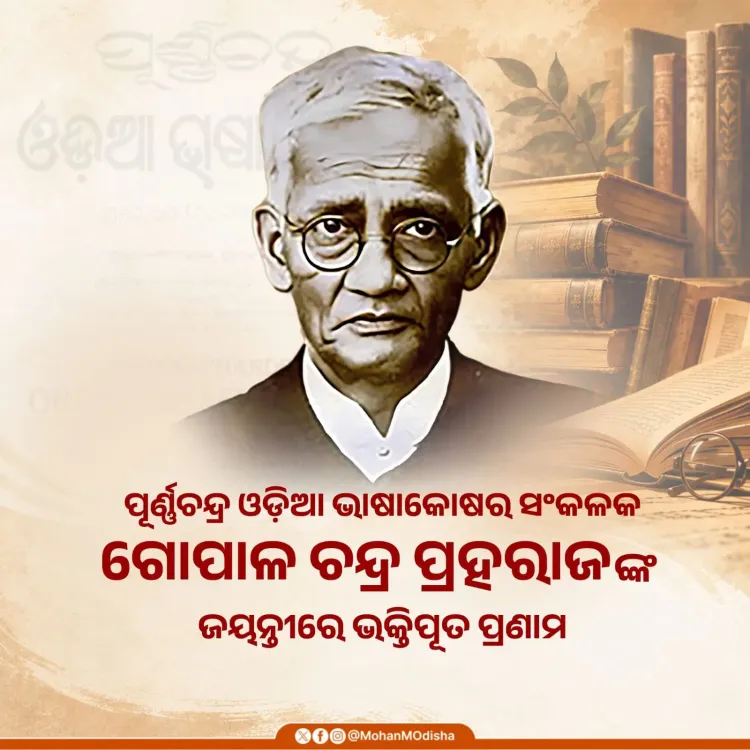
CM Majhi honours Odia lexicographer Gopal Chandra Praharaj
Synopsis
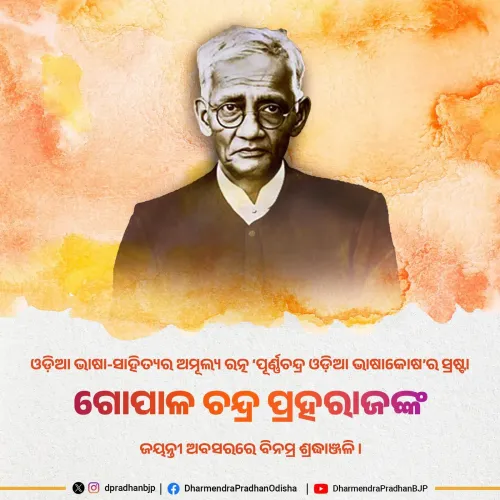
Odisha Chief Minister Mohan Charan Majhi marked the birth anniversary of Gopal Chandra Praharaj, calling the lexicographer's seven-volume Purnachandra Odia Bhashakosha an enduring beacon of the Odia language and a timeless inspiration for its promotion and preservation.
Key Takeaways
CM Mohan Charan Majhi paid tribute to Odia scholar Gopal Chandra Praharaj on his birth anniversary on 27 September 2026 .
Praharaj compiled the Purnachandra Odia Bhashakosha , a seven-volume Odia dictionary regarded as the language's foundational reference work.
CM Majhi described the Bhashakosha as 'an enduring beacon of the Odia language' and called Praharaj's work a timeless inspiration.
Odia was declared a Classical Language by the Government of India in 2014 , formalising support for its preservation and research.
Tributes to Odia literary figures by Odisha's chief ministers reflect a broader state commitment to mother-tongue education and cultural heritage.
A seven-volume dictionary compiled over decades in the early twentieth century still stands as the most authoritative reference in the Odia language — and on Sunday, 27 September 2026, Odisha Chief Minister Mohan Charan Majhi paid tribute to the man behind it, marking the birth anniversary of legendary scholar and lexicographer Gopal Chandra Praharaj.
Posting in Odia on X, CM Majhi offered his bhaktiputa pranama (devotional salutations) to Praharaj, describing his monumental Purnachandra Odia Bhashakosha as 'Odia bhashar eka amalina alokabarttika' — 'an enduring beacon of the Odia language'. He added that Praharaj's epoch-making contribution to the promotion, propagation, and preservation of the mother tongue 'will forever remain an inspiration and guiding light for us'.
The dictionary that defined a language
The Purnachandra Odia Bhashakosha is not simply a dictionary — it is the backbone of modern Odia scholarship. Compiled by Gopal Chandra Praharaj in the early twentieth century, the seven-volume work catalogued Odia vocabulary, etymology, and usage at a time when the language's literary and administrative identity was still being fought for. It remains the foundational reference for linguists, writers, and students of Odia to this day.
The scale of the undertaking is hard to overstate. Praharaj worked across thousands of pages and multiple volumes, drawing on classical texts, folk usage, and regional dialects — an individual effort that effectively gave the Odia language its definitive written form. Among Odia speakers, his name carries the same reverence as that of the great lexicographers of any major world language.
Classical status and the stakes of preservation
Praharaj's legacy sits at the heart of a larger national recognition. In 2014, the Government of India declared Odia a classical language — a designation that formalises central and state support for its preservation, research, and promotion. The Bhashakosha was among the foundational evidence cited for the antiquity and richness of the language's literary tradition.
For Odisha's political leadership, tributes to literary giants like Praharaj serve a dual purpose: honouring genuine intellectual heritage while reinforcing the state's commitment to mother-tongue education and cultural identity. CM Majhi's post follows a pattern of Odisha chief ministers marking such anniversaries publicly — a signal, particularly under a BJP government keen on cultural-linguistic identity, that the classical language framework is treated as living policy, not archived history.
As Odia-language digitisation and academic documentation continue — with scholars increasingly looking to the Bhashakosha as a base text — Praharaj's birth anniversary serves as an annual reminder of how much of modern Odia rests on one scholar's extraordinary lifetime of work. The beacon, as CM Majhi put it, has not dimmed.
Point of View
Majhi signals continuity in state support for Odia linguistic identity at a time when mother-tongue education and digital preservation are active policy fronts. These anniversaries also function as soft political messaging — connecting the ruling party to deep cultural roots in a state where regional pride and linguistic identity are potent electoral forces.
NationPress
27 Sept 2026
Frequently Asked Questions
Who was Gopal Chandra Praharaj?
Gopal Chandra Praharaj was a prominent Odia scholar and lexicographer who compiled the Purnachandra Odia Bhashakosha, a monumental seven-volume Odia dictionary in the early twentieth century that remains the definitive reference work for the language.
What is the Purnachandra Odia Bhashakosha?
The Purnachandra Odia Bhashakosha is a seven-volume Odia-language dictionary compiled by Gopal Chandra Praharaj, covering vocabulary, etymology, and usage drawn from classical texts, folk tradition, and regional dialects. It is considered the foundational reference for Odia linguistics and literature.
When was Odia declared a classical language?
The Government of India declared Odia a classical language in 2014, formally recognising its ancient literary tradition and providing a basis for state and central support for its preservation and promotion.
Why did CM Mohan Majhi tribute Gopal Chandra Praharaj?
CM Mohan Charan Majhi posted his tribute on the occasion of Gopal Chandra Praharaj's birth anniversary on 27 September 2026, honouring the scholar's epoch-making contribution to Odia language documentation and preservation.
What did CM Majhi say about the Purnachandra Odia Bhashakosha?
CM Majhi described the Purnachandra Odia Bhashakosha as 'an enduring beacon of the Odia language' and said Praharaj's contributions to the promotion, propagation, and preservation of the mother tongue would forever remain an inspiration and guiding light.