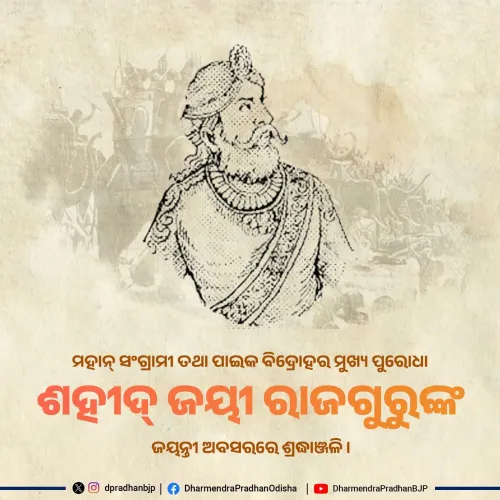
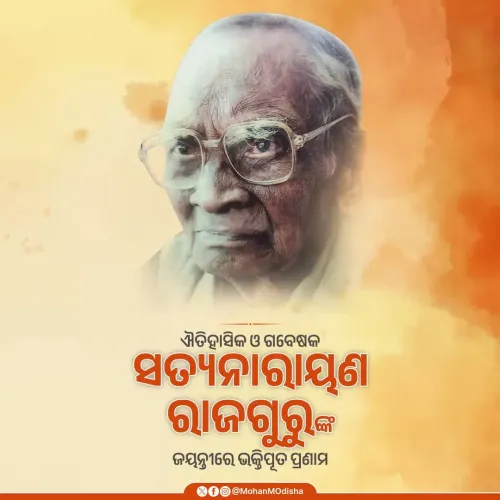
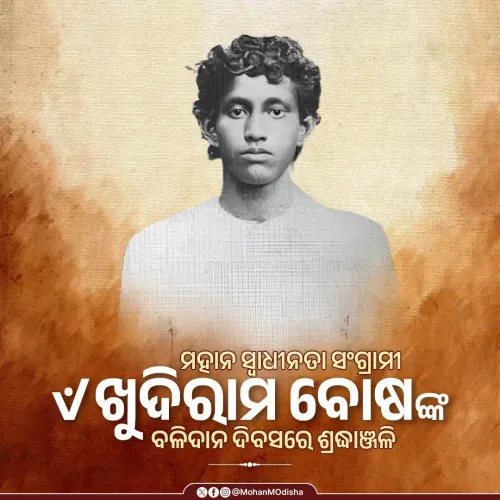
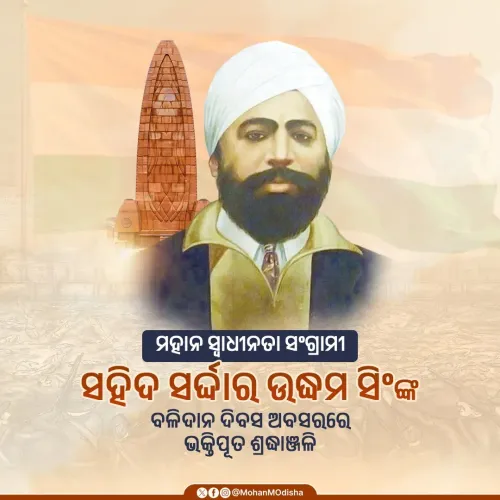
CM Majhi pays tribute to Odisha's first martyr Jayee Rajguru
Synopsis
Odisha Chief Minister Mohan Charan Majhi honoured Jayee Rajguru — the first Odia martyr of India's independence movement, executed by the British in 1806 — on his birth anniversary, calling his sacrifice a timeless inspiration for India's youth.
Key Takeaways
Jayee Rajguru is recognised as the first Odia martyr of India's independence struggle, executed by the British in 1806 .
His resistance is linked to the Paika Rebellion of 1803–1806 , formally acknowledged by the central government as an early war of independence.
Odisha CM Mohan Charan Majhi paid tribute on 29 October 2026 , Rajguru's birth anniversary, posting in Odia on X.
Majhi invoked Rajguru's ideals as a guiding light for the nation's youth in the context of nation-building and service.
State-level BJP leaders regularly commemorate pre-1857 regional martyrs to integrate local resistance histories into the national narrative.
More than two centuries after the British hanged him, Jayee Rajguru — the first Odia martyr of India's independence struggle — was remembered on Thursday, 29 October 2026, as Odisha Chief Minister Mohan Charan Majhi offered a heartfelt tribute on the freedom fighter's birth anniversary.
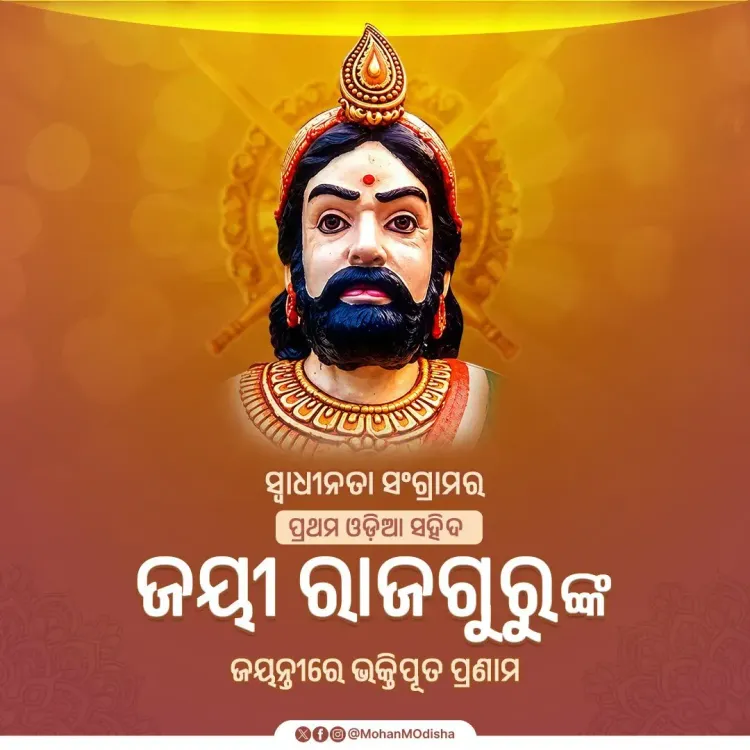
Posting in Odia on the occasion, CM Majhi wrote: 'ସ୍ୱାଧୀନତା ସଂଗ୍ରାମର ପ୍ରଥମ ଓଡ଼ିଆ ସହିଦ ଜୟୀ ରାଜଗୁରୁଙ୍କ ଜୟନ୍ତୀରେ ଭକ୍ତିପୂତ ପ୍ରଣାମ' — 'Reverent salutations on the birth anniversary of Jayee Rajguru, the first Odia martyr of the freedom struggle.' He added that Rajguru's supreme sacrifice and ideals 'will forever inspire the youth of the nation towards nation-building and service to the country.'
Who was Jayee Rajguru — and why 1806 matters
Jayee Rajguru served as a commander and minister under the Khurda kingdom in present-day Odisha, and led one of the earliest organised armed resistances against British colonial expansion in the region. He was executed by the British in 1806, more than fifty years before the 1857 uprising that is more commonly cited as India's 'First War of Independence.' That chronology is precisely why his name carries weight: Rajguru's defiance predates the national mainstream narrative of revolt.
His resistance is historically linked to the Paika Rebellion of 1803–1806, an armed uprising by the Paika warrior community of Odisha against the East India Company. The rebellion is now formally recognised by the central government as an early war of independence — a recognition that gathered official momentum from 2017 onwards, when commemorative events were held across the state.
Majhi's tribute and the BJP's regional-martyr strategy
The tribute is part of a visible pattern among state-level BJP leaders of regularly marking the birth and death anniversaries of pre-1857 regional freedom fighters. The aim is deliberate: to weave local histories of resistance into the larger national fabric, highlighting that the independence struggle was not confined to one geography or one era.
For Odisha — which has its own rich and often under-documented history of anti-colonial resistance — invoking Rajguru carries both civic and political resonance. The post, directed explicitly at the 'youth of the nation,' frames the martyrdom not as a chapter of the past but as a live moral instruction for the present generation.
A martyr executed in 1806 is still shaping how a state's chief minister speaks to its young people in 2026. That is the measure of how deeply Jayee Rajguru is woven into Odisha's identity — and why each passing anniversary is less a ceremony than a recalibration of collective memory.
Point of View
Pushing back the conventional starting point of India's freedom movement to earlier, regionally specific acts of resistance. By invoking Rajguru on his birth anniversary, CM Majhi reinforces Odisha's place in a pan-India historical arc while speaking directly to youth — a demographic the party has consistently targeted through heritage-and-identity messaging. The central recognition of the Paika Rebellion from 2017 onward gave this regional narrative national legitimacy, and state leaders have since amplified it steadily. Each such tribute is both a moment of genuine commemoration and a brick in a longer ideological architecture.
NationPress
29 Oct 2026
Frequently Asked Questions
Who was Jayee Rajguru?
Jayee Rajguru was a commander and minister under the Khurda kingdom in Odisha who led early armed resistance against British colonial rule and was executed in 1806, making him the first recognised Odia martyr of the independence struggle.
What is the Paika Rebellion?
The Paika Rebellion of 1803–1806 was an armed uprising by the Paika warrior community of Odisha against the East India Company. The central government has formally recognised it as one of India's earliest wars of independence, with commemorative events held since 2017.
Why is Jayee Rajguru significant before 1857?
Rajguru's execution in 1806 predates the 1857 uprising by over five decades, establishing Odisha's contribution to anti-colonial resistance well before the event conventionally called India's First War of Independence.
What did CM Mohan Majhi say about Jayee Rajguru?
CM Majhi offered 'reverent salutations' on Rajguru's birth anniversary and said his supreme sacrifice and ideals will forever inspire the nation's youth towards nation-building and service to the country.
When is Jayee Rajguru Jayanti observed?
Jayee Rajguru Jayanti is observed on 29 October, as marked by the 2026 tribute from Odisha Chief Minister Mohan Charan Majhi.