CM Majhi pays tribute to Odissi legend Sanjukta Panigrahi
Synopsis
Odisha Chief Minister Mohan Charan Majhi on 24 June 2026 paid homage to legendary Odissi dancer Sanjukta Panigrahi on her death anniversary, calling her contribution to the global recognition of Odissi 'forever memorable.' The tribute reflects Odisha's longstanding state tradition of honouring classical arts icons.
Key Takeaways
CM Mohan Charan Majhi posted a tribute to Sanjukta Panigrahi on her death anniversary on 24 June 2026 .
Sanjukta Panigrahi was a pioneering Odissi dancer who performed globally from the 1960s and received the Padma Shri in 1975 .
The Sangeet Natak Akademi formally recognised Odissi as a classical dance form in 1956 .
Both BJD and BJP administrations in Odisha have maintained a tradition of state patronage and public commemoration for classical arts icons.
The annual Konark Dance Festival remains the flagship state platform for showcasing Odissi and related classical forms.
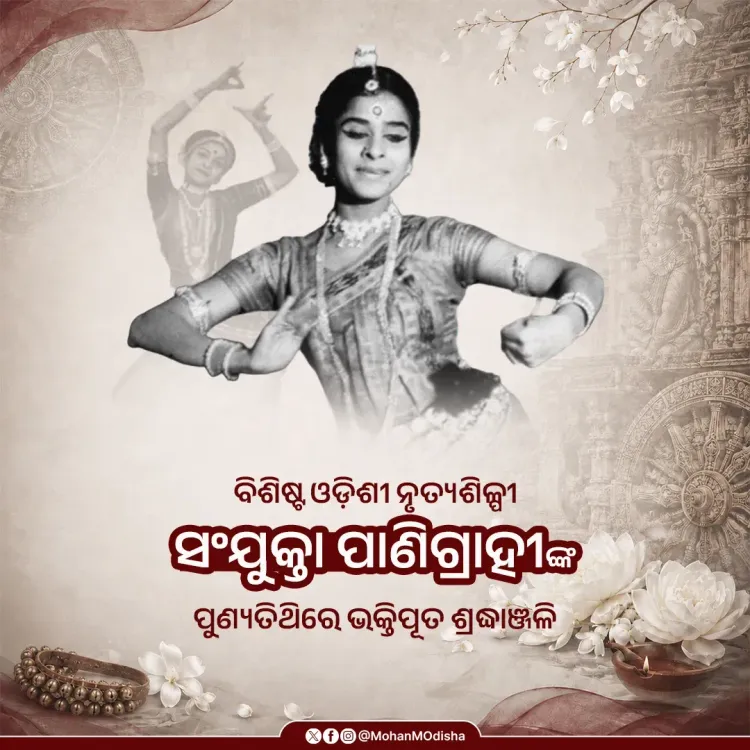
Odisha Chief Minister Mohan Charan Majhi on Wednesday, 24 June 2026 paid homage to legendary Odissi dancer Sanjukta Panigrahi on her death anniversary, honouring her lifelong contribution to elevating the classical dance form on the world stage.
Posting in Odia on X, CM Majhi wrote: 'ବିଶିଷ୍ଟ ଓଡ଼ିଶୀ ନୃତ୍ୟଶିଳ୍ପୀ ସଂଯୁକ୍ତା ପାଣିଗ୍ରାହୀଙ୍କ ପୁଣ୍ୟତିଥିରେ ଭକ୍ତିପୂତ ଶ୍ରଦ୍ଧାଞ୍ଜଳି' — 'Devout tributes on the death anniversary of distinguished Odissi dancer Sanjukta Panigrahi.' He added that her contribution to giving Odissi dance a unique identity on the world stage and raising its glory to new heights 'will remain forever memorable.'
Context
Sanjukta Panigrahi was one of the foremost figures in the revival and global propagation of Odissi, performing internationally from the 1960s onward. She was awarded the Padma Shri in 1975 in recognition of her role in bringing the dance form to audiences far beyond Odisha. Her collaboration with celebrated gurus helped codify the grammar of Odissi at a time when the form was still consolidating its classical identity.
The Sangeet Natak Akademi formally recognised Odissi as a classical dance form in 1956, following sustained revival efforts by gurus, scholars, and performers — a movement in which Panigrahi later became a defining presence.
Policy Backdrop
Successive Odisha governments — both BJD and BJP administrations — have maintained a tradition of state patronage for Odia performing arts, using public commemorations of cultural icons to reinforce the state's classical heritage. This patronage spans state academies, institutional support for Odissi training, and marquee events such as the annual Konark Dance Festival.
CM Majhi, who assumed office in June 2024, has continued this practice, issuing public tributes on the death anniversaries of major cultural figures as a signal of the government's commitment to preserving and promoting Odia identity.
Stakeholders and Impact
The tribute resonates with the broader community of Odissi dancers, gurus, students, and cultural institutions across Odisha and the Indian classical arts ecosystem. Panigrahi's legacy directly influences the syllabi of Odissi academies and the programming of state-sponsored cultural festivals.
For the state government, such commemorations also carry soft-power significance, linking Odisha's cultural diplomacy — through dance festivals and international cultural exchanges — to its heritage tourism and education agendas.
What's Next
Observers of Odisha's cultural policy will watch whether the tribute translates into concrete announcements — such as enhanced state budget allocations for Odissi training institutions or new scholarships for young classical dancers — in the months ahead. The Konark Dance Festival, scheduled later in the year, is expected to serve as a key platform for the state to reaffirm its investment in the classical performing arts.
As Odisha positions itself as a hub for cultural tourism, the government's public recognition of icons like Sanjukta Panigrahi underscores a broader effort to keep classical traditions visible and state-supported in a competitive cultural landscape.
Point of View
Publicly honouring icons of Odia classical heritage helps signal cultural continuity and state patronage beyond electoral politics. The tribute also keeps the spotlight on Odissi at a moment when state budget priorities and the upcoming Konark Dance Festival will test the government's actual commitment to institutional support for the art form. Whether the rhetoric of 'forever memorable' contributions translates into fresh policy action for Odissi academies and young dancers remains the more consequential question.
NationPress
24 Jun 2026
Frequently Asked Questions
Who was Sanjukta Panigrahi?
Sanjukta Panigrahi was a legendary Odissi classical dancer who performed globally from the 1960s and was awarded the Padma Shri in 1975 for her role in elevating and internationalising the Odissi dance form.
Why did CM Mohan Majhi pay tribute to Sanjukta Panigrahi?
CM Mohan Charan Majhi posted a tribute on 24 June 2026 to mark Sanjukta Panigrahi's death anniversary, honouring her contribution to giving Odissi dance a unique identity on the world stage.
When was Odissi recognised as a classical dance form?
The Sangeet Natak Akademi formally recognised Odissi as a classical dance form in 1956, following revival efforts by gurus, scholars, and performers.
What is the Konark Dance Festival?
The Konark Dance Festival is an annual state-sponsored cultural event in Odisha that serves as a flagship platform for showcasing Odissi and other classical Indian dance forms.
How does the Odisha government support Odissi dance?
Successive Odisha governments have supported Odissi through state academies, institutional funding for training, public commemorations of cultural icons, and marquee events like the Konark Dance Festival.