CM Majhi eyes Pahadpur as Odisha's first solar village
Synopsis
Odisha Chief Minister Mohan Charan Majhi announced on 21 June 2026 that Pahadpur will be developed as a 'solar village,' offering residents free electricity and income from surplus power generation, invoking the Konark Sun Temple as a cultural touchstone for the initiative.
Key Takeaways
CM Mohan Charan Majhi announced on 21 June 2026 that Pahadpur will be developed as a dedicated solar village.
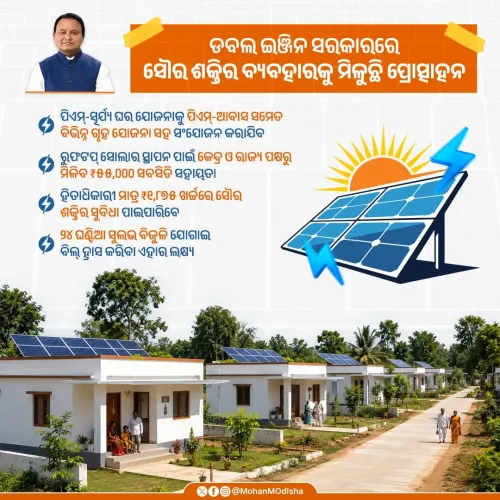
Residents are promised free electricity and the ability to earn additional income by selling surplus solar power.
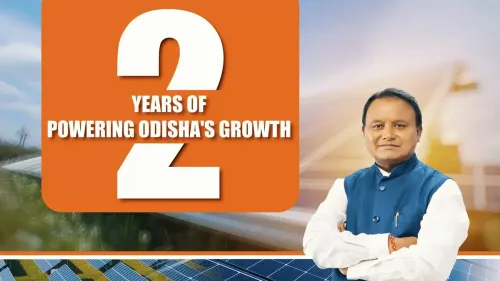
The announcement was made under the hashtag #2YearsofLokankaSarakar , marking two years of the BJP-led Odisha government.
The initiative draws a cultural parallel with the Konark Sun Temple , a UNESCO World Heritage Site.
The model aligns with the central government's PM-KUSUM scheme and India's target of 500 GW non-fossil fuel capacity by 2030 .
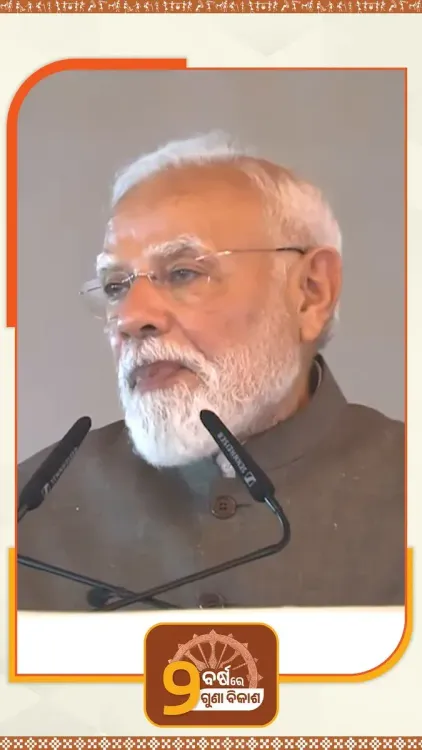
The post quoted Prime Minister Narendra Modi , signalling central-state coordination on the initiative.
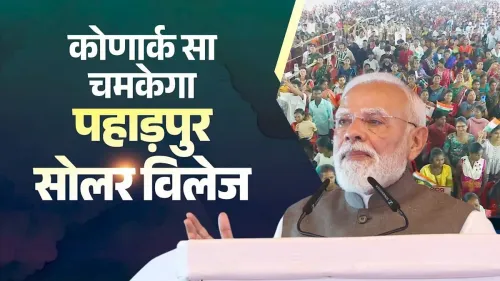
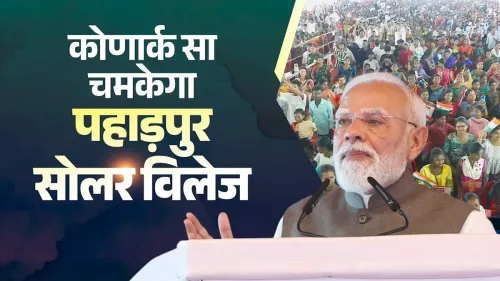
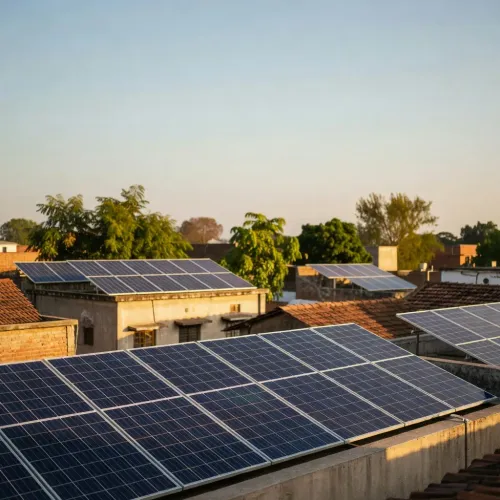
Odisha Chief Minister Mohan Charan Majhi on Sunday, 21 June 2026 invoked the state's iconic Konark Sun Temple to announce his government's ambition to transform Pahadpur into a dedicated 'solar village,' promising free electricity and supplementary income for local residents through surplus power generation.
Context
Posting in Odia on X, CM Majhi quoted Prime Minister Narendra Modi and drew a direct cultural parallel: 'ଓଡ଼ିଶାର କୋଣାର୍କ ଯେପରି ସୂର୍ଯ୍ୟ ମନ୍ଦିର ପାଇଁ ବିଶ୍ୱପ୍ରସିଦ୍ଧ' — 'Just as Odisha's Konark is world-famous for its Sun Temple, Pahadpur will in the coming days create a new identity as a solar village.' The post was tagged under the hashtag #2YearsofLokankaSarakar, marking two years of the BJP-led state government that came to power after the 2024 Odisha assembly elections.
The announcement frames the solar village initiative as both an energy policy and a cultural statement, linking Odisha's ancient solar heritage to its renewable energy future. The Konark Sun Temple, a UNESCO World Heritage Site, has long served as a symbol of the state's identity.
Policy Backdrop
The initiative aligns with the central government's Pradhan Mantri Kisan Urja Suraksha evam Utthaan Mahabhiyan (PM-KUSUM) scheme, launched in 2019, which supports solar power adoption in rural and agricultural communities. India has also committed to achieving 500 GW of non-fossil fuel energy capacity by 2030, a target announced at the COP26 summit in 2021.
Odisha has increasingly aligned state-level renewable projects with central schemes, and the 'solar village' model fits within a broader national push to reduce dependence on fossil fuels and extend clean energy access to rural households. Under this model, residents are expected to receive free electricity while earning additional income by selling surplus power back to the grid.
Stakeholders and Impact
The primary beneficiaries of the Pahadpur solar village campaign are local rural households, who stand to gain both energy security and a new income stream. CM Majhi stated that residents will 'receive free electricity and also increase their income by generating surplus power' — a dual benefit designed to address both energy poverty and rural livelihoods.
If successfully implemented, the model could serve as a replicable template for other villages across Odisha, potentially drawing interest from state and central planners looking to scale grassroots solar adoption. The initiative also carries political significance as the BJP government seeks to demonstrate developmental delivery in its second year in office.
What's Next
Attention will now turn to the rollout of solar installations in Pahadpur and the mechanisms through which surplus power earnings will be channelled to participating households. Observers will watch whether the state government extends the 'solar village' model to additional villages under a broader state-central coordination framework.
The success of Pahadpur as a proof-of-concept could accelerate Odisha's contribution to India's 2030 renewable energy targets while offering a culturally resonant narrative that connects the state's ancient solar symbolism to its modern energy ambitions.
Point of View
CM Majhi is deploying a culturally potent narrative that serves both policy and political purposes — framing the BJP government's second-year agenda as rooted in Odisha's identity rather than imported ideology. The dual promise of free electricity and income generation targets rural voters directly, mirroring the welfare-plus-livelihood formula that has proven electorally effective for the BJP nationally. Invoking PM Modi's name in the post reinforces the centre-state alignment that has been a hallmark of BJP-governed states since 2014. If Pahadpur delivers measurable results, it could become a model that the party replicates across other states with significant rural and tribal constituencies.
NationPress
20 Sept 2026
Frequently Asked Questions
What is the Pahadpur solar village initiative in Odisha?
The Pahadpur solar village initiative is a plan announced by Odisha Chief Minister Mohan Charan Majhi to transform Pahadpur into a dedicated solar-powered village, where residents will receive free electricity and earn income by selling surplus power back to the grid.
Why did CM Majhi compare Pahadpur to the Konark Sun Temple?
CM Majhi drew the comparison to highlight Odisha's historic association with solar symbolism — just as Konark is world-famous for its Sun Temple, Pahadpur is intended to gain a new identity as a modern solar village, connecting cultural heritage to renewable energy policy.
How will residents of Pahadpur benefit from the solar village scheme?
According to CM Majhi's announcement, local residents will receive free electricity and will also be able to generate surplus power, which they can sell to earn additional income, improving household livelihoods.
What central government scheme supports Odisha's solar village plans?
The central government's PM-KUSUM (Pradhan Mantri Kisan Urja Suraksha evam Utthaan Mahabhiyan) scheme, launched in 2019, supports solar power adoption in rural areas and provides a policy framework aligned with initiatives like the Pahadpur solar village.
When did the BJP come to power in Odisha?
The BJP-led government in Odisha came to power after the 2024 Odisha assembly elections, with Mohan Charan Majhi as Chief Minister. The solar village announcement was made under the hashtag marking two years of this government.