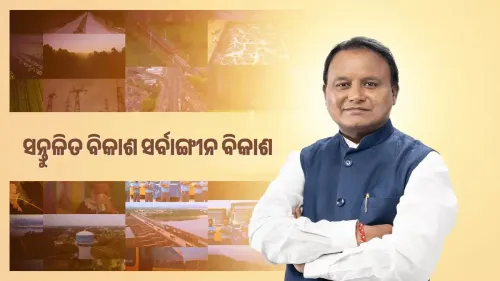
CM Majhi Marks Two Years of Odisha Energy Sector Reforms
Synopsis
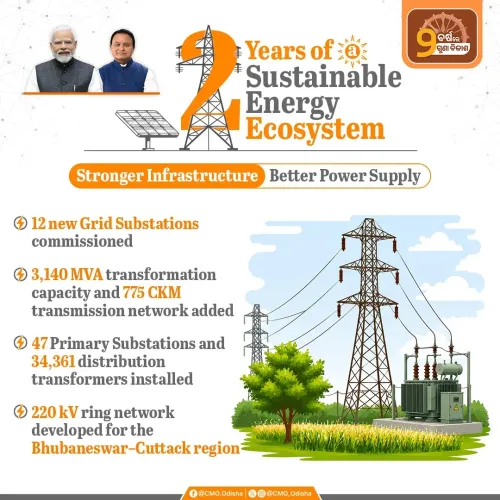
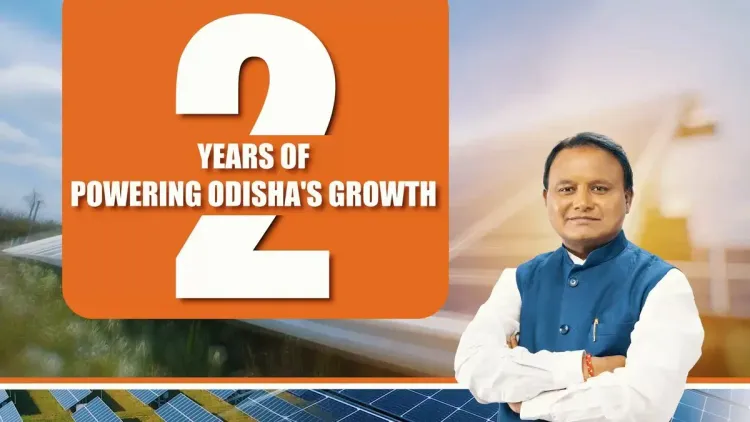
Odisha Chief Minister Mohan Charan Majhi has marked two years of his government's energy sector reforms, highlighting modern power infrastructure, renewable energy expansion, and solar adoption as pillars of a 'Samruddha Odisha' vision, with a direct tag to the Prime Minister's Office.
Key Takeaways
CM Mohan Charan Majhi posted on 14 July 2026 marking two years of energy sector progress under the Odisha government.
The government claims advances in modern power infrastructure , renewable energy expansion, and rapid solar adoption.
Reliable electricity supply to homes, farms, and industries is cited as a core goal of the initiative.
The post tags @PMOIndia , signalling alignment with central government energy priorities.
The effort is framed under the 'Samruddha Odisha' (prosperous Odisha) vision of the BJP-led state government.
India's 500 GW non-fossil fuel target by 2030 and a net-zero goal of 2070 form the national policy backdrop for these state-level efforts.
Odisha Chief Minister Mohan Charan Majhi on Tuesday, 14 July 2026, highlighted his government's two-year record on energy infrastructure, citing advances in power distribution, renewable energy expansion, and solar adoption across the state. The post, addressed in part to the Prime Minister's Office, frames these efforts as building a 'Samruddha Odisha' — a prosperous Odisha.
Context
In the post, Chief Minister Majhi stated that the 'People's Government' has, over the past two years, worked to modernise Odisha's power infrastructure, expand renewable energy, and accelerate solar adoption. He added that 'reliable electricity reaching homes, farms and industries' is central to the state's vision of a 'sustainable and future-ready energy ecosystem.' The phrase Samruddha Odisha (prosperous Odisha) has been a recurring theme in the BJP-led state government's communications since Majhi assumed office in June 2024.
The post's tag to @PMOIndia signals deliberate alignment with the central government's energy priorities, a pattern common among BJP-ruled states that seek to underscore coordination with New Delhi on infrastructure and development programmes.
Policy Backdrop
India committed at COP26 in 2021 to achieving 500 GW of non-fossil fuel energy capacity by 2030, a target that has driven state-level renewable energy programmes across the country. Odisha, an eastern state rich in mineral resources and historically significant to national power generation, has been part of this broader push toward grid modernisation and clean energy scaling.
The National Solar Mission, launched in 2010, provided an early framework for solar capacity addition in states including Odisha. Successive state governments have built on this foundation, and the current administration's messaging suggests continued momentum in solar deployment and transmission upgrades.
Stakeholders and Impact
The primary beneficiaries of improved power infrastructure in Odisha are households, agricultural users, and industrial units — three segments the Chief Minister explicitly named. Reliable electricity supply to farms supports irrigation and cold-chain operations, while stable industrial power underpins the state's manufacturing and mining sectors.
Eastern India as a region has historically lagged in per-capita electricity access compared to western and southern states. Investments in grid reliability and renewable capacity in Odisha therefore carry significance not just for the state but for the broader regional industrialisation agenda that both state and central governments have prioritised.
What's Next
Observers will watch for concrete announcements on new solar parks, transmission corridor upgrades, or power purchase agreements between Odisha and central agencies. State-central coordination on renewable energy financing — through schemes linked to the PMO — is likely to be a focus area as the government approaches the midpoint of its current term.
With India's net-zero target set for 2070 and the 2030 renewable capacity milestone drawing closer, the pace of project commissioning in states like Odisha will be scrutinised as a measure of whether national commitments translate into ground-level delivery.
Point of View
A state the party won for the first time in 2024. The tag to @PMOIndia is not incidental — it positions state-level achievements within the larger national energy narrative, lending them greater political weight. The 'Samruddha Odisha' framing mirrors similar prosperity-branding exercises by BJP-ruled states, suggesting a coordinated messaging strategy ahead of potential mid-term reviews. The broader significance lies in whether the rhetoric is backed by verifiable capacity additions, a question that independent audits and upcoming project announcements will help answer.
NationPress
13 Oct 2026
Frequently Asked Questions
What has Odisha done for renewable energy in the past two years?
According to Chief Minister Mohan Charan Majhi's post on 14 July 2026, the Odisha government has focused on modernising power infrastructure, expanding renewable energy, and accelerating solar adoption over the past two years, though specific capacity figures have not been independently verified.
What is 'Samruddha Odisha'?
'Samruddha Odisha' translates to 'prosperous Odisha' and is a vision framework used by the BJP-led state government under CM Mohan Charan Majhi to describe its development agenda since taking office in June 2024.
Who is Mohan Charan Majhi?
Mohan Charan Majhi is a BJP leader who became Chief Minister of Odisha in June 2024 after the party won the state assembly elections, marking the BJP's first-ever majority government in the state.
What is India's renewable energy target by 2030?
India has committed to achieving 500 GW of non-fossil fuel energy capacity by 2030, a target announced at COP26 in 2021 that has driven renewable energy programmes across states including Odisha.
Why did Odisha CM tag PMO India in the energy post?
Tagging @PMOIndia signals the Odisha government's alignment with the central BJP government's national energy priorities, a common practice among BJP-ruled states to underscore coordination with New Delhi on infrastructure and development.