CM Majhi announces farm relief package for Cyclone Arnab victims

Synopsis
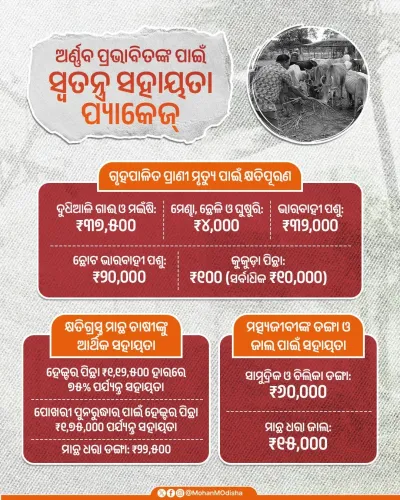
Odisha Chief Minister Mohan Charan Majhi announced special relief measures for farmers affected by Cyclone Arnab, comprising crop-loss input subsidies, subsidised seed minikits and agricultural loan restructuring to restore livelihoods across cyclone-hit districts.
Key Takeaways
CM Mohan Charan Majhi announced a post-cyclone agricultural relief package on 2 November 2026 for Cyclone Arnab -affected farmers in Odisha.
The package includes crop-loss input subsidies to reimburse cultivation expenditure lost to the storm.
Subsidised seed minikits will be distributed to enable farmers to re-sow and recover at least a partial season.
Agricultural loan restructuring is included to prevent cyclone-hit farmers from falling into a debt spiral.
The measures follow an established Odisha template — similar steps were taken after Cyclone Fani in 2019 .
Watch-points include the speed of subsidy disbursement and any supplementary assistance from the National Disaster Response Fund .
When a Bay of Bengal cyclone tears through Odisha's paddy fields, the damage outlasts the storm by months — and Odisha Chief Minister Mohan Charan Majhi moved on Monday, 2 November 2026 to close that gap, announcing a targeted relief package for farmers hit by Cyclone Arnab.
What the package covers: input subsidies, seed minikits and loan relief
The relief announced by CM Majhi rests on three pillars. First, crop-loss input subsidies to compensate farmers for expenditure on seeds, fertilisers and cultivation that the cyclone wiped out before harvest. Second, subsidised seed minikits to enable an accelerated re-sowing cycle so affected households can salvage at least a partial season. Third, agricultural loan restructuring — a measure that prevents farmers from sliding into a debt trap when a natural disaster destroys the crop that was meant to service their borrowings.
In his post on X, the Chief Minister described the move as a 'ସ୍ୱତନ୍ତ୍ର ପଦକ୍ଷେପ' (special initiative) of the 'people's government', framing it as both immediate relief and a pathway to restoring agricultural livelihoods for the cyclone-affected districts of Odisha.
Odisha's cyclone belt and the farm sector in the firing line
Odisha sits squarely on the Bay of Bengal cyclone track, and its coastal and near-coastal districts carry some of India's most cyclone-exposed farmland. Kharif crops — paddy chief among them — bear the brunt when storms arrive during or just after the growing season, turning cultivated fields into flooded wastelands overnight.
The state has built a well-documented response architecture over successive administrations. After Cyclone Fani devastated large swathes of Odisha in 2019, the government deployed almost the same combination: input subsidies, seed distribution, and credit restructuring. The Arnab package fits squarely within that lineage — an acknowledgement that crop recovery requires both cash in hand and seeds in the ground.
What to watch as rollout begins
The immediate test is execution speed. Input subsidy disbursements have historically been delayed by the time it takes to verify crop-loss claims at the village level — a bottleneck that can undercut the best-designed packages. Whether the Majhi government streamlines that verification process, and whether National Disaster Response Fund support is sought to supplement state resources, will determine how quickly Odisha's cyclone-hit farmers see money in their accounts.
The seed minikits, if distributed before the next viable sowing window closes, could make the difference between a partial recovery and a full season lost — and that clock is already ticking.
Point of View
Deploying this package quickly is also a governance credibility moment: Odisha's cyclone response capacity is internationally recognised, and any stumble in farm-relief rollout carries outsized reputational cost. The framing as a 'people's government' initiative suggests the BJP is also keen to convert disaster management into a rural political dividend ahead of any future electoral cycle. The deeper structural question — whether recurring NDRF-backed packages can substitute for longer-term coastal agricultural resilience investment — remains unanswered.
NationPress
2 Nov 2026
Frequently Asked Questions
What relief has the Odisha government announced for Cyclone Arnab-affected farmers?
The Odisha government announced crop-loss input subsidies, subsidised seed minikits and agricultural loan restructuring to help farmers affected by Cyclone Arnab recover their livelihoods.
Who announced the Cyclone Arnab farm relief package in Odisha?
Odisha Chief Minister Mohan Charan Majhi announced the package on 2 November 2026 via a post on X.
What is an input subsidy for crop loss in Odisha?
An input subsidy compensates farmers for money spent on seeds, fertilisers and cultivation that could not be recovered because the crop was destroyed — in this case by Cyclone Arnab.
What are seed minikits and how do they help cyclone-hit farmers?
Seed minikits are government-distributed small seed packets provided at subsidised or no cost, allowing farmers who lost their crops to re-sow quickly without bearing the full cost of new seeds.
Has Odisha offered similar farm relief after cyclones before?
Yes. After Cyclone Fani in 2019, the Odisha government implemented a nearly identical combination of input subsidies, seed distribution and agricultural loan restructuring for affected farmers.