CM Mann urges Centre to rethink Higher Education Bill 2025
Synopsis
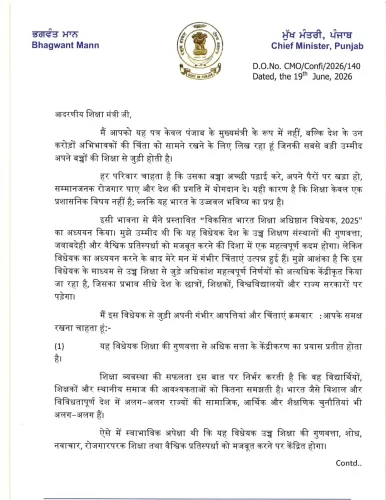
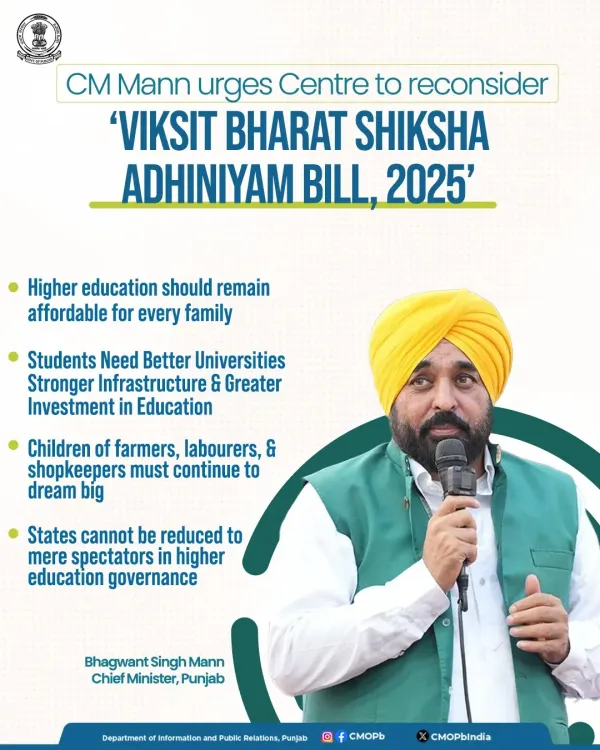
Punjab Chief Minister Bhagwant Mann has urged Union Education Minister Dharmendra Pradhan to reconsider the Viksit Bharat Shiksha Adhiniyam Bill, 2025, warning it could raise costs, shut out students from ordinary families, and strip states of the flexibility to meet local educational needs.
Key Takeaways
CM Bhagwant Mann wrote a detailed letter to Union Education Minister Dharmendra Pradhan on June 21, 2026 .
Mann warned the Viksit Bharat Shiksha Adhiniyam Bill, 2025 could make higher education 'more expensive' for students from ordinary families.
The Chief Minister called for wider consultations before the Bill is implemented.
Punjab under AAP has consistently opposed central reforms it views as undermining state autonomy in education.
Education is a Concurrent List subject, giving both Parliament and state legislatures legislative authority, but central law prevails in conflict.
Responses from other state education ministers and parliamentary committee scrutiny are expected next.
The Chief Minister's Office of Punjab announced on Sunday, June 21, 2026, that Chief Minister Bhagwant Mann has written to Union Education Minister Dharmendra Pradhan urging the central government to reconsider the proposed Viksit Bharat Shiksha Adhiniyam Bill, 2025, warning that it could make higher education costlier and erode state autonomy.
Context
In a detailed letter to the Union Education Minister, CM Bhagwant Singh Mann argued that the proposed legislation could 'make higher education more expensive, weaken opportunities for students from ordinary families and diminish the ability of states to address local educational needs.' He called on the Centre to hold wider consultations before implementing reforms that could 'significantly alter the higher education landscape.'
Policy Backdrop
The proposed Bill comes in the wake of the National Education Policy (NEP) 2020, approved by the Union Cabinet in July 2020, which introduced sweeping structural changes including four-year undergraduate programmes and greater central coordination in higher education. Since the NEP rollout, several non-BJP-governed states have raised concerns about perceived erosion of federal flexibility over curriculum design, fee structures, and institutional governance.
Punjab under the Aam Aadmi Party (AAP), which has been in power since March 2022, has consistently positioned itself against what it describes as top-down reforms that prioritise national standardisation over regional equity and access. The Viksit Bharat Shiksha Adhiniyam Bill, 2025 represents the latest flashpoint in this ongoing centre-state friction over education policy.
Stakeholders and Impact
The primary concern raised by CM Mann centres on affordability and access. Students from lower-income and middle-class families in states like Punjab could face higher tuition costs if the Bill introduces new regulatory or fee frameworks that reduce state governments' ability to subsidise or control fees at public institutions. State universities and colleges, which serve the bulk of students outside metropolitan centres, are particularly exposed to any centralisation of governance norms.
Opposition-ruled states more broadly are watching the Bill closely, as it touches on a constitutionally concurrent subject — education falls under the Seventh Schedule's Concurrent List — giving both Parliament and state legislatures the right to legislate, but with central law prevailing in case of conflict. Any reduction in states' practical authority over admissions, fees, or curricula would be felt most acutely by governments that have built distinct social-sector models.
What's Next
Mann's letter is likely to be followed by responses from education ministers of other states, particularly those governed by non-BJP parties, who may coordinate objections ahead of any parliamentary committee review or introduction of the Bill in the monsoon session of Parliament. The Centre has not yet publicly responded to the Punjab Chief Minister's letter. Wider consultations, if accepted, would involve state governments, university administrators, student bodies, and education experts before the Bill proceeds further.
The outcome of this exchange will signal how much federal accommodation the Centre is prepared to offer on a reform that could reshape access to higher education for millions of students across India.
Point of View
Often ahead of parliamentary debate. The invocation of affordability and local need is particularly pointed given that higher education access remains a live issue in semi-urban and rural Punjab. Whether the Centre engages substantively or proceeds regardless will be a test of how much federal accommodation is built into the Viksit Bharat reform agenda.
NationPress
21 Jun 2026
Frequently Asked Questions
What is the Viksit Bharat Shiksha Adhiniyam Bill 2025?
The Viksit Bharat Shiksha Adhiniyam Bill, 2025 is a proposed central legislation on higher education that CM Bhagwant Mann has warned could make college education more expensive and reduce states' ability to manage their own educational institutions.
Why is Punjab opposing the Higher Education Bill?
Punjab Chief Minister Bhagwant Mann argues the Bill could raise costs for students from ordinary families and diminish state governments' ability to address local educational needs, reflecting broader AAP concerns about central overreach in education.
Who did CM Bhagwant Mann write to about the education bill?
CM Bhagwant Mann wrote a detailed letter to Union Education Minister Dharmendra Pradhan urging him to reconsider the Bill and hold wider consultations before proceeding.
Is education a state or central subject in India?
Education is a Concurrent List subject under the Seventh Schedule of the Indian Constitution, meaning both Parliament and state legislatures can legislate on it, but a central law prevails in the event of conflict with a state law.
What happens next with the Viksit Bharat Shiksha Adhiniyam Bill?
The Centre is yet to formally respond to Mann's letter. Wider consultations and potential parliamentary committee review are expected, with other state education ministers likely to weigh in ahead of any monsoon session introduction.