CM Mohan Majhi Strengthens Odisha Power Grid in Two Years
Synopsis
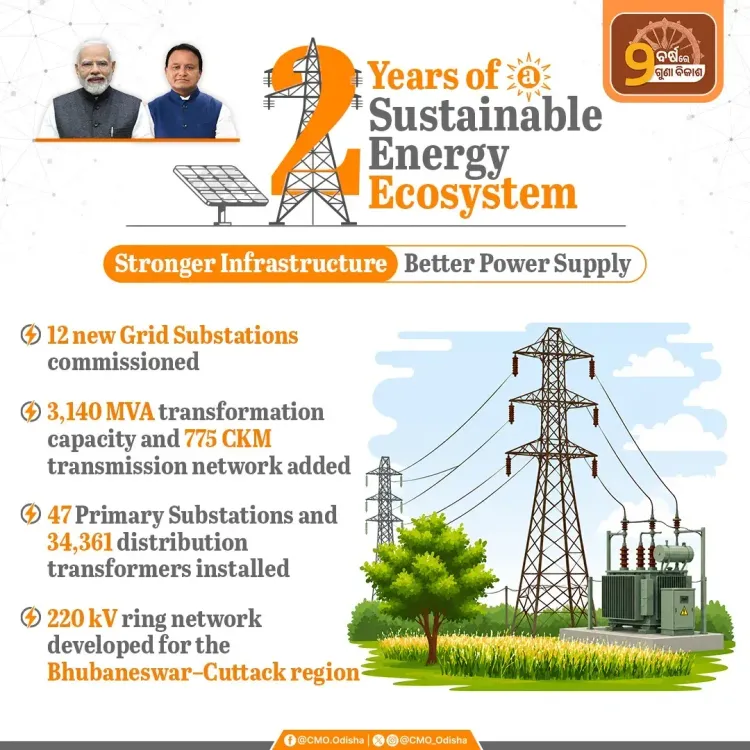
The Chief Minister's Office of Odisha on 11 July 2026 credited CM Mohan Majhi's two-year tenure with major power infrastructure gains, including new grid substations, higher transmission capacity, and a stronger distribution network aimed at reliable electricity and economic growth.
Key Takeaways
The Chief Minister's Office of Odisha announced significant power infrastructure upgrades on 11 July 2026 .
CM Mohan Majhi has led the state since June 2024 following the BJP's assembly election win.
New grid substations and enhanced transmission and distribution capacity are the headline infrastructure additions cited.
The post was addressed to the Prime Minister's Office , signalling alignment with central government power priorities.
Odisha is implementing upgrades consistent with the national Revamped Distribution Sector Scheme (RDSS) framework.
Key beneficiaries include industrial investors , rural households , and small commercial consumers across the state.
The Chief Minister's Office of Odisha on Saturday, 11 July 2026 highlighted significant upgrades to the state's power infrastructure carried out over the past two years under Chief Minister Mohan Majhi, citing new grid substations, expanded transmission capacity, and a reinforced distribution network aimed at delivering reliable electricity across the state.
Context
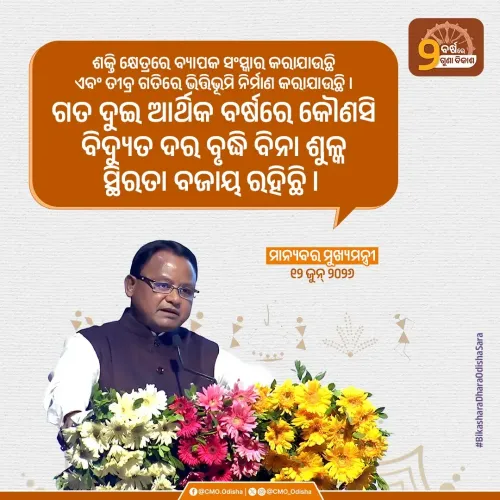
The CMO's post, addressed also to the Prime Minister's Office, states that Odisha has 'significantly strengthened its power infrastructure to ensure reliable and uninterrupted electricity' since Majhi assumed office in June 2024 following the BJP's assembly election victory. The communication frames the infrastructure push as a deliberate effort to 'build a robust power ecosystem to support growth and improve service delivery.'
The reference to PMO India signals an intent to position the state's progress within the broader national power development agenda, aligning Odisha's efforts with central government priorities on energy access and industrial readiness.
Policy Backdrop
Odisha has a long history of power sector reform, having unbundled its state electricity board in the late 1990s — among the earliest such moves in India. The state participated in the national Ujwal DISCOM Assurance Yojana (UDAY) launched in 2015 to stabilise distribution company finances and reduce aggregate technical and commercial losses.
More recently, the Revamped Distribution Sector Scheme (RDSS), approved by the central government in 2021, has provided a funding framework for states to upgrade metering infrastructure, reduce losses, and strengthen transmission and distribution networks. Odisha's current grid substation additions and network expansion are consistent with the implementation trajectory of RDSS across Indian states.
Across India, states have pursued similar grid modernisation efforts to reduce transmission losses and attract manufacturing investment, particularly as industrial corridors and data centre projects demand more reliable power supply.
Stakeholders and Impact
Industrial investors eyeing Odisha — which has been actively courting investment in steel, aluminium, and downstream manufacturing — stand to benefit directly from a more stable grid. Reliable power supply is consistently cited as a primary requirement by large industrial units evaluating site locations.
For rural households and small consumers, an enhanced distribution network translates into fewer outages and more consistent voltage levels. Odisha still has significant rural electrification depth to maintain, making network strengthening critical beyond urban and industrial zones.
The broader power consumer base — including commercial establishments and small enterprises — also gains from reduced load-shedding, which has historically constrained productivity in the state during peak demand seasons.
What's Next
Analysts and policy observers will watch Odisha's upcoming state budget allocations for the power sector to gauge the financial commitment behind these infrastructure claims. Memoranda of understanding with central public sector undertakings for substation construction and transmission line additions will be key markers of project pipeline depth.
As CM Majhi approaches the midpoint of his term, the power infrastructure narrative is likely to feature prominently in the government's development messaging, particularly as the state prepares for further investment summits and seeks to position Odisha as an investor-friendly destination on the eastern seaboard.
Point of View
Reinforcing the party's dual-government synergy ahead of potential investor events. The emphasis on 'two years' of progress is a classic mid-term credibility marker, designed to establish a performance baseline before the electoral cycle intensifies. Odisha's power sector push also reflects a broader competitive dynamic among eastern Indian states to attract capital-intensive industries that demand grid reliability. Whether the infrastructure claims translate into measurable loss reduction and uptime data will determine how durable this narrative proves to be.
NationPress
11 Jul 2026
Frequently Asked Questions
What power infrastructure improvements has Odisha made under CM Mohan Majhi?
According to the Chief Minister's Office, Odisha has added new grid substations, enhanced transmission capacity, and strengthened its distribution network over the two years since Mohan Majhi became Chief Minister in June 2024.
What is the Revamped Distribution Sector Scheme and how does it relate to Odisha?
The Revamped Distribution Sector Scheme (RDSS) is a central government programme approved in 2021 that funds metering upgrades, loss reduction, and network strengthening for state distribution companies. Odisha's current grid and distribution improvements align with the RDSS implementation framework.
Why did the Odisha CMO tag PMO India in the power infrastructure post?
Tagging the Prime Minister's Office signals that the state government is aligning its infrastructure progress with central government priorities on energy access and economic growth, a common practice for BJP-governed states to highlight cooperative federalism.
Who benefits from Odisha's power sector upgrades?
Industrial investors, rural households, and commercial consumers all stand to benefit. A more reliable grid reduces outages for households, lowers production disruptions for industries, and supports Odisha's broader investment attraction efforts.
When did Mohan Majhi become Chief Minister of Odisha?
Mohan Majhi became Chief Minister of Odisha in June 2024 after the BJP won the state assembly election, ending a long period of Biju Janata Dal rule in the state.