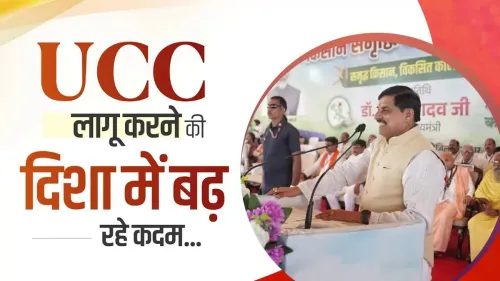
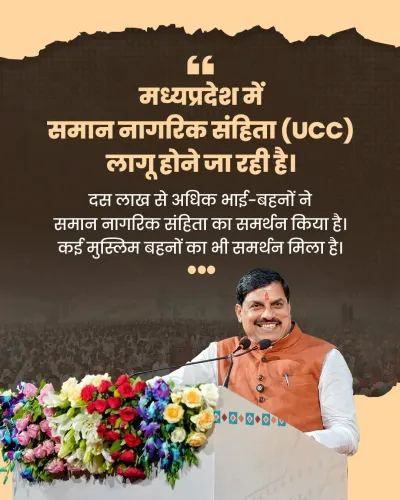
CM Mohan Yadav announces UCC for MP on Independence Day
Synopsis
On Independence Day 2026, Madhya Pradesh Chief Minister Dr. Mohan Yadav announced the state will implement the Uniform Civil Code, invoking Article 44 and PM Modi's Viksit Bharat vision, following Uttarakhand's landmark 2024 UCC legislation.
Key Takeaways
Mohan Yadav announced on August 15, 2026 that Madhya Pradesh will implement the Uniform Civil Code .
The announcement was made on Independence Day , linking state legal reform to national progress narratives.
Uttarakhand was the first Indian state to enact UCC legislation, in February 2024 , setting the precedent.
The UCC is rooted in Article 44 of the Directive Principles of State Policy of the Indian Constitution.
The BJP national manifestos of 2019 and 2024 both committed to a nationwide Uniform Civil Code.
Formal rule notification, potential High Court challenges, and parallel moves in Gujarat and Assam are the next developments to watch.
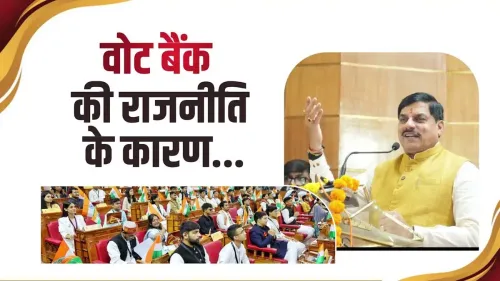
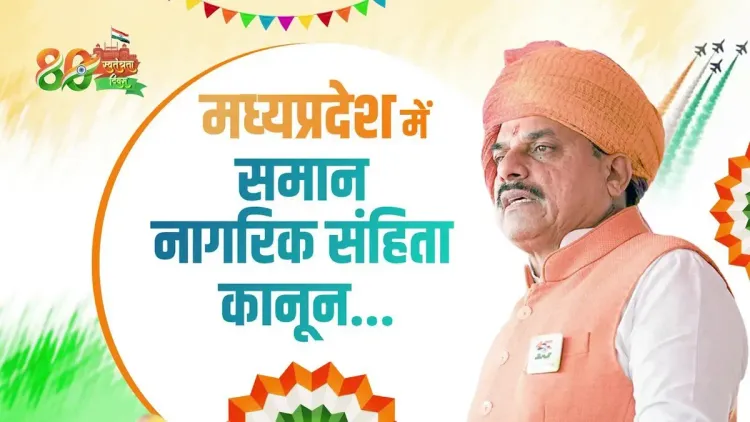
On Independence Day, August 15, 2026, as the national song Vande Mataram rang out across Madhya Pradesh, Chief Minister Dr. Mohan Yadav used the occasion to announce a landmark legal shift: the state will implement the Uniform Civil Code (UCC), framing it as a historic step in line with the spirit of the Indian Constitution.
A national holiday, a state-level declaration
Posting on August 15, Dr. Yadav declared that Madhya Pradesh is moving to enforce a common civil code — replacing religion-based personal laws with a unified legal framework for all citizens. He tied the announcement directly to the national mood, invoking Prime Minister Narendra Modi's vision of a 'modern, developed, self-reliant, secure, prosperous and glorious nation' (aadhunik, viksit, atmanirbhar, surakshit, samridh aur gauravshali rashtra). Independence Day as the backdrop was no accident — it gave a state-level legal reform the weight of a national moment.
Article 44 and the Uttarakhand precedent
Article 44 of the Directive Principles of State Policy has long directed the Indian state to secure a Uniform Civil Code for its citizens — a provision that has sat largely dormant for decades. That changed when Uttarakhand became the first state to enact a UCC law in February 2024, breaking the political logjam. The BJP's national manifestos of 2019 and 2024 both reiterated the commitment to a common code, and BJP-governed states have progressively moved to follow Uttarakhand's lead.
Madhya Pradesh, a BJP stronghold under Dr. Yadav since December 2023, now joins that trajectory. The announcement positions the state as the next significant domino in a carefully sequenced national rollout.
What the UCC would change for MP's residents
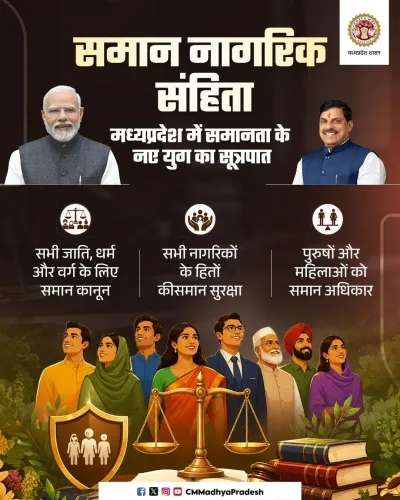
For the state's residents, a Uniform Civil Code would mean a single set of laws governing marriage, divorce, inheritance, and adoption — regardless of religious affiliation. Proponents argue it fulfils a constitutional promise and advances gender equality, particularly for women in communities where personal law has historically limited their rights. The reform is politically charged: critics, including minority community groups, have raised concerns about cultural autonomy and the pace of implementation.
The immediate questions now are procedural: formal notification of UCC rules in Madhya Pradesh, the legislative or executive route chosen, and whether High Court petitions follow — as they did in Uttarakhand. Parallel moves in other BJP states such as Gujarat and Assam will also be watched closely.
A constitutional directive that waited decades just found its newest address: Bhopal.
Point of View
Fusing state governance with the BJP's long-running national constitutional agenda. Following Uttarakhand's 2024 precedent, Madhya Pradesh's move suggests a coordinated, state-by-state strategy to normalise UCC before any central legislation, insulating the reform from a single parliamentary battle. The announcement also reinforces Dr. Yadav's positioning as an ideologically aligned executor of the Modi-era BJP project, not merely a regional administrator. How the state navigates legal challenges and community concerns will determine whether this becomes a governance milestone or a prolonged courtroom contest.
NationPress
15 Aug 2026
Frequently Asked Questions
What is the Uniform Civil Code and why is it significant in India?
The Uniform Civil Code (UCC) is a proposed common set of civil laws — covering marriage, divorce, inheritance, and adoption — that would apply equally to all citizens regardless of religion, replacing separate religion-based personal laws. It is significant because Article 44 of the Indian Constitution's Directive Principles has long called for its implementation, but it has remained politically sensitive for decades.
Which was the first Indian state to implement UCC?
Uttarakhand became the first Indian state to enact a Uniform Civil Code law in February 2024, setting the legislative precedent that BJP-governed states including Madhya Pradesh are now following.
What did CM Mohan Yadav announce on Independence Day 2026?
Madhya Pradesh Chief Minister Dr. Mohan Yadav announced on August 15, 2026 that the state will implement the Uniform Civil Code, describing it as a historic step in line with the spirit of the Indian Constitution and PM Modi's vision for a developed, self-reliant India.
What does the UCC mean for residents of Madhya Pradesh?
If implemented, the UCC would replace religion-specific personal laws with a single legal framework governing marriage, divorce, inheritance, and adoption for all residents of Madhya Pradesh, irrespective of their faith.
What are the next steps after Madhya Pradesh's UCC announcement?
The key next steps include the formal notification of UCC rules by the Madhya Pradesh government, the legislative or executive route chosen for enactment, and potential legal challenges in the High Court — a pattern seen after Uttarakhand's UCC law was passed.