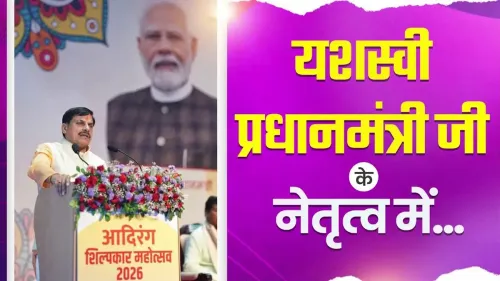
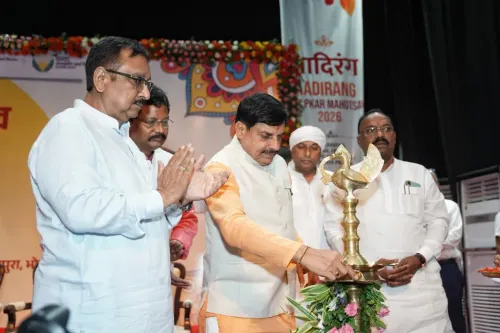
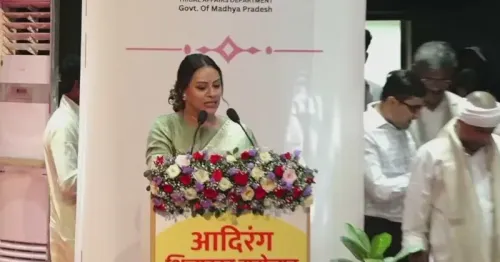
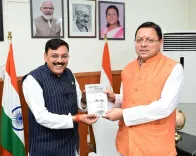
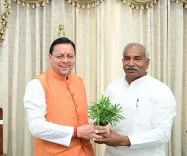
CM Mohan Yadav attends Aadirang Shilpkar Mahotsav-2026 closing
Synopsis
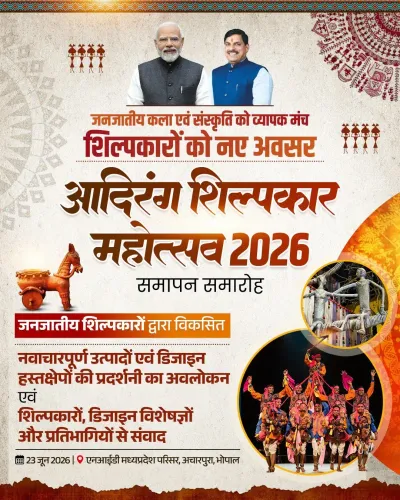
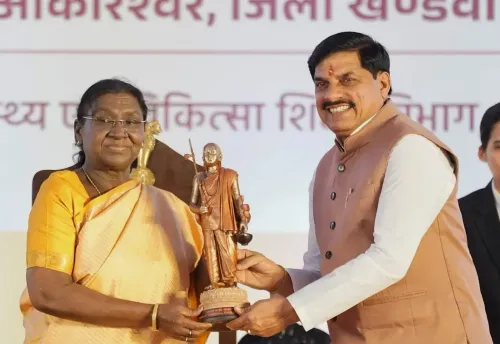
Madhya Pradesh Chief Minister Dr. Mohan Yadav closed the Aadirang Shilpkar Mahotsav-2026 in Bhopal on 23 June 2026, co-hosted by NID and the state Tribal Affairs Department. He viewed an artisan exhibition and highlighted government efforts on tribal craft promotion and sickle cell anaemia screening.
Key Takeaways
Aadirang Shilpkar Mahotsav-2026 concluded in Bhopal on 23 June 2026 , jointly organised by the National Institute of Design and Madhya Pradesh Tribal Affairs Department .
Mohan Yadav attended the closing ceremony and viewed an exhibition of tribal handicrafts.
The state government is actively working on sickle cell anaemia screening and treatment targeting tribal communities.
Madhya Pradesh hosts one of India's largest tribal populations, including Bhil , Gond , and Baiga communities.
The festival reflects a broader state policy linking tribal cultural preservation with rural livelihood and market access.
The government aims to expand the reach of Madhya Pradesh tribal crafts to national and international markets.
Madhya Pradesh Chief Minister Dr. Mohan Yadav attended the closing ceremony of Aadirang Shilpkar Mahotsav-2026 in Bhopal on Tuesday, 23 June 2026, reaffirming his government's commitment to preserving tribal culture and addressing the health and livelihood challenges of the state's tribal communities.
Context
The festival was organised jointly by the National Institute of Design (NID) and the Madhya Pradesh Tribal Affairs Department. At the closing ceremony, Dr. Yadav viewed an exhibition of handicrafts created by tribal artisans from across the state. In his address, he said — 'आज हमारी जनजातीय शिल्प का डंका देश-विदेश में बज रहा है' — 'Today, our tribal craft is making its mark across the country and abroad.'
Madhya Pradesh is home to one of the largest tribal populations in India, encompassing communities such as the Bhil, Gond, and Baiga. The state government has run the Adivasi Kala Utsav series since the early 2010s to bring tribal crafts to state and national platforms.
Policy Backdrop
The National Institute of Design, established in 1961, has long partnered with state governments to document and modernise traditional crafts, helping artisans access wider commercial markets. The collaboration with Madhya Pradesh's Tribal Affairs Department for this festival reflects a growing national trend of pairing cultural preservation with economic opportunity for tribal communities.
Alongside the craft festival, Dr. Yadav highlighted the state government's ongoing work on sickle cell anaemia screening and treatment — a disease that disproportionately affects tribal populations. India's National Sickle Cell Anaemia Control Programme, significantly strengthened after 2016, targets high-prevalence tribal districts for screening and genetic counselling, and Madhya Pradesh has been an active implementer of this programme.
Stakeholders and Impact
Tribal artisans stand to benefit directly from increased market visibility generated by events such as Aadirang Shilpkar Mahotsav, which positions their work before buyers, designers, and policymakers simultaneously. The state government has framed such festivals as instruments of both cultural dignity and supplementary rural income.
For tribal communities more broadly, the dual focus — craft promotion and sickle cell intervention — signals a policy approach that links livelihood, health, and cultural identity under one administrative umbrella. Tribal welfare schemes in Madhya Pradesh also run alongside implementation of the Forest Rights Act, addressing land, health, and market access together.
What's Next
Attention will now turn to follow-up action: whether expanded sickle cell screening camps are rolled out in scheduled tribal districts, and whether buyer-seller meets or export linkages emerge from the artisan networks built at the 2026 festival. The government's stated ambition to take Madhya Pradesh tribal craft to international markets will be tested by concrete orders and institutional support in the months ahead.
Point of View
The Madhya Pradesh government is attempting to present a holistic tribal-welfare narrative ahead of continued political competition in the state's tribal-dominated constituencies. The NID partnership lends institutional credibility to what could otherwise be seen as a routine cultural event, signalling an intent to commercialise tribal art beyond symbolic gestures. Whether the policy architecture translates into measurable income gains for artisans and reduced sickle cell burden in scheduled districts will determine the initiative's lasting impact.
NationPress
23 Jun 2026
Frequently Asked Questions
What is Aadirang Shilpkar Mahotsav 2026?
Aadirang Shilpkar Mahotsav-2026 is a tribal artisan festival held in Bhopal, jointly organised by the National Institute of Design and the Madhya Pradesh Tribal Affairs Department to showcase and promote tribal handicrafts.
Why did CM Mohan Yadav attend the tribal craft festival?
CM Dr. Mohan Yadav attended the closing ceremony to reaffirm his government's commitment to preserving tribal culture and supporting tribal artisans, and also viewed an exhibition of tribal handicrafts at the event.
What is the Madhya Pradesh government doing about sickle cell anaemia?
The Madhya Pradesh government is conducting sickle cell anaemia screening and treatment programmes targeting tribal communities, in line with India's National Sickle Cell Anaemia Control Programme that focuses on high-prevalence tribal districts.
Which tribal communities live in Madhya Pradesh?
Madhya Pradesh is home to one of India's largest tribal populations, including the Bhil, Gond, and Baiga communities, among others.
What is the National Institute of Design's role in tribal crafts?
The National Institute of Design, established in 1961, partners with state governments to document, modernise, and commercialise traditional crafts, helping tribal artisans gain access to wider markets.