CM Mohan Yadav Marks World Sickle Cell Day at Omkareshwar

Synopsis
On World Sickle Cell Day, President Droupadi Murmu addressed a national event at Omkareshwar in Madhya Pradesh, with CM Dr. Mohan Yadav reaffirming the state's pledge of a sickle-cell-free MP and felicitating panchayat leaders and health workers for their contributions to the elimination mission.
Key Takeaways
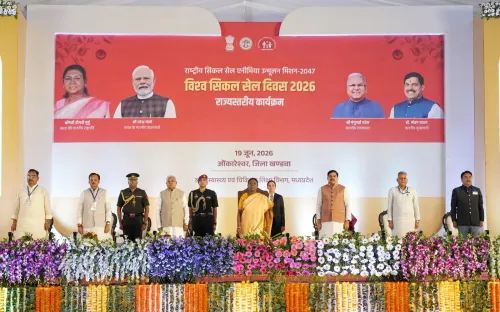
President Droupadi Murmu addressed Madhya Pradesh's sickle cell elimination programme at Omkareshwar on World Sickle Cell Day, 19 June 2026 .
Prime Minister Narendra Modi launched the National Sickle Cell Anaemia Elimination Mission from Shahdol, MP in July 2023 , targeting elimination by 2047 .
Governor Mangubhai Patel also participated in the Omkareshwar event alongside CM Dr.
Panchayats, sarpanches, health officers and frontline workers were felicitated for outstanding contributions to the sickle cell elimination drive.
Yadav reaffirmed the state's goal of a ' Sickle Cell-Free Madhya Pradesh ' driven by people's participation.
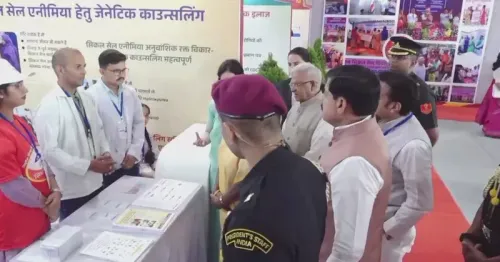
The mission integrates mass screening, genetic counselling and hydroxyurea distribution, with a focus on tribal communities in central India.
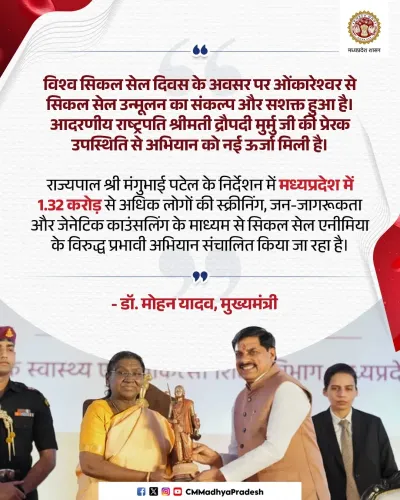
Madhya Pradesh Chief Minister Dr. Mohan Yadav on Friday, 19 June 2026, highlighted the state's accelerating push to eliminate sickle cell anaemia as President Droupadi Murmu addressed a landmark programme at the sacred site of Omkareshwar, lending national weight to the state's campaign on World Sickle Cell Day.
Context
Posting on X, Dr. Yadav said President Murmu provided 'a new direction and momentum' — nai disha evam gati — to Madhya Pradesh's sickle cell elimination programme from the 'sacred land of Omkareshwar.' He also recalled that Prime Minister Narendra Modi had launched the National Sickle Cell Anaemia Elimination Mission from Shahdol, Madhya Pradesh, approximately three years ago, and that the mission 'continues to run with full commitment.' The Chief Minister expressed confidence that the resolve of a 'Sickle Cell-Free Madhya Pradesh' — Sickle Cell Mukt Madhya Pradesh — would be achieved through people's participation.
Governor Mangubhai Patel also participated in the Omkareshwar event, with Dr. Yadav describing his presence as 'inspirational guidance.' Panchayats, sarpanches, health officers and frontline workers who made outstanding contributions to sickle cell elimination were felicitated at the ceremony.
Policy Backdrop
Prime Minister Narendra Modi launched the National Sickle Cell Anaemia Elimination Mission from Shahdol in July 2023, setting a national target to eliminate the hereditary haemoglobin disorder by 2047. The mission focuses on mass screening, genetic counselling and hydroxyurea distribution, with particular emphasis on tribal districts in Madhya Pradesh, Chhattisgarh, Odisha and neighbouring states where prevalence is highest.
The programme is integrated with tribal health outreach under the National Health Mission, reflecting the central government's broader commitment to reducing morbidity in Scheduled Tribe populations. Madhya Pradesh, home to one of India's largest tribal populations, has been a frontline state in implementing the mission since its inception.
Stakeholders and Impact
Sickle cell disease is a hereditary condition disproportionately affecting tribal communities across central and eastern India. The disease causes chronic anaemia, pain crises and organ damage, imposing a heavy burden on households with limited access to specialist healthcare. Community-level screening and genetic counselling — central to the national mission — are intended to reduce new cases by informing at-risk couples before and during pregnancy.
The decision to honour panchayat leaders, sarpanches and health workers at the Omkareshwar event signals a deliberate strategy of incentivising grassroots participation. By publicly recognising local contributors, the state government aims to sustain momentum and encourage replication of best practices across high-burden districts.
What's Next
The health ministry's next quarterly review is expected to include state-level screening coverage data and hydroxyurea supply reports, which will offer a clearer picture of the mission's reach across Madhya Pradesh. The panchayat-level awards model piloted at Omkareshwar could be replicated in other high-burden states if it demonstrates measurable improvements in community screening rates. Dr. Yadav's public reaffirmation of the 'Sickle Cell-Free Madhya Pradesh' goal signals that the state intends to keep the campaign at the centre of its public health agenda through the remaining years of the mission's timeline.
Point of View
Anchored by the President's presence, elevates sickle cell elimination from a state health programme to a visible national-political commitment — particularly significant given that Madhya Pradesh holds one of India's largest tribal populations. By honouring grassroots workers publicly, Dr. Yadav is embedding a community-accountability mechanism into what has historically been a top-down public health drive. The timing — nearly three years after the mission's launch from Shahdol — also serves as a mid-course signal that the ruling dispensation intends to keep the 2047 elimination target in public view. Whether screening and treatment coverage data justify the optimism will become clearer at the next health ministry review.
NationPress
18 Sept 2026
Frequently Asked Questions
What is the National Sickle Cell Anaemia Elimination Mission?
The National Sickle Cell Anaemia Elimination Mission is a central government programme launched by Prime Minister Narendra Modi in July 2023 from Shahdol, Madhya Pradesh, aiming to eliminate sickle cell disease in India by 2047 through mass screening, genetic counselling and hydroxyurea distribution, with a focus on tribal communities.
Why was World Sickle Cell Day 2026 celebrated at Omkareshwar?
The Madhya Pradesh government hosted the national World Sickle Cell Day programme at Omkareshwar on 19 June 2026, with President Droupadi Murmu addressing the event to give renewed direction and momentum to the state's sickle cell elimination campaign.
Who was felicitated at the Omkareshwar sickle cell event?
Panchayats, sarpanches, health officers and frontline health workers who made outstanding contributions to sickle cell elimination in Madhya Pradesh were felicitated at the Omkareshwar event on World Sickle Cell Day 2026.
What is 'Sickle Cell Mukt Madhya Pradesh'?
'Sickle Cell Mukt Madhya Pradesh' — meaning 'Sickle Cell-Free Madhya Pradesh' — is the state government's declared goal to completely eliminate sickle cell anaemia from the state, aligned with the national mission's 2047 target, driven through community participation and grassroots health outreach.
Which communities are most affected by sickle cell disease in Madhya Pradesh?
Tribal communities in Madhya Pradesh and across the central and eastern Indian belt — including districts in Chhattisgarh and Odisha — bear the highest burden of sickle cell disease, which is why the National Sickle Cell Anaemia Elimination Mission specifically targets Scheduled Tribe populations.