CM Mohan Yadav hosts tribal leaders at Bhopal Niwas
Synopsis
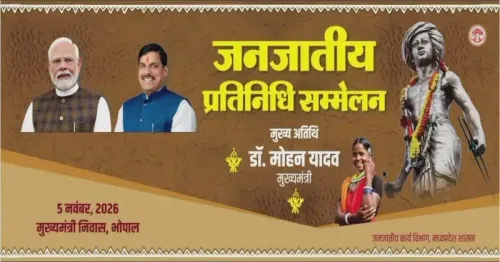
MP Chief Minister Dr. Mohan Yadav met tribal representatives at Bhopal Niwas on November 5, 2026, reaffirming his government's pledge to deliver education, health, and self-employment opportunities to tribal communities through targeted schemes.
Key Takeaways
Mohan Yadav hosted tribal representatives at Bhopal Niwas on November 5, 2026 .
The CM committed to ground-level delivery of education, health, self-employment, and development schemes for tribal communities.
Union Ministers of State Durga Das Uikey and Savitri Thakur attended alongside senior BJP leadership.
Rawat , Chairman of the National Commission for Scheduled Tribes , was present, linking state delivery to constitutional oversight.
The meeting reflects a continuing BJP strategy of direct grassroots outreach in states with large Scheduled Tribe populations.
Madhya Pradesh is one of India's states with the highest ST population, making tribal welfare a central political and policy priority.
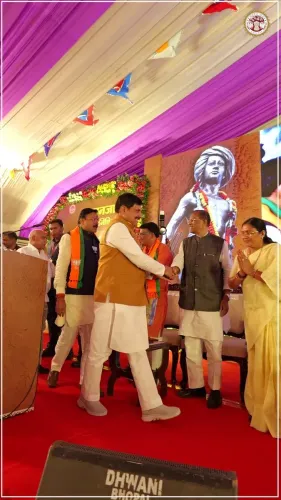
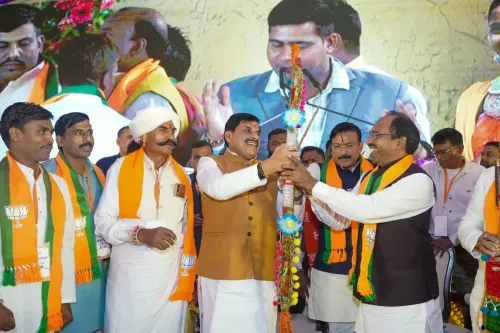
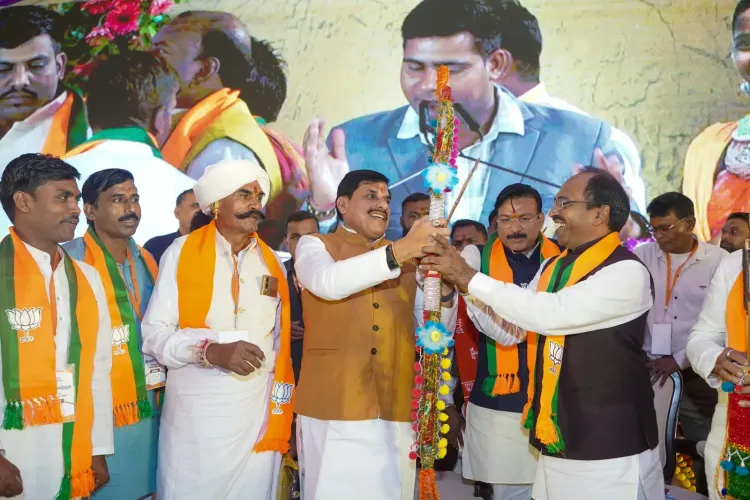
Tribal welfare moved from slogan to conversation on Thursday, November 5, 2026, when Madhya Pradesh Chief Minister Dr. Mohan Yadav convened a gathering of tribal representatives at Bhopal Niwas, pledging that his government's commitment to inclusive development would be realised on the ground — not merely proclaimed.
What was said at Bhopal Niwas
Speaking to the assembled representatives, Dr. Mohan Yadav invoked the BJP-led government's guiding framework — 'Sabka Saath, Sabka Vikas, Sabka Vishwas aur Sabka Prayas' ('Together with all, development for all, trust of all, and efforts of all') — and was explicit that it must translate into tangible outcomes. 'This is not merely a phrase to be repeated,' he said, 'but a commitment our government will realise in every sector, on the ground.'
He outlined four pillars of tribal empowerment the state is focused on: education, health, self-employment, and development opportunities — framing the goal as not just welfare delivery but integration of tribal communities into the mainstream of society.
Senior BJP and national commission figures in attendance
The gathering drew a notable cross-section of central and state leadership. Union Ministers of State Durga Das Uikey and Savitri Thakur attended, as did M. L. Rawat, Chairman of the National Commission for Scheduled Tribes — the constitutional body mandated to protect and promote tribal rights across India. Madhya Pradesh BJP State President Hitendra Khandelwal, state organisation secretary Chandrashekhar, national co-organisation minister V. Srivatsa, national general secretary Gajendra, and Rajya Sabha MP Rajneesh were also present alongside cabinet colleagues and other elected representatives.
The presence of the National Commission for Scheduled Tribes chairman alongside state machinery signals that Thursday's meeting was more than a ceremonial photo opportunity — it links the state's implementation record directly to the constitutional oversight body.
MP's tribal welfare push in a national frame
Madhya Pradesh is one of India's states with the highest Scheduled Tribe population, making it a bellwether for how central tribal welfare schemes translate at the state level. Since 2014, the BJP-led central government has expanded the Eklavya Model Residential Schools network and broadened tribal sub-plans, while the state has maintained its own targeted welfare architecture. The 'Sabka Saath' framework, now in its second decade as a governing principle, is increasingly measured not by its articulation but by delivery metrics — school enrolment, health coverage, and self-employment figures in tribal districts.
Direct outreach gatherings of this kind — the CM meeting community representatives, flanked by central ministers and the national commission — have become a recurring feature of BJP governance in states with significant tribal demographics, designed to signal both intent and accountability in the same room.
With tribal welfare scheme reviews expected in upcoming Madhya Pradesh assembly sessions, Thursday's meeting sets the political temperature: the CM has staked his government's credibility on making inclusion measurable.
Point of View
Dr. Mohan Yadav's pledges carry a layer of institutional accountability rarely visible in routine outreach events. For the BJP, tribal engagement is both moral commitment and electoral arithmetic: Madhya Pradesh's large ST population has been a critical constituency in state elections. The 'Sabka Saath' invocation, now over a decade old, is under growing pressure to show outcome data rather than intent, and meetings like this are designed to demonstrate that the pipeline from policy to delivery is active. Watch the upcoming assembly session for scheme-specific announcements that will test whether the conversation at Bhopal Niwas produces concrete legislative or budgetary follow-through.
NationPress
6 Nov 2026
Frequently Asked Questions
Why did CM Mohan Yadav meet tribal representatives at Bhopal Niwas?
CM Dr. Mohan Yadav convened the meeting to reaffirm his government's commitment to tribal welfare, emphasising that schemes in education, health, self-employment, and development must deliver on the ground rather than remain policy pronouncements.
What is the National Commission for Scheduled Tribes?
The National Commission for Scheduled Tribes is a constitutional body in India mandated to protect and promote the rights and welfare of Scheduled Tribe communities. Its chairman, M. L. Rawat, attended the Bhopal Niwas event.
What does 'Sabka Saath, Sabka Vikas, Sabka Vishwas aur Sabka Prayas' mean?
It translates as 'Together with all, development for all, trust of all, and efforts of all' — a governing framework articulated by the BJP-led central government from 2014 onward as a principle of inclusive national development.
Which tribal welfare schemes is the Madhya Pradesh government running?
Madhya Pradesh maintains Tribal Sub-Plans and participates in centrally sponsored schemes including Eklavya Model Residential Schools, targeting education, health, and livelihood support for Scheduled Tribe communities. Specific new announcements from the November 2026 meeting have not yet been detailed publicly.
How large is the Scheduled Tribe population in Madhya Pradesh?
Madhya Pradesh has one of the largest Scheduled Tribe populations of any Indian state, making it a key focus for both central and state tribal welfare policy under successive governments.