CM Mohan Yadav Outlines MP's Governance Road Map at Panchjanya Forum
Synopsis
MP Chief Minister Dr. Mohan Yadav addressed 'Sushasan Samvad 3.0' in Bhopal on 25 October 2026, outlining a six-point welfare agenda covering women, farmers, rural housing, education, healthcare, and tribal development, while flagging Singhsth-2028 infrastructure and industrial investment as core state priorities.
Key Takeaways
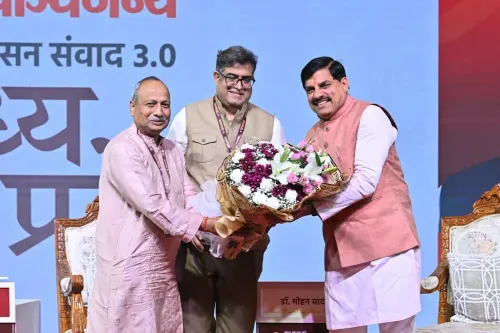
Mohan Yadav addressed Panchjanya 's 'Sushasan Samvad 3.0' in Bhopal on 25 October 2026 .
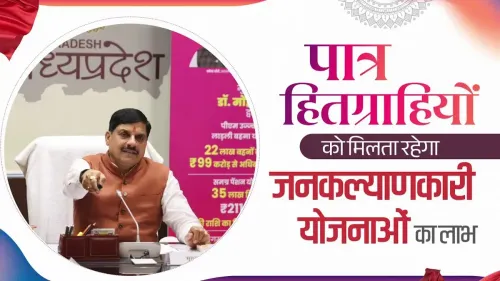
He outlined six welfare priorities: women's economic empowerment, farmers' income growth, rural housing ownership, quality education, universal healthcare, and tribal-area development.
Permanent infrastructure for Singhsth-2028 — the Simhastha Kumbh Mela in Ujjain — is listed as a top state priority; the previous edition was held in 2016 .
Wildlife conservation and industrial investment were both named as government priorities, reflecting MP's dual role as India's top tiger-reserve state and an emerging investment destination.
The forum was organised by Panchjanya , the RSS-affiliated national weekly magazine, underscoring the ideological audience for the governance agenda.
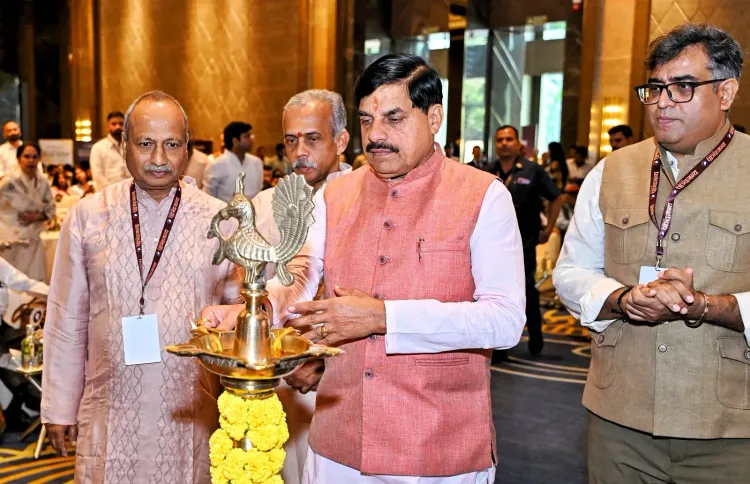
At a packed governance conclave in Bhopal on Sunday, 25 October 2026, Madhya Pradesh Chief Minister Dr. Mohan Yadav laid out an ambitious, multi-front development agenda for the state — from rural housing and women's economic empowerment to tribal welfare and the countdown to one of India's grandest religious gatherings.
Speaking at 'Sushasan Samvad 3.0' ('Good Governance Dialogue 3.0'), organised by the RSS-affiliated national weekly magazine Panchjanya, Dr. Yadav framed his government's mission in concrete, people-first terms: 'Our resolve is that the benefits of development reach every family, women receive economic support, farmers' incomes rise, rural families get home ownership, students get quality education, and all citizens have access to better healthcare.'
Six Pillars Driving MP's 'Samriddh Madhya Pradesh' Vision
The Chief Minister enumerated a six-point welfare charter — women's economic security, agricultural income growth, rural housing ownership, quality education, universal healthcare, and tribal-area development. Each pillar maps directly onto the BJP government's stated 'Samriddh Madhya Pradesh' (prosperous Madhya Pradesh) framework, which has anchored state policy through successive terms.
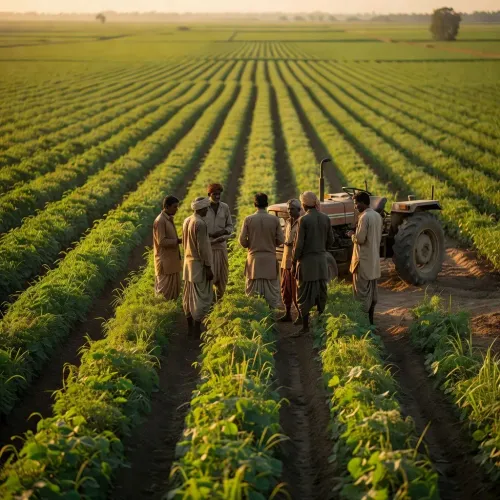
The emphasis on rural home ownership signals continued momentum for property-titling programmes that have gained traction across BJP-governed states, while the focus on women's economic support points to self-help group and livelihoods schemes that form the backbone of grassroots welfare delivery in the state.
Singhsth-2028: Bhopal Is Already Building
Perhaps the sharpest signal of long-term planning in Dr. Yadav's address was the explicit mention of Singhsth-2028 — the Simhastha Kumbh Mela to be held in Ujjain, Madhya Pradesh. The Simhastha is one of Hinduism's most significant pilgrimages; the last edition, in 2016, drew tens of millions of devotees to Ujjain over several weeks. With the next edition still two years away, the government is already committing to 'permanent facilities' — infrastructure built to outlast the event and serve the city long after the mela ends.
That framing is deliberate. Hosting a mega-mela at this scale is both a logistical challenge and an economic opportunity, generating hospitality, trade, and visibility that ripple well beyond pilgrimage season. Permanent infrastructure investment now means Ujjain gains lasting urban assets — roads, ghats, sanitation, and accommodation — regardless of the mela calendar.
Wildlife Conservation and Industrial Investment in the Same Breath
Dr. Yadav also paired two priorities that don't always sit comfortably together: wildlife conservation and industrial investment. Madhya Pradesh is home to more tiger reserves than any other Indian state, making ecological stewardship both a governance responsibility and a tourism asset. Listing industrial investment alongside conservation signals the government's intent to pursue economic growth while maintaining the state's environmental credentials — a balance that will be tested as investment proposals arrive.
The Panchjanya forum itself underscores the audience the Chief Minister was addressing: a platform associated with organised cultural nationalism, where governance credibility is measured not just in GDP figures but in delivery to rural, tribal, and agrarian communities.
With Singhsth-2028 as the headline event and welfare delivery as the daily metric, Dr. Mohan Yadav's governance agenda is now publicly benchmarked — and the clock is running.
Point of View
Women's income, tribal development) that also resonate with the broader electorate. The Singhsth-2028 infrastructure push is a dual-purpose play: a cultural statement for the party's Hindu nationalist constituency and a hard economic investment in Ujjain's long-term urban development. Pairing wildlife conservation with industrial investment in the same address reflects a tension that will define MP's policy choices over the next two years — managing ecological assets without turning away capital. The 'Samriddh Madhya Pradesh' framing gives the government a measurable public commitment to welfare outcomes, raising the political stakes for actual delivery.
NationPress
25 Oct 2026
Frequently Asked Questions
What is Sushasan Samvad 3.0?
'Sushasan Samvad' — meaning 'Good Governance Dialogue' — is an event series organised by the national weekly magazine Panchjanya. The third edition, held in Bhopal on 25 October 2026, featured Madhya Pradesh Chief Minister Dr. Mohan Yadav discussing governance, welfare, and development priorities.
What is Singhsth-2028 and why is it significant for Madhya Pradesh?
Singhsth-2028 refers to the Simhastha Kumbh Mela, a major Hindu pilgrimage held every 12 years in Ujjain, Madhya Pradesh. The previous edition in 2016 attracted tens of millions of pilgrims. The 2028 edition is a priority for the state government, which is investing in permanent infrastructure in Ujjain ahead of the event.
What are Madhya Pradesh CM Mohan Yadav's top development priorities?
CM Dr. Mohan Yadav has listed six key welfare priorities: women's economic empowerment, increasing farmers' incomes, rural housing ownership, quality education, universal healthcare, and tribal-area development. He has also highlighted Singhsth-2028 infrastructure, wildlife conservation, and industrial investment as state priorities.
What is Panchjanya magazine?
Panchjanya is an RSS-affiliated national weekly magazine in India. It regularly hosts forums and dialogues on governance, culture, and policy, and has an audience closely aligned with the ideological ecosystem of the Sangh Parivar.
How does Madhya Pradesh plan to develop tribal areas?
CM Dr. Mohan Yadav has identified tribal-area development as a formal government priority, though specific schemes were not detailed in his 25 October address. The broader state framework places tribal welfare alongside women's empowerment, rural housing, and agricultural income as pillars of the 'Samriddh Madhya Pradesh' vision.