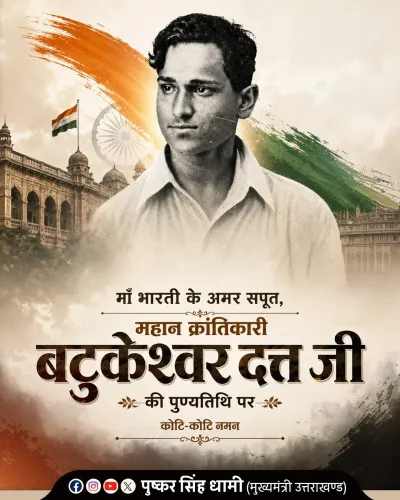
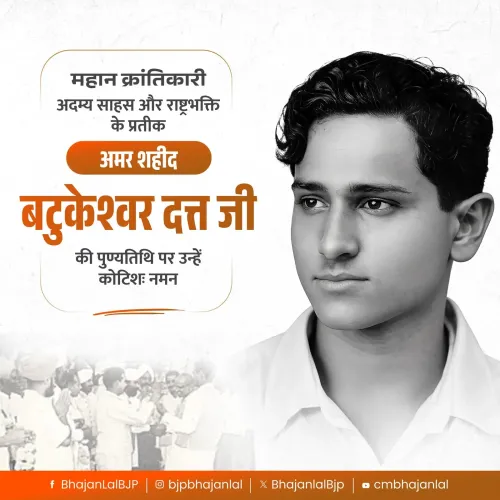
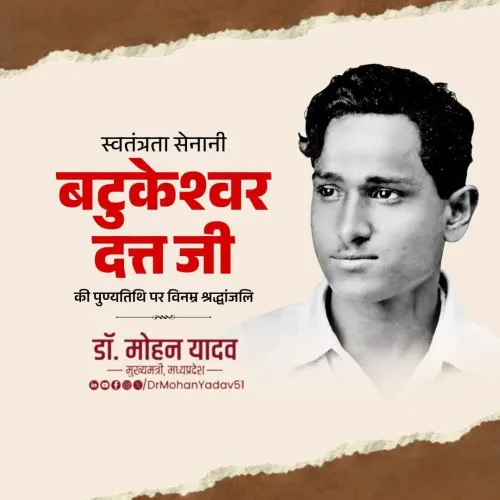
CM Mohan Yadav pays tribute to revolutionary Batukeshwar Dutt on birth anniversary
Synopsis
Madhya Pradesh CM Dr. Mohan Yadav paid tribute to revolutionary Batukeshwar Dutt on his birth anniversary, honouring the man who, with Bhagat Singh, bombed the Central Legislative Assembly in 1929 as an act of anti-colonial defiance.
Key Takeaways
Mohan Yadav posted a tribute to revolutionary Batukeshwar Dutt on his birth anniversary on 18 November 2026 .
Batukeshwar Dutt and Bhagat Singh threw smoke bombs in the Central Legislative Assembly, Delhi , on 8 April 1929 to protest colonial legislation.
Dutt was sentenced to transportation for life and was imprisoned in the Cellular Jail, Andaman Islands .
The tribute reflects a standard pattern of national commemoration by Indian political leaders across parties on freedom fighter anniversaries.
CM Yadav described Dutt's sacrifice and devotion to the nation as 'always to be remembered.'
A freedom fighter who walked into the heart of colonial power and detonated not just a bomb but a political idea — Batukeshwar Dutt is remembered on his birth anniversary today, Wednesday, 18 November 2026, with Madhya Pradesh Chief Minister Dr. Mohan Yadav leading tributes on social media.
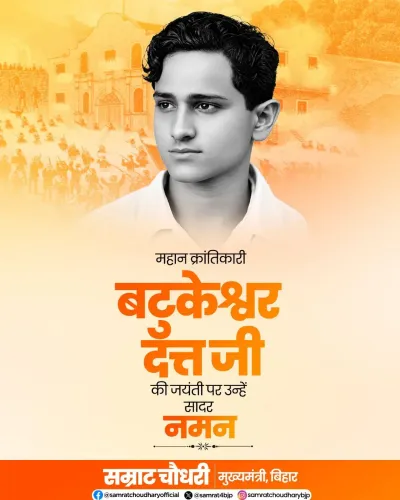
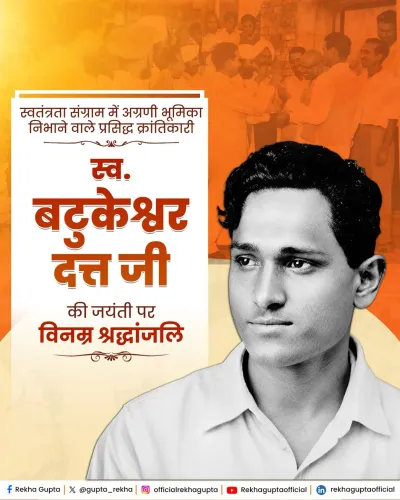
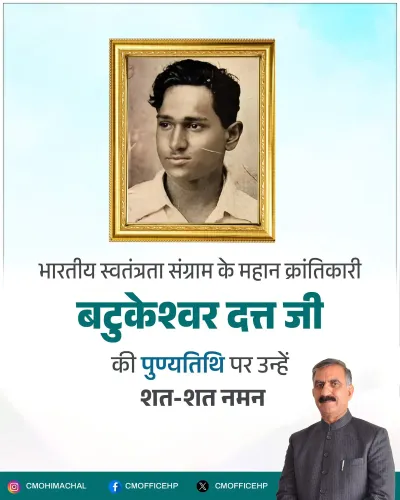
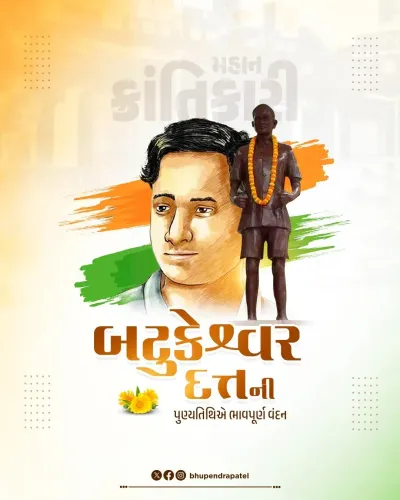
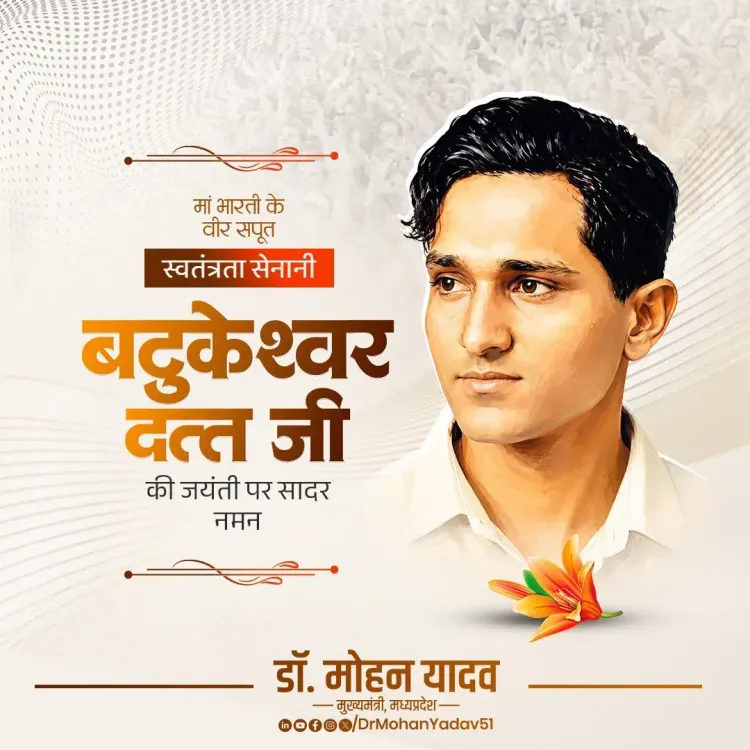
CM Dr. Yadav wrote, 'मां भारती की स्वतंत्रता के लिए अदम्य साहस और अटूट संकल्प के साथ संघर्ष करने वाले महान क्रांतिकारी बटुकेश्वर दत्त जी की जयंती पर सादर नमन' — 'Respectful salutation to the great revolutionary Batukeshwar Dutt Ji on his birth anniversary, who fought for the freedom of Mother India with indomitable courage and unwavering resolve.' He added that Dutt's sacrifice, dedication, and devotion to the nation 'will always be remembered.'
The 1929 Assembly bombing that shook British India
On 8 April 1929, Batukeshwar Dutt and Bhagat Singh threw smoke bombs from the public gallery of the Central Legislative Assembly in Delhi — a carefully choreographed act of defiance timed to protest repressive colonial legislation. The goal was not to kill but to make the deaf hear, as the accompanying pamphlet declared. Both men surrendered to British authorities immediately after, turning the act into a trial-by-fire for anti-colonial ideas.
Dutt was sentenced to transportation for life and endured years of imprisonment, including the infamous Cellular Jail in the Andaman Islands. Unlike many contemporaries whose stories were eventually canonised, Dutt spent his later years in relative obscurity, struggling with poverty and illness — a reality that lends his memory both a heroic and a quietly poignant dimension.
Routine tributes, enduring purpose
Indian political leaders across parties observe a steady calendar of freedom-fighter birth anniversaries through social-media homages. What gives these moments meaning beyond ritual is the specificity of the revolutionary being remembered — Dutt's act in 1929 was a turning point in public consciousness about non-violent versus militant resistance and remains a studied episode in India's independence history.
For a ruling BJP government in Madhya Pradesh, invoking the revolutionary tradition of figures like Dutt also reinforces a broader nationalist narrative that spans the full spectrum of the independence movement — not just its Gandhian strand. The tribute is brief, but the history it gestures toward is not.
Point of View
Invoking the militant-revolutionary strand of the independence movement — distinct from the dominant Gandhian narrative — has long been part of its ideological self-positioning. Dr. Mohan Yadav's post is routine in form but carries that symbolic undertone. As India's freedom-fighter commemoration calendar grows more crowded, the figures who get amplified — and by whom — remain a quiet but telling indicator of which historical memories a government chooses to keep alive.
NationPress
18 Nov 2026
Frequently Asked Questions
Who was Batukeshwar Dutt?
Batukeshwar Dutt was an Indian revolutionary who, alongside Bhagat Singh, threw smoke bombs in the Central Legislative Assembly in Delhi on 8 April 1929 to protest repressive colonial legislation. Both men surrendered immediately, turning the act into a public statement against British rule.
What was the significance of the 1929 Central Legislative Assembly bombing?
The 1929 bombing was a deliberately symbolic act — the bombs were designed to make noise, not cause mass casualties. The act, accompanied by pamphlets, was intended to highlight colonial laws and mobilise public opinion. The slogan 'Inquilab Zindabad' gained wide circulation after the incident.
What happened to Batukeshwar Dutt after his arrest?
Batukeshwar Dutt was sentenced to transportation for life and imprisoned in the Cellular Jail in the Andaman Islands. He endured years of harsh imprisonment and, unlike many celebrated independence figures, spent his later life in relative obscurity before his death.
Why do Indian politicians tribute freedom fighters on social media?
Indian political leaders across parties maintain a steady calendar of birth and death anniversaries of freedom fighters, using social media tributes as a form of national commemoration. It reinforces patriotic credentials and keeps historical memory in public discourse.
What did CM Mohan Yadav say about Batukeshwar Dutt?
CM Dr. Mohan Yadav said Dutt fought for India's freedom with 'indomitable courage and unwavering resolve' and that his 'sacrifice, dedication, and devotion to the nation will always be remembered.'