CM Mohan Yadav Pledges 21 Lakh Saplings in Indore Under Ek Ped Maa Ke Naam

Synopsis
Chief Minister Dr. Mohan Yadav has announced a pledge to plant 21 lakh saplings in Indore under PM Modi's 'Ek Ped Maa Ke Naam' campaign, calling the initiative a growing people's movement and signalling Madhya Pradesh's active role in India's national afforestation push.
Key Takeaways
The Chief Minister's Office of Madhya Pradesh announced the pledge on 12 July 2026 .
Mohan Yadav has set a target of 21 lakh saplings to be planted in Indore .
The drive falls under the 'Ek Ped Maa Ke Naam' campaign launched by PM Narendra Modi in 2024 .
CM Yadav described the campaign as taking the form of a janandolan (people's movement), emphasising mass public participation.
Indore — Madhya Pradesh's largest city and a perennial top performer in national cleanliness rankings — is the focal city for this target.
Post-monsoon sapling survival rates will be a key indicator of the campaign's real-world environmental impact.
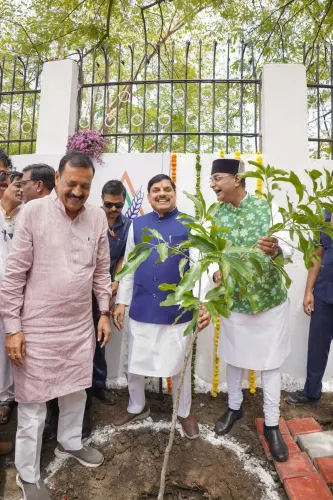
The Chief Minister's Office of Madhya Pradesh announced on Sunday, 12 July 2026 that Chief Minister Dr. Mohan Yadav has pledged a plantation drive of 21 lakh saplings in Indore under the 'Ek Ped Maa Ke Naam' campaign, describing the initiative as rapidly evolving into a mass public movement.
Context
Sharing the update on X, CM Dr. Mohan Yadav stated: 'यह अभियान जनआंदोलन का रूप ले रहा है' ('This campaign is taking the form of a people's movement'). He credited the drive to the guidance of Prime Minister Narendra Modi, under whose leadership the national afforestation push has been rolled out across the country. The post marks one of the most specific district-level targets announced publicly under the campaign in Madhya Pradesh.
Policy Backdrop
The 'Ek Ped Maa Ke Naam' (One Tree in Mother's Name) campaign was launched by Prime Minister Narendra Modi in 2024 as a nationwide afforestation initiative, encouraging citizens to plant and dedicate saplings to their mothers as a symbol of environmental stewardship. The campaign draws on emotional and cultural resonance to drive voluntary public participation beyond government machinery. Madhya Pradesh, one of India's most forested states, has positioned itself as an active implementer of central environmental schemes, integrating such drives into both urban and rural development frameworks.
Indore, the state's largest city, has a well-established track record of civic mobilisation — having consistently topped national urban cleanliness rankings — making it a natural anchor city for high-visibility environmental targets. The 21-lakh sapling pledge for Indore signals an intent to replicate that civic energy in the domain of green cover expansion.
Stakeholders and Impact
The primary beneficiaries of the drive are Indore's residents and its surrounding peri-urban and rural communities, who stand to gain from increased tree cover, improved air quality, and urban heat mitigation. Local volunteers, resident welfare associations, and municipal bodies are expected to serve as the operational backbone of the plantation effort. Indian states routinely align with central environmental drives to meet national climate commitments, and a successful 21-lakh sapling campaign in Indore could serve as a model for replication across other Madhya Pradesh districts.
The campaign's framing as a 'janandolan' (people's movement) is also significant: it shifts responsibility and ownership to citizens, potentially improving long-term sapling survival rates compared to purely government-led plantation exercises.
What's Next
Observers will watch whether the 21-lakh target in Indore is followed by comparable district-level pledges across Madhya Pradesh, particularly ahead of the peak monsoon planting window — the most ecologically optimal period for sapling establishment. Official reporting on sapling survival rates after Monsoon 2026 will be a key metric for assessing the campaign's on-ground impact. If the Indore drive delivers measurable results, it could strengthen the state's positioning in national environmental rankings and inform the broader 'Ek Ped Maa Ke Naam' playbook for urban centres across India.
Point of View
Using Indore's civic brand equity to generate momentum. By framing the drive as a 'people's movement' rather than a government programme, CM Yadav is attempting to build durable community ownership — a recurring challenge in mass plantation exercises where sapling survival rates often disappoint. The move also fits a broader pattern of the BJP-governed state aligning tightly with the Prime Minister's signature initiatives ahead of electoral cycles. Whether the 21-lakh target translates into verified green cover or remains a headline figure will depend heavily on post-plantation monitoring, which has historically been the weakest link in such campaigns.
NationPress
12 Jul 2026
Frequently Asked Questions
What is the 'Ek Ped Maa Ke Naam' campaign?
'Ek Ped Maa Ke Naam' (One Tree in Mother's Name) is a national tree-plantation campaign launched by Prime Minister Narendra Modi in 2024, encouraging citizens across India to plant saplings and dedicate them to their mothers as part of a broader afforestation and environmental awareness drive.
How many saplings are being planted in Indore under this campaign?
Chief Minister Dr. Mohan Yadav has pledged the plantation of 21 lakh saplings in Indore under the 'Ek Ped Maa Ke Naam' campaign, as announced by the Chief Minister's Office of Madhya Pradesh on 12 July 2026.
Who is leading the tree plantation drive in Madhya Pradesh?
The drive is being led by Chief Minister Dr. Mohan Yadav under the guidance of Prime Minister Narendra Modi, with the Chief Minister's Office of Madhya Pradesh coordinating the state-level rollout of the national campaign.
Why is Indore chosen for the 21-lakh sapling target?
Indore is Madhya Pradesh's largest city and has a strong record of civic mobilisation, having repeatedly topped national urban cleanliness rankings. This makes it a natural focal point for high-profile environmental targets requiring large-scale public participation.
When is the best time to plant saplings under this campaign in Madhya Pradesh?
The monsoon season — typically June to September — is the most ecologically optimal window for sapling plantation in Madhya Pradesh, as adequate rainfall significantly improves survival rates for newly planted trees.