CM MP Office Announces Metro, IT Hubs, Airport Push
Synopsis
The Chief Minister's Office of Madhya Pradesh announced a sweeping infrastructure agenda on 4 July 2026, covering underground metro lines, elevated corridors, industrial and logistics parks, IT hubs, and new airports — signalling a multi-sector push to accelerate urban and economic growth across the state.
Key Takeaways
The Chief Minister's Office of Madhya Pradesh announced plans for underground metro lines, elevated corridors , industrial and logistics parks, IT hubs, and new airports on 4 July 2026 .
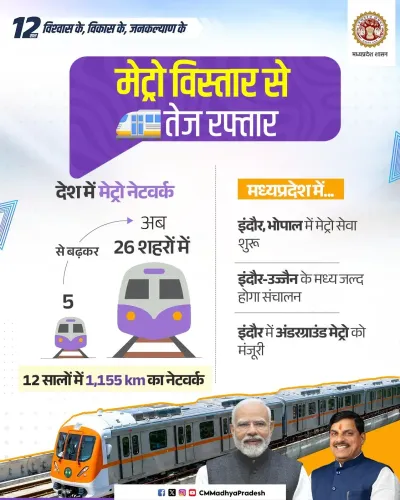
Metro rail projects for Indore and Bhopal were approved under the Metro Rail Policy of 2017–2018 , with the Indore Metro combining underground and elevated sections.
The announcement aligns with the state's Logistics Policy of 2022 and the national PM Gati Shakti multimodal infrastructure framework.
Industrial investors, logistics operators, and urban commuters are the primary stakeholders of the multi-sector development plan.
Specific project timelines, investment figures, and airport locations have not been detailed in the current announcement.
State budget allocations and tender awards in the coming fiscal year will indicate how quickly the vision translates into implementation.
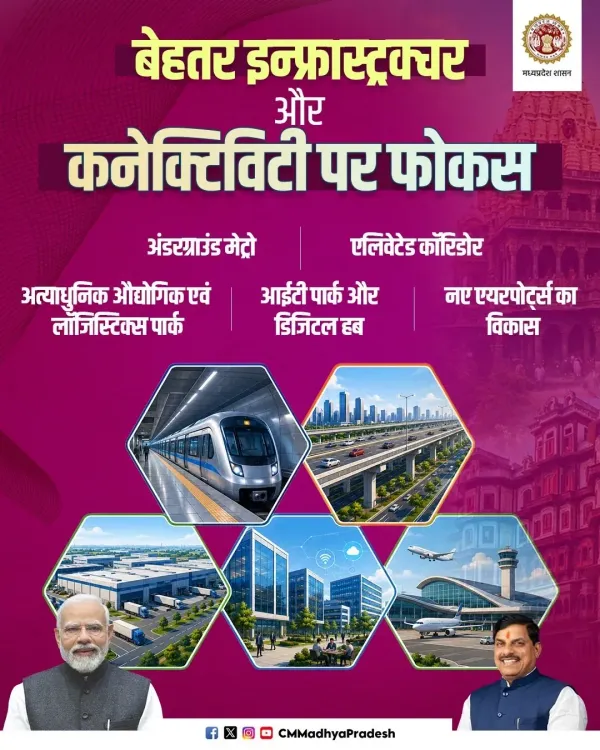
The Chief Minister's Office of Madhya Pradesh announced on Saturday, 4 July 2026 a broad infrastructure push for the state, outlining plans for underground metro lines, elevated corridors, advanced industrial and logistics parks, IT hubs, and new airports. The announcement, shared on the official @CMMadhyaPradesh X account, signals a multi-sector urban and economic development agenda for Madhya Pradesh.
Context
The post, written in Hindi, states: 'अंडरग्राउंड मेट्रो, एलिवेटेड कॉरिडोर, अत्याधुनिक औद्योगिक एवं लॉजिस्टिक्स पार्क, आईटी हब और नए एयरपोर्ट्स का होगा विकास' — translated: 'Underground metro, elevated corridors, state-of-the-art industrial and logistics parks, IT hubs, and new airports will be developed.' The breadth of the announcement covers urban mobility, industrial infrastructure, digital economy, and air connectivity in a single statement.
Madhya Pradesh is a fast-urbanising central Indian state whose two largest cities — Indore and Bhopal — have been at the centre of metro rail planning for nearly a decade. The simultaneous mention of underground and elevated segments reflects the mixed-terrain topology of these cities.
Policy Backdrop
Metro rail projects for Indore and Bhopal received central government approval under the Metro Rail Policy of 2017–2018, with both cities progressing through civil construction phases in subsequent years. The Indore Metro, in particular, combines underground and elevated sections to navigate the city's dense commercial core.
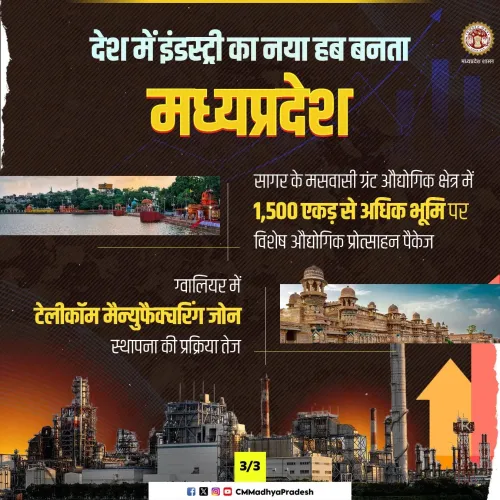
The state's Logistics Policy of 2022 laid the groundwork for developing industrial parks and multimodal logistics hubs, aligning with the national PM Gati Shakti master plan — a 2021 initiative integrating roads, rail, airports, and logistics corridors across India. The current announcement appears to build on that policy lineage, extending it to IT infrastructure and airport development.
At the national level, programmes such as the Smart Cities Mission have channelled investment into urban mobility and digital infrastructure in cities like Indore, which has also ranked as India's cleanest city multiple consecutive times, boosting its profile as an investment destination.
Stakeholders and Impact
Urban commuters in Indore and Bhopal stand to benefit most directly from metro expansion and elevated corridors, which are designed to reduce surface congestion in rapidly growing urban centres. Industrial investors and logistics operators are the primary audience for the parks and multimodal hub components of the plan.
The inclusion of IT hubs signals an attempt to attract technology-sector investment and white-collar employment, a competitive space where states such as Telangana, Karnataka, and Tamil Nadu have historically held an edge. New or expanded airports, if progressed, would improve regional air connectivity and support both business travel and cargo movement tied to the proposed industrial zones.
The announcement is likely to be watched closely by manufacturers scouting locations under the national Make in India and production-linked incentive frameworks, for whom logistics infrastructure and air connectivity are key decision factors.
What's Next
The immediate focus for observers will be on state budget allocations and tender awards for specific metro packages, airport upgrades, and park development in the coming fiscal cycle. Detailed project timelines and investment figures have not been specified in this announcement.
As Madhya Pradesh positions itself alongside other aspirational states in India's infrastructure race, the translation of this multi-sector vision into awarded contracts and ground-level construction will be the true measure of momentum. State and central agencies will need to coordinate on land acquisition, environmental clearances, and funding structures for projects of this scale.
Point of View
Logistics, and digital economy infrastructure into a single political communication to signal investor-readiness. For Madhya Pradesh, which has historically lagged behind coastal and southern states in attracting technology-sector investment, the explicit mention of IT hubs alongside metro and airport development is a notable strategic pivot. The framing also dovetails with the Centre's PM Gati Shakti logic of integrated, multimodal infrastructure planning, giving the state a narrative hook to leverage national funding streams. Whether this translates into accelerated project delivery will depend on the pace of land acquisition, environmental clearances, and budgetary commitment in the months ahead.
NationPress
4 Jul 2026
Frequently Asked Questions
What infrastructure projects did the Madhya Pradesh CM Office announce?
The Chief Minister's Office of Madhya Pradesh announced plans for underground metro lines, elevated corridors, state-of-the-art industrial and logistics parks, IT hubs, and new airports, as stated in a post on 4 July 2026.
Which cities in Madhya Pradesh have metro rail projects?
Indore and Bhopal are the two cities in Madhya Pradesh with approved metro rail projects. The Indore Metro includes both underground and elevated sections, and both projects received central government approval under the Metro Rail Policy of 2017–2018.
What is PM Gati Shakti and how does it relate to MP's infrastructure plans?
PM Gati Shakti is a national multimodal infrastructure master plan launched in 2021 that integrates roads, rail, airports, and logistics corridors. Madhya Pradesh's industrial park and logistics hub plans align with this framework, potentially enabling the state to access central funding and coordination support.
What is Madhya Pradesh's Logistics Policy?
Madhya Pradesh introduced its Logistics Policy in 2022 to develop industrial parks and multimodal logistics hubs across the state, forming the policy foundation for the infrastructure push announced in July 2026.
When will Madhya Pradesh's new metro and airport projects be completed?
Specific timelines for the announced metro expansions, new airports, and other infrastructure projects have not been detailed in the current announcement. State budget allocations and tender awards in the coming fiscal year are expected to provide clearer timelines.