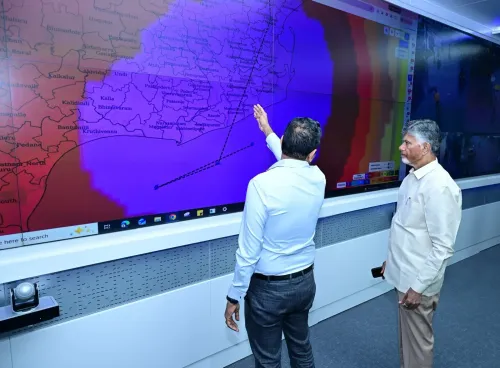
CM Chandrababu Reviews Cyclone Arnab Response via Teleconference

Synopsis
Chief Minister Nara Chandrababu Naidu convened an emergency teleconference on October 29 as Cyclone Arnab struck Andhra Pradesh, ordering officials to remain deployed in the field until full normalcy is restored and crediting the administration with minimising casualties and damage.
Key Takeaways
CM Nara Chandrababu Naidu held a teleconference on October 29, 2026 to review the state's response to Cyclone Arnab .
Officials were directed to stay deployed at the field level until normal conditions are restored across affected areas.
The Chief Minister credited the administrative machinery with performing 'marvellously' during the cyclone.
The government stated it had minimised both loss of life and property damage to the greatest possible extent.
Andhra Pradesh has a documented track record of large-scale cyclone evacuations dating back to Cyclone Hudhud in 2014 .
Damage assessment, relief distribution, and infrastructure restoration are the administration's next immediate priorities.
With Cyclone Arnab still battering Andhra Pradesh, Chief Minister Nara Chandrababu Naidu held an emergency teleconference on Thursday, October 29, 2026, directing the state machinery to stay on the ground until full normalcy returns — no standing down, no standing by.
The CM's message: no rest until normalcy returns
Naidu's instruction to officials was unambiguous: remain deployed at the field level until conditions stabilise for affected residents. Addressing the administration via teleconference, the Chief Minister credited the state machinery with an outstanding performance during the cyclone, saying the government had succeeded in minimising both loss of life and property damage to the greatest extent possible.
The post from the Chief Minister's Office quoted him directly: the administrative apparatus had worked 'marvellously' during Cyclone Arnab, and every effort was made to reduce casualties and damage as much as possible.
Andhra Pradesh's hard-won edge in cyclone preparedness
Andhra Pradesh sits squarely in the Bay of Bengal's cyclone corridor — one of the most storm-exposed coastlines in South Asia. The state has spent years building institutional muscle for exactly these moments. During Cyclone Hudhud in 2014, the Naidu administration's coordinated mass evacuations drew national attention for driving down the death toll against a storm of exceptional intensity. That precedent set a benchmark the state has since tried to match and exceed with every successive system.
The framework that emerged — early warnings, pre-emptive evacuations, round-the-clock official deployment — is now the template. Naidu's teleconference today signals that the same protocol is live and active for Arnab.
What comes next: damage counts and relief pipelines
The immediate priority for the administration shifts to damage assessment across affected districts, restoring power and communication links, and activating relief distribution networks. Officials have been explicitly told to hold their positions on the ground until those benchmarks are met. The pace of that restoration — and the final casualty and damage figures — will define the full measure of this response.
For a coastline that has weathered storm after storm, the real test of preparedness is never the cyclone itself. It is what the numbers say when the water recedes.
Point of View
Hands-on crisis management — a style that doubles as political signalling of administrative competence. The explicit instruction to officials not to stand down until normalcy returns is less a logistical directive than a public accountability benchmark, setting a visible standard against which post-cyclone performance will be judged. For a government that built its credibility partly on the Hudhud response of 2014, each new cyclone is both a test and an opportunity to reinforce that narrative. How quickly relief reaches affected districts will determine whether the self-assessment of 'marvellous' performance holds up beyond the teleconference.
NationPress
29 Oct 2026
Frequently Asked Questions
What is Cyclone Arnab and where did it hit?
Cyclone Arnab is a cyclonic storm that struck Andhra Pradesh in late October 2026 , prompting the state government to activate its full disaster-response machinery along the Bay of Bengal coast.
What did CM Chandrababu Naidu say about Cyclone Arnab?
CM Nara Chandrababu Naidu said the administrative machinery worked marvellously during Cyclone Arnab and that the government had succeeded in minimising casualties and property damage to the greatest possible extent.
What instructions did the Andhra Pradesh CM give to officials after Cyclone Arnab?
Naidu directed officials not to rest or stand down until normal conditions are fully restored at the field level in all cyclone-affected areas of Andhra Pradesh .
How has Andhra Pradesh handled cyclones in the past?
During Cyclone Hudhud in 2014 , the Andhra Pradesh government coordinated large-scale evacuations that significantly reduced loss of life, establishing a disaster-response model the state has built upon in subsequent storms.
What are the next steps for Andhra Pradesh after Cyclone Arnab?
The state administration is focused on damage assessment across affected districts, restoring power and communication links, and activating relief distribution networks while officials remain deployed on the ground.