CM Chandrababu Reviews Cyclone Arnab Threat to AP Coast

Synopsis
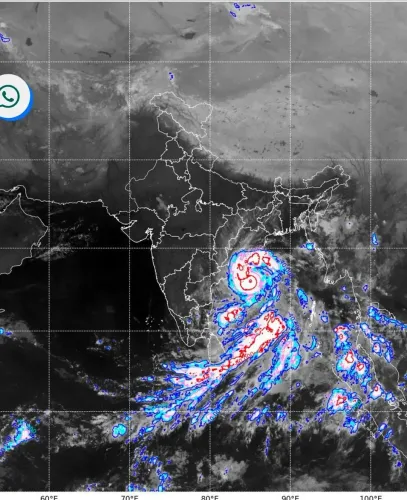
Chief Minister Nara Chandrababu Naidu on October 27 chaired a high-level review of Cyclone Arnab, positioned 167 km from Yanam and moving at 23 km/h. He ordered district collectors to evacuate low-lying areas, stock relief camps, restore power swiftly, and deploy NDRF and SDRF teams fully.
Key Takeaways
Cyclone Arnab was centred 167 km from Yanam near Kakinada as of the October 27 review, moving toward the coast at 23 km/h .
CM Chandrababu Naidu chaired a high-level review at his camp office and issued orders via teleconference to district collectors.
Collectors were directed to evacuate residents of low-lying areas to safe locations and stock relief camps with food and drinking water.
NDRF and SDRF teams already on standby were ordered to be deployed to their full capacity.
Rapid power restoration in the event of disruptions was flagged as a key operational priority.
District control rooms were tasked with continuous real-time field monitoring throughout the cyclone event.
With Cyclone Arnab bearing down on Andhra Pradesh's coastline, Chief Minister Nara Chandrababu Naidu chaired a high-level emergency review at his camp office on Tuesday, October 27, 2026 — issuing real-time directives to district collectors across the state to protect lives and property before the storm makes landfall.
Storm's position: 167 km from Yanam, closing fast
Officials briefing the Chief Minister confirmed that the cyclone's centre was located 167 kilometres from Yanam, the coastal enclave near Kakinada, and had been tracking toward the shore at 23 kilometres per hour over the preceding six hours. That trajectory puts landfall squarely in the crosshairs of one of Andhra Pradesh's most densely populated coastal belts.
The CM sought granular, district-by-district updates on the storm's impact and the scale of rainfall already battering vulnerable zones — signalling that the review was not ceremonial but operationally hands-on.
Naidu's orders to collectors: evacuate, restore, stockpile
Via a teleconference with district collectors, CM Naidu issued a precise four-point instruction set. First: take every precaution to prevent loss of life and property. Second: restore power supply 'as swiftly as possible' if disruptions occur. Third: ensure relief camps are stocked with food and drinking water. Fourth: move all residents of low-lying areas to safer ground without delay.
These are not improvised responses — they reflect protocols embedded in Andhra Pradesh's disaster management architecture after Cyclone Hudhud in 2014 forced a systematic overhaul of district-level coordination, evacuation logistics, and communication chains.
NDRF and SDRF teams on full deployment
The Chief Minister directed collectors to make full use of NDRF (National Disaster Response Force) and SDRF (State Disaster Response Force) units already positioned in the field. District control rooms set up across the affected zone were tasked with continuous, real-time ground-level monitoring — ensuring that information flows up to the state instantly rather than through delayed reporting chains.
Andhra Pradesh's long Bay of Bengal coastline makes it one of India's most cyclone-exposed states. The combination of pre-positioned forces, stocked relief camps, and a Chief Minister personally driving the review from his camp office is precisely the kind of early-response architecture that determines whether a cyclone becomes a tragedy or a manageable emergency.
The next critical window is landfall — and whether the evacuations ordered today hold firm against what Arnab brings ashore.
Point of View
Pre-landfall executive engagement a standard protocol rather than a reactive measure. By personally chairing the review and issuing specific operational directives, CM Naidu is reinforcing a governance model where political accountability and disaster preparedness are visibly linked. The deployment of both NDRF and SDRF before landfall signals a shift from reactive rescue to proactive shielding — a metric on which coastal state governments are increasingly judged. How effectively the evacuation and relief camp orders translate into ground-level action will determine the political and humanitarian verdict on this storm.
NationPress
27 Oct 2026
Frequently Asked Questions
Where is Cyclone Arnab expected to make landfall in Andhra Pradesh?
Cyclone Arnab was centred 167 kilometres from Yanam near Kakinada as of the October 27 review, moving toward the coast at 23 km/h. Kakinada and the surrounding coastal belt of East Godavari district are in the storm's projected path.
What orders did CM Chandrababu Naidu give regarding Cyclone Arnab?
CM Naidu directed district collectors to evacuate residents from low-lying areas, stock relief camps with food and drinking water, restore power supply swiftly if disrupted, and fully deploy NDRF and SDRF teams for emergency response.
What are NDRF and SDRF and why are they deployed for Cyclone Arnab?
NDRF (National Disaster Response Force) is India's specialised central agency for disaster relief, while SDRF (State Disaster Response Force) is Andhra Pradesh's own emergency unit. Both were pre-positioned and ordered to full deployment ahead of Cyclone Arnab's landfall.
How is Andhra Pradesh prepared for cyclones after past storms?
After Cyclone Hudhud devastated the coast in 2014 , Andhra Pradesh overhauled its disaster protocols — strengthening district-level control rooms, evacuation procedures, and pre-positioning of relief forces, which are now standard before any major cyclonic event.
What should residents of coastal Andhra Pradesh do during Cyclone Arnab?
Residents of low-lying and coastal areas should follow government evacuation orders and move to designated relief camps , which are being stocked with food and drinking water. District control rooms are monitoring the situation continuously.