CM Bhupendra Patel Unveils Fish Scale Weir on Banas River
Synopsis
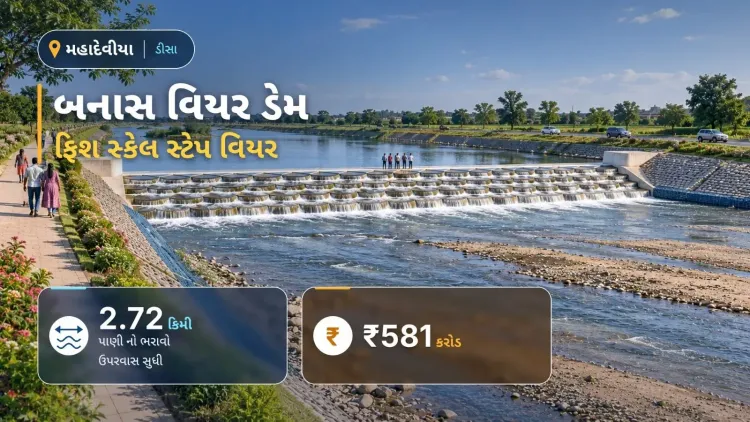
Gujarat CM Bhupendra Patel announced a Fish Scale Stepped Weir dam on the Banas River in Banaskantha, designed with IIT Roorkee to store water in a 2.72 km reservoir, raise groundwater levels, and benefit farmers, livestock keepers, and villages across north Gujarat.
Key Takeaways
Gujarat CM Bhupendra Patel announced a Fish Scale Stepped Weir dam on the Banas River in Banaskantha district on 3 November 2026 .
The structure is designed in collaboration with IIT Roorkee to suit the Banas River's unusually wide bed, where conventional check dams are less effective.
Water released from Dantiwada Dam and Sipu Dam will be stored in a reservoir 2.72 km in length instead of flowing away.
The project aims to raise groundwater levels, benefit farmers, livestock keepers, and rural villages across north Gujarat.
The completed site may be developed as a new tourism centre , adding economic potential beyond irrigation.
The initiative is framed as an extension of PM Narendra Modi 's Jal Shakti mass water conservation movement.
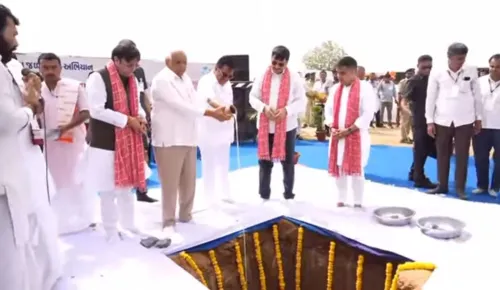
Water is slipping away — and Gujarat Chief Minister Bhupendra Patel wants to stop it. On Tuesday, 3 November 2026, the CM announced a technically advanced water conservation structure on the Banas River in Banaskantha district, designed with support from IIT Roorkee to store water that has long been lost to runoff across the river's characteristically wide bed.
Why a traditional check dam would not work on the Banas
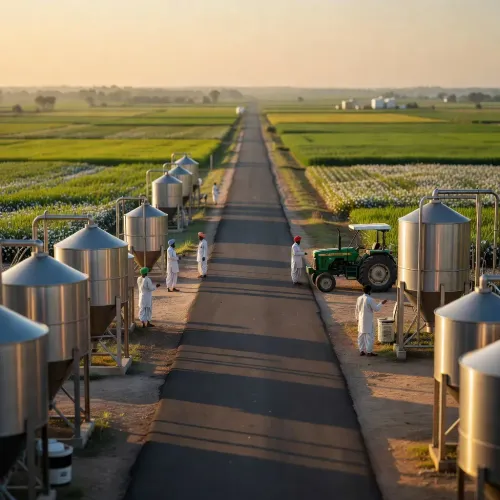
The Banas River's wide, flat bed has always made conventional check dams an imperfect fit — water spreads too thin, seeps too quickly, and moves on before it can recharge the aquifer. Patel's announcement signals a deliberate departure from that older model. The state has planned a 'Fish Scale Stepped Weir' dam, a design developed in collaboration with IIT Roorkee, engineered specifically for rivers with broad, shallow profiles where conventional masonry barriers underperform.
Water released from Dantiwada Dam and Sipu Dam currently flows downstream and dissipates. The new structure is intended to capture that outflow into a reservoir stretching 2.72 kilometres in length — turning waste into storage.
Groundwater, green fields, and the villages of Banaskantha
Banaskantha is one of Gujarat's most water-stressed districts — a semi-arid belt where groundwater tables have fallen steadily over decades, squeezing farmers, cattle keepers, and village communities alike. The CM's post frames the project explicitly in those terms: rising groundwater levels mean greener farms, relief for livestock herders, and a more secure supply for rural households.
The logic is direct. Store surface water, let it percolate, and the wells that communities depend on begin to recover. It is a principle Gujarat has pursued since the early 2000s, when thousands of check dams and boribunds (earthen plugs) were built across the state under then-Chief Minister Narendra Modi. The national Jal Shakti Abhiyan, launched in 2019, carried that same philosophy to the rest of India as a mass movement — what Patel calls a jan aandolan, a people's campaign.
A reservoir that could become a destination
Patel's announcement carries an additional ambition beyond irrigation. Once the structure is complete, the state is considering developing the site as a new tourism centre — a possibility that adds economic texture to what begins as an infrastructure project. Completed reservoirs have become leisure and pilgrimage destinations elsewhere in Gujarat; the Banas site could follow that template.
The CM closed his post with a pledge: walking the path that Prime Minister Modi charted for water conservation, the state's resolve is to make Banaskantha and all of Gujarat jal surakshit — water-secure. That word, 'resolve', carries weight in a district where the next monsoon is never guaranteed to be enough.
Point of View
Invoking PM Modi's Jal Shakti legacy is also a political alignment move, threading local infrastructure into a national narrative of water security. The tourism angle is a newer layer: it converts a utilitarian reservoir into a development asset, broadening the coalition of beneficiaries beyond just farmers. Whether groundwater tables in Banaskantha actually recover will be the unsentimental scoreboard that judges this project long after the inauguration.
NationPress
3 Nov 2026
Frequently Asked Questions
What is a Fish Scale Stepped Weir dam?
A Fish Scale Stepped Weir is an advanced hydraulic structure designed for rivers with wide, shallow beds where conventional check dams lose efficiency. Its stepped profile slows and captures water flow across a broad cross-section, improving storage and groundwater recharge. Gujarat is building one on the Banas River with IIT Roorkee's technical support.
Why is Banaskantha district chosen for this water project?
Banaskantha is one of Gujarat's most water-stressed districts, with chronic groundwater depletion and dependence on surface water structures. Its semi-arid terrain and the wide bed of the Banas River make it both a high-need zone and a suitable site for the innovative weir design announced by CM Patel.
What is the role of IIT Roorkee in the Banas River dam project?
IIT Roorkee, a premier technical institution with deep expertise in hydraulic and river engineering, is collaborating with the Gujarat government to design the Fish Scale Stepped Weir. The partnership reflects a shift toward research-institution-backed engineering for complex river morphologies.
What is the Jal Shakti Abhiyan and how does it relate to this project?
The Jal Shakti Abhiyan is a national campaign launched in 2019 to promote rainwater harvesting, groundwater recharge, and water conservation as a mass movement. CM Patel has positioned the Banas River project as a direct continuation of that mission at the state level in Gujarat.
Will the Banas River dam site also become a tourist spot?
Yes, CM Patel's announcement includes plans to develop the completed reservoir site as a new tourism centre in Banaskantha. This follows a broader Gujarat pattern of converting large water infrastructure projects into recreational and leisure destinations after completion.