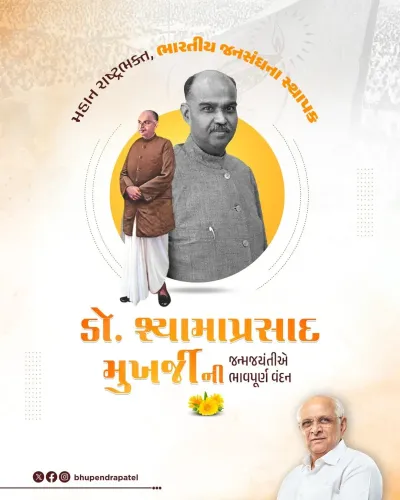
CM Bhupendra Patel Pays Tribute to Dr. Shyama Prasad Mukherjee
Synopsis
Gujarat Chief Minister Bhupendra Patel marked the martyrdom anniversary of Dr. Shyama Prasad Mukherjee on 23 June 2026, honouring the Bharatiya Jana Sangh founder's lifelong campaign for Kashmir's full integration and crediting PM Modi's 2019 abrogation of Article 370 as the fulfilment of that vision.
Key Takeaways
Gujarat CM Bhupendra Patel paid tribute to Dr.
Shyama Prasad Mukherjee on his martyrdom day, 23 June 2026 .
Mukherjee died on 23 June 1953 in detention in Srinagar while protesting Jammu and Kashmir's special constitutional status.
He founded the Bharatiya Jana Sangh in 1951 , championing the slogan 'Ek Vidhan, Ek Nishan, Ek Pradhan' to demand uniform constitutional status for Kashmir.
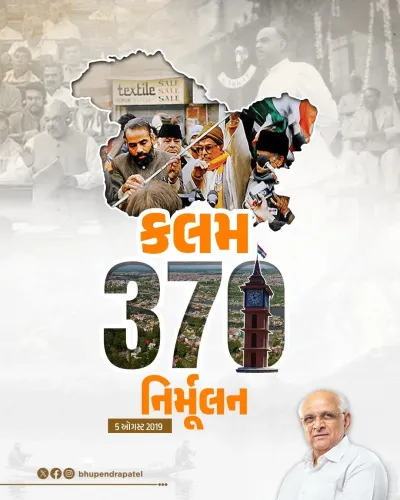
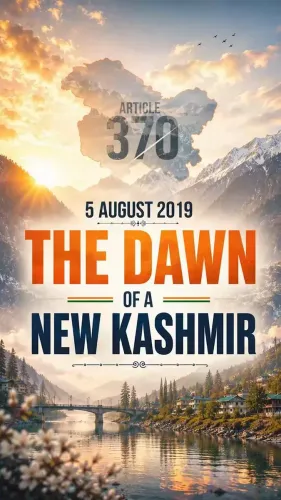
Article 370 was abrogated in August 2019 under PM Narendra Modi , converting Jammu and Kashmir into two union territories.
Patel described the abrogation as the realisation of the dream for which Mukherjee gave his life.
The restoration of full statehood to Jammu and Kashmir remains a key pending political question.
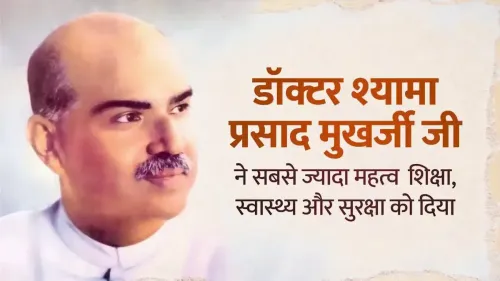
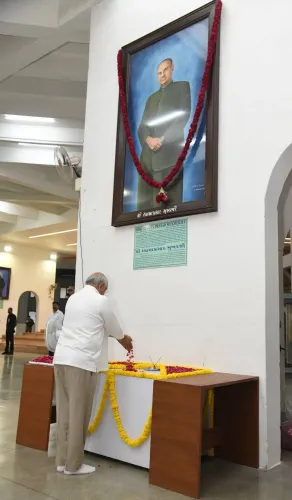
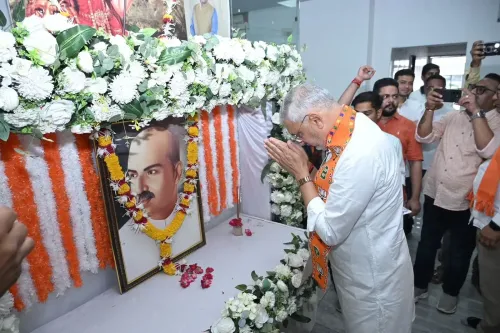
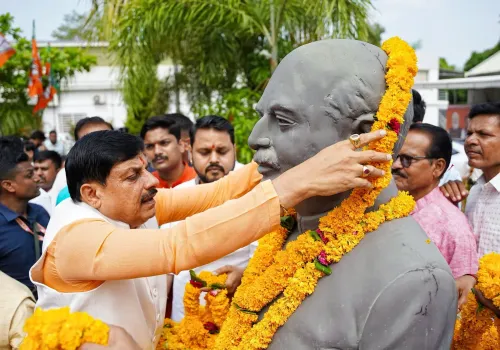
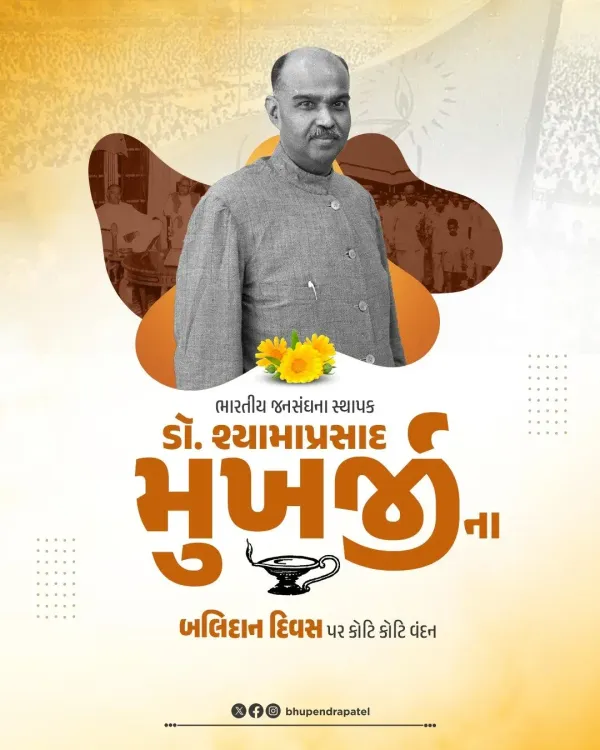
Gujarat Chief Minister Bhupendra Patel on Tuesday, 23 June 2026 paid homage to Dr. Shyama Prasad Mukherjee on his martyrdom anniversary, honouring the Bharatiya Jana Sangh founder as a selfless nationalist who sacrificed his life for the complete integration of Jammu and Kashmir with India. Patel credited Prime Minister Narendra Modi with fulfilling Mukherjee's long-standing vision by abrogating Article 370 in 2019.
Context
In his post, CM Patel wrote — 'એક દેશમાં બે વિધાન, બે પ્રધાન અને બે નિશાન નહીં ચાલે' ('One country cannot have two constitutions, two prime ministers, and two emblems') — invoking the rallying cry that defined Dr. Mukherjee's political movement in the early 1950s. He described Mukherjee as a 'fervent nationalist leader' who gave up everything for Kashmir's full merger and national unity. The tribute was posted on the occasion of Mukherjee's balidan diwas (martyrdom day).
Dr. Shyama Prasad Mukherjee died on 23 June 1953 while in detention in Srinagar, where he had been held after crossing into Jammu and Kashmir without the permit then required of Indian citizens under the state's special constitutional arrangements. His death while protesting those restrictions became a defining moment in the Jana Sangh's campaign against Article 370.
Policy Backdrop
The Bharatiya Jana Sangh, founded in 1951 as the ideological predecessor to the BJP, had made the demand of 'Ek Vidhan, Ek Nishan, Ek Pradhan' ('One Constitution, One Emblem, One Prime Minister') a central plank of its platform. The slogan directly challenged the separate constitutional status that Article 370 conferred on Jammu and Kashmir, including its own constitution and the title of 'Prime Minister' for its head of government.
In August 2019, the Modi government abrogated Article 370 through a presidential order and a parliamentary resolution, simultaneously bifurcating the former state into two union territories — Jammu and Kashmir and Ladakh. The BJP framed this move as the completion of unfinished integration work that leaders like Dr. Mukherjee had begun seven decades earlier.
Stakeholders and Impact
CM Patel's tribute reflects a broader BJP tradition of honouring Dr. Mukherjee as the ideological forefather of the party's constitutional-integration agenda. Annual commemorations on 23 June serve as recurring platforms for the BJP to connect the 2019 abrogation with the sacrifices of earlier nationalist figures, reinforcing the party's narrative of historical continuity.
For residents of Jammu and Kashmir, the post underscores the political framing around the region's status — one that remains a subject of significant debate. The union territory has been under central administration, and the question of restoring full statehood continues to be closely watched by political observers and local stakeholders alike.
What's Next
The restoration of full statehood to Jammu and Kashmir and the timeline for assembly elections under the new delimitation framework remain the most consequential pending questions in the region's political trajectory. Annual tributes to Dr. Mukherjee by senior BJP leaders are likely to continue serving as a platform to reiterate the party's position on national integration and uniform constitutional application across India.
CM Patel concluded his tribute by noting that Mukherjee's life 'will continue to inspire selfless work in defence of national unity' — a sentiment that signals the enduring relevance of this ideological lineage within the ruling party's political identity.
Point of View
Reinforcing a continuous historical narrative that stretches from the Jana Sangh era to the Modi government. By explicitly linking the 2019 abrogation of Article 370 to Mukherjee's martyrdom, the party frames the constitutional change not as a political decision but as the fulfilment of a decades-old national obligation. Annual tributes of this kind serve a dual purpose: honouring a founding figure while simultaneously validating the ruling party's most consequential action on Jammu and Kashmir. The post also keeps the ideological spotlight on 'Ek Bharat, Shreshtha Bharat' as a living project rather than a completed one, implicitly signalling that further steps — such as statehood restoration — may follow.
NationPress
21 Sept 2026
Frequently Asked Questions
Who was Dr. Shyama Prasad Mukherjee and why is he remembered?
Dr. Shyama Prasad Mukherjee was the founder of the Bharatiya Jana Sangh, established in 1951, and a fierce advocate for the complete constitutional integration of Jammu and Kashmir with India. He died on 23 June 1953 while in detention in Srinagar after crossing into the state without the permit then required, making him a martyr figure in the BJP's ideological tradition.
What does 'Ek Vidhan, Ek Nishan, Ek Pradhan' mean?
'Ek Vidhan, Ek Nishan, Ek Pradhan' translates to 'One Constitution, One Emblem, One Prime Minister' — the Jana Sangh's slogan demanding that Jammu and Kashmir be governed by the same constitutional framework as the rest of India, without the special status conferred by Article 370.
When was Article 370 abrogated and what changed?
Article 370 was abrogated in August 2019 through a presidential order and a parliamentary resolution under the Modi government. Jammu and Kashmir was simultaneously bifurcated into two union territories — Jammu and Kashmir, and Ladakh — ending its special constitutional status.
Why does the BJP commemorate Shyama Prasad Mukherjee's death anniversary?
The BJP observes 23 June as Mukherjee's balidan diwas (martyrdom day) because he is regarded as the ideological founder of the party's predecessor, the Bharatiya Jana Sangh. His death while protesting Article 370 is central to the BJP's narrative linking its current policies on Kashmir to a long-standing national integration mission.
What is the current status of Jammu and Kashmir?
Since August 2019, Jammu and Kashmir has been a union territory administered by the central government, following the abrogation of Article 370. The restoration of full statehood and the holding of assembly elections under the new delimitation framework remain pending and are closely watched by political observers.