Pema Khandu pushes coffee expansion in Arunachal, eyes grower income boost
Synopsis
Arunachal Pradesh has had coffee for nearly five decades — yet only 600 hectares are under cultivation. CM Pema Khandu's 'Hills to Cup' workshop push, backed by a study delegation to Andhra Pradesh and a promise of dedicated policy, signals the state may finally be serious about turning a neglected crop into a commercial and tourism-linked success story.
Key Takeaways
CM Pema Khandu called for expanding coffee cultivation in Arunachal Pradesh at the 'Hills to Cup' Coffee Workshop on 3 October in Itanagar .
The state currently has only around 600 hectares under coffee cultivation, according to the Agriculture Department .
A three-member delegation — including Agriculture officials and a retired PCCF — has been constituted to study coffee models in Andhra Pradesh and other states.
Coffee has not yet received a dedicated policy intervention despite five to six years of state agriculture and horticulture schemes.
The Coffee Board of India will prepare recommendations for the state government based on gaps identified at the workshop.
Khandu linked coffee's growth potential to the state's expanding tourism sector , urging youth to explore cultivation and processing as entrepreneurship avenues.
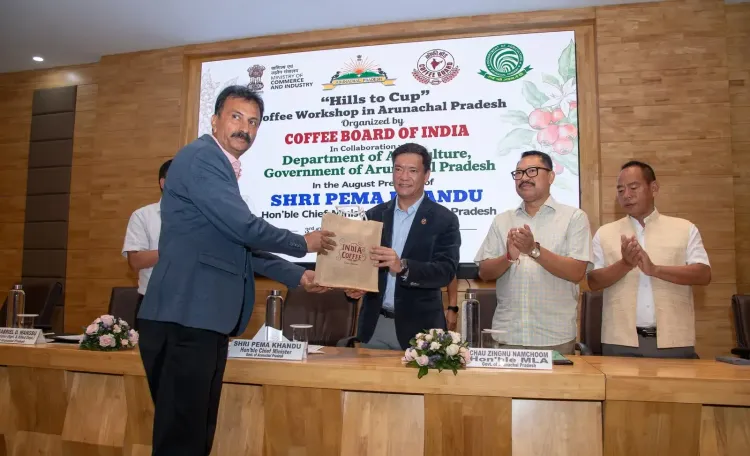
Arunachal Pradesh Chief Minister Pema Khandu on Saturday, 3 October called for a concerted push to expand coffee cultivation across the state, improve bean quality and productivity, and strengthen the value chain to raise incomes for coffee growers. The appeal came at the inaugural ceremony of the 'Hills to Cup' Coffee Workshop in Itanagar, organised by the Coffee Board of India in collaboration with the state's Agriculture Department.
Current Scale and Untapped Potential
According to data available with the state's Agriculture Department, Arunachal Pradesh currently has only around 600 hectares under coffee cultivation — a figure Khandu described as well below the state's actual potential. He noted that coffee cultivation in the state began nearly five decades ago, yet the crop has not received adequate awareness or promotion over the years.
A substantial portion of the existing plantation, he noted, falls under the Arunachal Pradesh Forest Corporation in eastern Arunachal, while several growers attending the workshop have taken up coffee as pilot or model initiatives.
Policy Interventions on the Horizon
Khandu said the state government would explore appropriate policy measures to support coffee growers and entrepreneurs. He disclosed that he had constituted a three-member delegation — comprising Agriculture officials, a retired Principal Chief Conservator of Forests (PCCF), and the Chairman of the Arunachal Pradesh Forest Corporation — to visit Andhra Pradesh and other states to study coffee cultivation practices and development models.
He also said he would personally follow up with the Coffee Board of India to determine what specific policy measures could be introduced to support the sector. The Chief Minister acknowledged that while the state government had rolled out several schemes under agriculture and horticulture over the past five to six years, coffee had not received a dedicated policy intervention so far.
Workshop as a Turning Point
Khandu described the workshop as a significant milestone, bringing together growers, young entrepreneurs, technical experts, and other stakeholders on a common platform. 'This is, in a way, the first chapter of Arunachal Pradesh stepping towards the history of coffee in Arunachal Pradesh,' he said.
He added that the workshop would help identify technical gaps and challenges faced by growers, after which the Coffee Board of India's technical experts would prepare recommendations for the state government. 'As they recommend, the state government will extend full support to you in the coming days,' Khandu assured participants.
Tourism, Youth, and the Bigger Picture
The Chief Minister stressed that the objective should not merely be to increase the area under cultivation, but also to improve productivity per hectare, enhance bean quality, and boost farmer incomes through value addition. He pointed to the state's diverse agro-climatic conditions, fertile land, and varied climatic zones as a favourable foundation for expansion.
Notably, Khandu linked coffee's growth prospects to Arunachal's booming tourism sector. 'Tourists who come to Arunachal always prefer coffee. With tourism growing so much in Arunachal, this is a very good avenue for our youngsters,' he said, urging young people to explore coffee cultivation, processing, and related enterprises as avenues for employment and entrepreneurship. He also highlighted the growing global market for coffee and its potential as a commercial crop.
With a dedicated delegation now on study tours and a policy framework in the works, the sector's trajectory over the next one to two years will be closely watched by growers and entrepreneurs across the state.
Point of View
But the real test is whether the promised policy framework moves beyond study tours and assurances to binding incentive structures. The tourism-coffee linkage is an astute framing, but it only holds if processing and branding infrastructure catches up. States like Meghalaya and Sikkim have demonstrated that Northeast India's agri-tourism potential can be monetised — Arunachal will need to move from intent to implementation faster than it has in the past.
NationPress
3 Oct 2026
Frequently Asked Questions
What is the 'Hills to Cup' Coffee Workshop in Arunachal Pradesh?
The 'Hills to Cup' Coffee Workshop is an initiative organised by the Coffee Board of India in collaboration with Arunachal Pradesh's Agriculture Department, held in Itanagar on 3 October. It brought together coffee growers, young entrepreneurs, technical experts, and government officials to identify challenges and chart a path for expanding coffee cultivation in the state.
How much land is currently under coffee cultivation in Arunachal Pradesh?
According to data available with the state's Agriculture Department, Arunachal Pradesh currently has around 600 hectares under coffee cultivation. Chief Minister Pema Khandu described this as well below the state's actual potential, given its diverse agro-climatic conditions.
What policy steps is the Arunachal Pradesh government planning for coffee growers?
The state government plans to explore dedicated policy interventions for coffee growers, which have been absent despite broader agriculture schemes over the past five to six years. A three-member delegation has been constituted to study coffee cultivation models in Andhra Pradesh and other states, and the Coffee Board of India will prepare recommendations for the government.
Why has coffee cultivation in Arunachal Pradesh remained limited despite decades of history?
Coffee cultivation in Arunachal Pradesh began nearly five decades ago but, according to CM Khandu, the crop has not received adequate awareness, promotion, or dedicated policy support over the years. The lack of a focused value chain and policy framework has kept the sector from scaling up.
How does tourism connect to coffee cultivation in Arunachal Pradesh?
CM Khandu highlighted that tourists visiting Arunachal Pradesh show a strong preference for coffee, making the state's growing tourism sector a ready market for local growers and processors. He urged young people to treat coffee cultivation, processing, and related enterprises as viable entrepreneurship and employment opportunities.