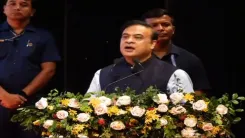
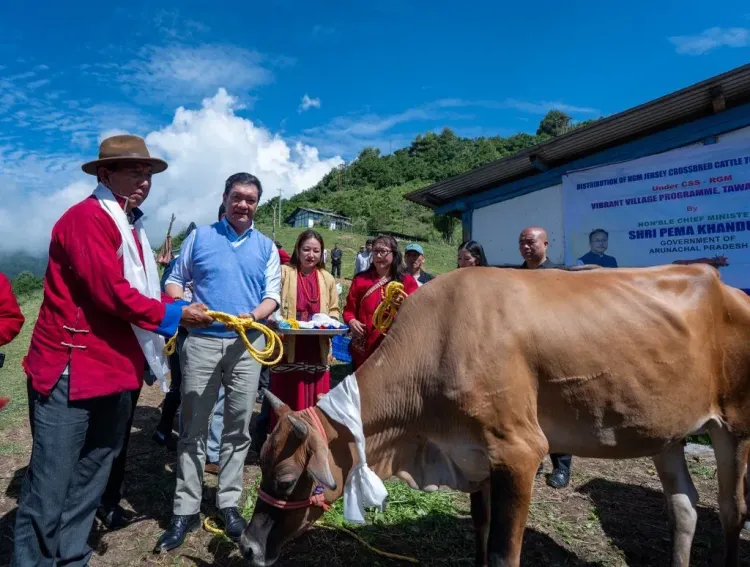
CM Pema Khandu distributes HGM cattle in Tawang under Vibrant Village Programme
Synopsis
Arunachal Pradesh CM Pema Khandu announced distribution of 105 HGM Jersey Crossbred cattle to 35 beneficiaries in Tawang under the Vibrant Village Programme, aiming to build sustainable dairy livelihoods in India's sensitive China-border districts.
Key Takeaways
35 beneficiaries in Tawang district received 105 pedigreed HGM Jersey Crossbred cattle under the Vibrant Village Programme .
The distribution is aimed at creating year-round income through sustainable dairy farming in a strategically sensitive border zone.
The Vibrant Village Programme was launched in Union Budget 2022-23 to develop villages along the India-China border .
NDDB Dairy Services , a subsidiary of the National Dairy Development Board , is providing technical support for dairy enterprise creation.
CM Pema Khandu framed border security as inseparable from border-village prosperity, articulating a livelihood-first frontier strategy.
The Tawang rollout is expected to serve as a model for similar distributions in other Arunachal Pradesh border districts.
Arunachal Pradesh Chief Minister Pema Khandu on Friday, 27 June 2026, announced the distribution of High Genetic Merit (HGM) Jersey Crossbred cattle to beneficiaries in Tawang district under the Vibrant Village Programme, underscoring the government's strategy of anchoring border security in rural economic prosperity.
Context
In a post on X, CM Khandu stated that 35 beneficiaries in Tawang district have received 105 pedigreed Jersey Crossbred cattle, opening pathways for sustainable dairy farming and year-round income in one of India's most strategically sensitive frontier zones. He framed the initiative with a clear policy thesis: 'The best way to secure our borders is to ensure that our border villages remain prosperous, self-reliant, and full of opportunity.'
The Chief Minister thanked the Government of India, the Department of Animal Husbandry and Dairying, and NDDB Dairy Services — the technical arm of the National Dairy Development Board — for their continued support in executing the programme.
Policy Backdrop
The Vibrant Village Programme was announced in the Union Budget 2022-23 with the explicit mandate of holistic development of villages along the India-China border, spanning Arunachal Pradesh and other Himalayan states. It targets livelihood creation, infrastructure upgrades, and social services in settlements that have historically suffered from outmigration and economic neglect.
Livestock distribution — particularly high-yield dairy cattle — is one of the programme's core livelihood components. HGM Jersey Crossbred cattle are selected for their superior milk productivity relative to indigenous breeds, making them especially suited to generating a dependable commercial income for smallholder families in hilly terrain. NDDB Dairy Services provides breeding, veterinary, and enterprise-development support to ensure the animals translate into viable dairy businesses rather than subsistence holdings.
Successive central administrations have used economic development in remote Himalayan districts as a complement to conventional security arrangements, recognising that populated, prosperous villages are themselves a form of territorial presence. Road connectivity, tourism promotion, and agriculture support have run alongside such livestock schemes in a multi-sectoral approach to frontier development.
Stakeholders and Impact
Tawang district borders both China and Bhutan and carries outsized strategic and cultural significance — it is home to one of the largest Tibetan Buddhist monasteries outside Tibet and has been a flashpoint in the India-China boundary dispute. Economic activity in the district directly influences the calculus of local communities on whether to remain in their villages.
The 35 beneficiary families receiving 105 cattle gain a capital asset with the potential to generate daily milk income, reduce dependence on seasonal agriculture, and build small-scale dairy enterprises. For border villages where alternative livelihoods are scarce, this intervention can meaningfully shift household economics. Broader community effects — including local milk supply, employment in ancillary dairy activities, and reduced outmigration — are among the expected downstream benefits.
What's Next
The Vibrant Village Programme covers multiple districts along Arunachal Pradesh's border and extends to other frontier states. The Tawang distribution is expected to serve as a template for similar cattle-distribution drives in other border blocks, with the Department of Animal Husbandry and Dairying and NDDB Dairy Services positioned to scale technical support as the rollout expands.
Whether the programme can sustain dairy enterprise viability beyond the initial distribution — through cold-chain infrastructure, milk procurement linkages, and veterinary follow-up — will determine its long-term impact on both household incomes and the broader goal of keeping border villages vibrant and inhabited.
Point of View
The BJP government in both Delhi and Itanagar signals continued political attention to Arunachal's frontier districts at a time when the India-China boundary remains unresolved. The choice of dairy — a commodity with daily cash-flow potential — over one-time asset transfers reflects a maturing understanding that subsistence inputs alone do not prevent outmigration. Whether institutional support from NDDB Dairy Services translates into durable market linkages will be the real test of whether this round of investment outlasts the photo opportunity.
NationPress
26 Jun 2026
Frequently Asked Questions
What is the Vibrant Village Programme and which states does it cover?
The Vibrant Village Programme is a central government scheme announced in Union Budget 2022-23 to provide holistic development — including livelihood support, infrastructure, and social services — to villages along India's northern border, covering Arunachal Pradesh and other Himalayan frontier states.
What are HGM Jersey Crossbred cattle and why are they used in border areas?
High Genetic Merit (HGM) Jersey Crossbred cattle are selectively bred animals with superior milk productivity compared to local breeds. They are used in schemes like the Vibrant Village Programme because their higher milk yields can generate dependable daily income for smallholder families, making dairy farming commercially viable even in hilly, remote terrain.
How many cattle were distributed in Tawang under the Vibrant Village Programme?
According to CM Pema Khandu's post, 105 pedigreed HGM Jersey Crossbred cattle were distributed to 35 beneficiaries in Tawang district under the Vibrant Village Programme.
What is the role of NDDB Dairy Services in this programme?
NDDB Dairy Services is a subsidiary of the National Dairy Development Board that provides breeding, veterinary, and enterprise-development technical support. In the Vibrant Village Programme, it helps ensure that distributed cattle translate into viable dairy enterprises rather than remaining subsistence assets.
Why is Tawang district significant for India's border development policy?
Tawang district borders both China and Bhutan and is one of India's most strategically sensitive frontier zones, historically linked to the India-China boundary dispute. Keeping its villages economically active and populated is considered integral to India's broader territorial and security posture in the eastern Himalayas.