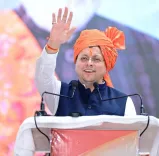
CM Pema Khandu hails ₹1,476 cr tax devolution for Arunachal

Synopsis
Arunachal Pradesh CM Pema Khandu announced a ₹1,476 crore advance tax devolution from the Centre, citing the state's high per-capita share under the Finance Commission's formula and pledging faster infrastructure and welfare spending on the strategic northeastern frontier.
Key Takeaways
₹1,476 crore allocated to Arunachal Pradesh as part of an advance instalment of central tax devolution.
CM Pema Khandu credited PM Narendra Modi and Finance Minister Nirmala Sitharaman for the release.
Arunachal receives one of India's highest per-capita devolution shares due to its vast area, low population density, and border location.
The 15th Finance Commission set a 41% devolution rate for 2021–26, with additional weightage benefiting northeastern states.
Funds are targeted at capital projects, infrastructure, and public welfare in a state bordering China, Myanmar, and Bhutan .
The 16th Finance Commission's upcoming report for 2026–31 could alter devolution shares for Arunachal and other frontier states.
A frontier state with sparse roads, a contested border, and one of India's lowest population densities just received a significant fiscal boost. Arunachal Pradesh Chief Minister Pema Khandu announced on Saturday, 1 August 2026 that the state has been allocated ₹1,476 crore as part of an advance instalment of tax devolution released by the Centre — money he says will accelerate capital projects in one of India's most strategically sensitive corners.
What the advance release means for Arunachal
The Centre's decision to release an advance instalment of tax devolution — a practice successive governments have used to ease state cash-flow pressures ahead of spending cycles — carries particular weight for a state like Arunachal. Arunachal Pradesh borders China, Myanmar, and Bhutan, spans a vast and rugged terrain, and has a population density so low that standard per-capita metrics rarely capture the true cost of delivering services here.
CM Khandu pointed out that on a per-capita basis, Arunachal 'continues to receive one of the highest shares among Indian states' — a reflection of how the Finance Commission weights factors like area, forest cover, and border location when distributing central taxes. The 15th Finance Commission (2020–26) recommended that 41% of central taxes flow to states, with additional weightage for northeastern and hilly states that benefits Arunachal disproportionately.
Cooperative federalism on the frontier
Khandu specifically credited Prime Minister Narendra Modi and Union Finance Minister Nirmala Sitharaman for the release, framing it as a demonstration of cooperative federalism — the principle that Centre and states function as fiscal partners rather than rivals. The hashtag #CooperativeFederalism in his post signals a deliberate political framing: northeastern states, long dependent on central transfers, have a stake in keeping that partnership robust.
The funds are earmarked to strengthen state finances for 'capital projects, infrastructure development, and public welfare initiatives,' Khandu said. For a state where building a road can mean blasting through a Himalayan ridge, capital expenditure is not a bureaucratic line item — it is the difference between a district being connected or cut off.
What the 16th Finance Commission could change
The timing matters beyond the immediate crore count. The 16th Finance Commission, which will set devolution shares for 2026–31, is expected to release its report soon — and any revision to the criteria for area, population density, or strategic importance could reshape Arunachal's fiscal position for the next five years. A state that currently benefits from high per-capita allocations has every reason to watch those deliberations closely.
For now, ₹1,476 crore flows toward a state that has consistently punched above its weight in national strategic calculus — and CM Khandu is making sure Delhi knows Arunachal noticed.
Point of View
But Khandu's public acknowledgement of it carries a pointed subtext: northeastern states, which depend heavily on central transfers, benefit from visibly reinforcing the cooperative federalism narrative ahead of the 16th Finance Commission's deliberations. By highlighting Arunachal's high per-capita share, Khandu is effectively lobbying in plain sight — reminding the Commission that the state's strategic and geographic costs justify continued preferential treatment. The framing also fits a broader BJP pattern of positioning the Centre's northeastern investments as proof of governance reach into India's most contested frontier.
NationPress
1 Aug 2026
Frequently Asked Questions
Why did Arunachal Pradesh receive an advance tax devolution instalment?
The Centre periodically releases advance instalments of tax devolution to ease state cash-flow pressures for capital spending. Arunachal Pradesh received ₹1,476 crore as part of such an advance release announced in August 2026.
Why does Arunachal Pradesh get one of the highest per-capita tax devolution shares in India?
The Finance Commission's formula gives additional weightage to factors like large area, low population density, forest cover, and border location — all of which apply strongly to Arunachal Pradesh, pushing its per-capita share above most other states.
What is cooperative federalism in the context of India's tax devolution?
Cooperative federalism refers to the principle that the Centre and states function as fiscal partners, with the Centre sharing a constitutionally mandated portion of tax revenues with states. Regular and advance devolution releases are seen as practical expressions of this principle.
What is the 15th Finance Commission's devolution rate for states?
The 15th Finance Commission recommended that 41% of central taxes be devolved to states for the period 2021–26, with additional criteria benefiting northeastern and hilly states like Arunachal Pradesh.
What will the 16th Finance Commission decide for Arunachal Pradesh?
The 16th Finance Commission will determine devolution shares for 2026–31. Any changes to weightage criteria for area, population density, or strategic importance could significantly affect Arunachal Pradesh's future allocations.