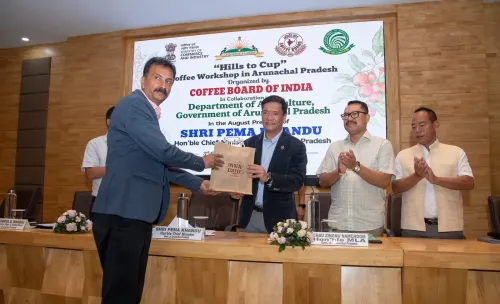
CM Pema Khandu Launches Arunachal's First Coffee Workshop
Synopsis
Arunachal Pradesh CM Pema Khandu announced the state's first official coffee workshop, co-hosted by the Coffee Board of India and the state Agriculture Department, aiming to build a full coffee value chain beyond the current 600-hectare cultivation footprint.
Key Takeaways
Arunachal Pradesh currently has 600 hectares under coffee cultivation — a figure CM Khandu described as a starting point, not a ceiling.
The state's first official coffee workshop was jointly organised by the Coffee Board of India and the Department of Agriculture, Government of Arunachal Pradesh .
CM Pema Khandu stated the goal is to build a 'full value chain,' moving beyond raw farming into processing, branding, and market linkages.
The Coffee Board's involvement gives the initiative access to federal technical expertise, quality certification, and market-linkage programmes.
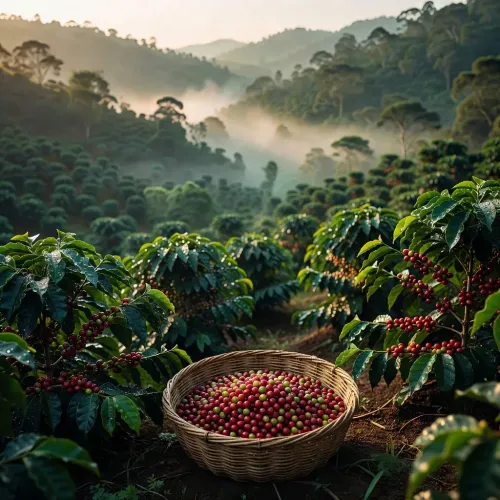
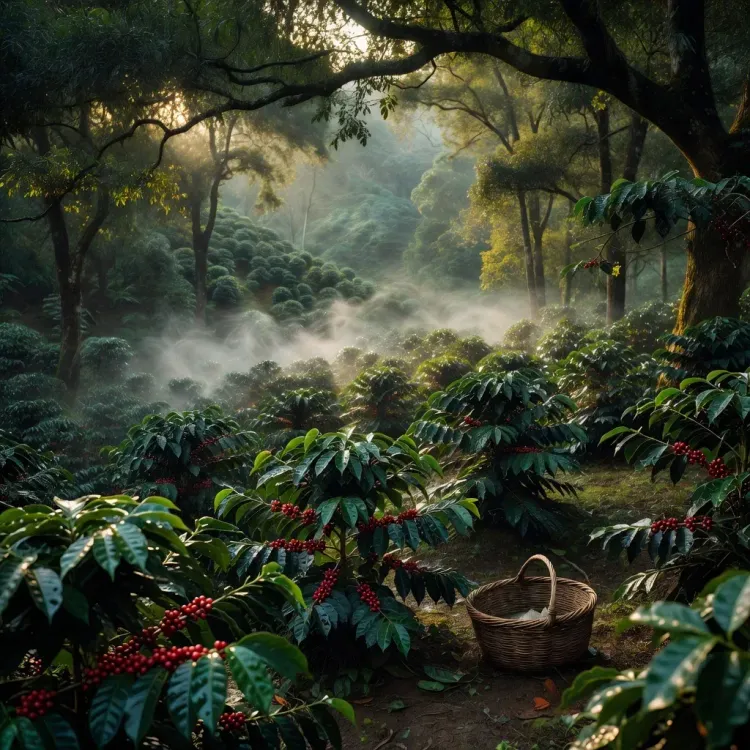
Arunachal's climate and terrain — high elevation, forest shade, consistent rainfall — closely mirror conditions in India's established coffee-growing south.
The workshop represents Arunachal's first structured step toward joining northeastern India's emerging specialty coffee economy.
A state better known for its alpine valleys and biodiversity has just announced its first serious move into India's booming coffee economy. Arunachal Pradesh Chief Minister Pema Khandu on Saturday, October 3, 2026, revealed that the state hosted its first official coffee workshop — a collaboration between the Coffee Board of India and the Department of Agriculture, Government of Arunachal Pradesh — marking a deliberate push to embed the northeastern frontier state in one of agriculture's most lucrative value chains.
600 Hectares and a Much Bigger Ambition
The numbers are modest today — coffee cultivation currently spans just 600 hectares across Arunachal Pradesh. But CM Khandu framed this not as a limitation, but as a baseline. The state's climate, he argued, offers 'huge potential' that has yet to be systematically tapped. The workshop was designed precisely to begin that systematic work: training growers, connecting stakeholders, and laying the groundwork for a structured industry rather than scattered smallholder plots.
The Chief Minister was explicit that the ambition goes beyond acreage. 'Our goal isn't just to grow more coffee, but to build a full value chain,' Khandu stated — signalling an intent to move from raw cultivation into processing, branding, and eventually export-readiness. That end-to-end thinking is what separates a commodity play from a genuine rural development engine.
Why the Coffee Board's Presence Signals Institutional Seriousness
The Coffee Board of India's involvement is significant. As the statutory body under the Ministry of Commerce and Industry that regulates, promotes, and develops the coffee industry nationwide, its participation in Arunachal's first formal workshop gives the initiative federal institutional weight — and access to technical expertise, quality certification pathways, and market linkage programmes that a state agriculture department alone could not easily provide.
India's northeastern states have long sat at the margins of the country's coffee map, which has traditionally been dominated by Karnataka, Kerala, and Tamil Nadu. Yet elevation, rainfall patterns, and forest-shade growing conditions in states like Arunachal closely mirror the terroir that produces some of India's finest specialty beans. The workshop plants a flag on that opportunity.
A First Step Toward Northeast India's Specialty Coffee Belt
For Arunachal — a state where agriculture remains a primary livelihood for a large share of the population — coffee offers a high-value crop that suits its terrain without requiring large-scale deforestation or industrial inputs. A full value chain, as Khandu envisions it, would mean local processing units, quality grading, farmer producer organisations, and eventually a distinct geographic identity for Arunachal coffee the way Coorg or Wayanad commands one.
One workshop does not a coffee economy make. But in a state of 28 districts and formidable infrastructure challenges, getting the Coffee Board and state agriculture officials in the same room — with growers — is the unglamorous but essential first link in that chain.
The next test will be whether today's workshop translates into a concrete expansion roadmap, farmer onboarding targets, and processing infrastructure. Arunachal's coffee story has its first chapter. The rest is still being written — and the whole country's specialty-coffee drinkers have reason to watch.
Point of View
The move signals a preference for institutional depth over headline announcements. The 'full value chain' framing is politically smart: it promises income at every stage — growing, processing, branding — rather than a simple acreage target that is easy to game. Whether Arunachal can overcome its infrastructure deficit to realise that chain will determine if this workshop becomes a footnote or a turning point.
NationPress
3 Oct 2026
Frequently Asked Questions
How much land in Arunachal Pradesh is currently under coffee cultivation?
As of CM Pema Khandu's announcement in October 2026, coffee cultivation covers 600 hectares in Arunachal Pradesh, which the state government views as a baseline with significant room for expansion.
Who organised Arunachal Pradesh's first official coffee workshop?
The workshop was jointly organised by the Coffee Board of India and the Department of Agriculture, Government of Arunachal Pradesh .
What is the Coffee Board of India?
The Coffee Board of India is a statutory body under the Ministry of Commerce and Industry that regulates, promotes, and develops India's coffee sector, providing technical support, quality certification, and market linkage to growers across the country.
Why is Arunachal Pradesh considered suitable for coffee farming?
Arunachal Pradesh's high elevation, consistent rainfall, and forest-shade growing conditions closely mirror the terroir of India's established coffee belts in Karnataka, Kerala, and Tamil Nadu , making it naturally suited for specialty arabica cultivation.
What does CM Khandu mean by a 'full value chain' for Arunachal coffee?
A full value chain means moving beyond growing raw coffee beans to include local processing, quality grading, branding, farmer producer organisations, and market linkages — so farmers and the state capture value at every stage, not just at the farm gate.